
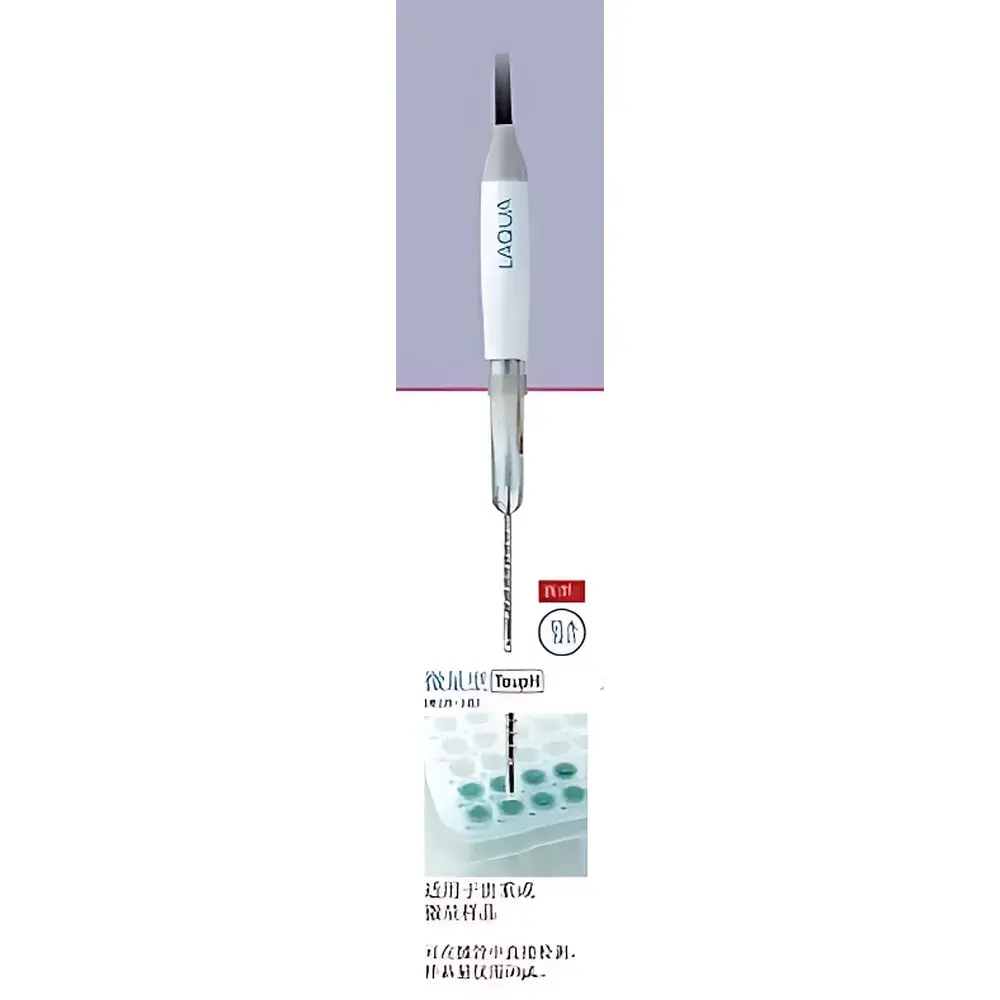
HORIBA 9618-10D Micro-TouPH pH Electrode
| Brand | HORIBA |
|---|---|
| Origin | Japan |
| Model | 9618-10D |
| Temperature Range | 0–60 °C |
| pH Range | 0–14 |
| Electrode Type | Combination pH Electrode with Flat-tip ISFET-enhanced Glass Membrane |
| Compliance | JIS Z 8802 (pH electrode performance), ISO 7888 (water quality — pH determination) |
| Enclosure Material | Chemically resistant PPS body |
| Tip Geometry | Hemispherical + flat-surface sensing zone |
| Reference System | Cation-conductive hollow-fiber junction |
| Response Time (t₉₀) | ≤15 s (typical, at 25 °C, ΔpH = 1.0) |
| Mechanical Strength | >10× JIS Z 8802 specified impact resistance |
Overview
The HORIBA 9618-10D Micro-TouPH pH Electrode is a precision-engineered combination sensor designed for high-reproducibility pH and ORP measurements in microvolume, surface, and challenging sample environments. Unlike conventional glass electrodes, the 9618-10D integrates an advanced ion-sensitive field-effect transistor (ISFET)-compatible architecture with a proprietary rare-earth-doped pH-sensitive glass membrane. This hybrid design enables robust electrochemical transduction while maintaining mechanical resilience and rapid equilibration kinetics. The electrode operates on the Nernst principle—generating a millivolt potential proportional to hydrogen ion activity—but achieves enhanced stability through dual patented innovations: (1) a low-drift reference junction utilizing cation-selective hollow-fiber membranes to suppress Ag⁺ leaching by >99.9% versus conventional double-junction systems; and (2) a thermally stabilized glass matrix that reduces response time by 50% without compromising long-term calibration integrity. Its operational envelope spans pH 0–14 and 0–60 °C, making it suitable for QC labs, pharmaceutical formulation development, semiconductor wafer rinse monitoring, and academic surface science applications where conventional electrodes fail due to volume constraints or physical fragility.
Key Features
- Flat-tip hemispherical sensing geometry enabling direct surface pH mapping of solids, gels, and thin-film samples—with tip-to-protection-shield clearance <100 µm to minimize air bubble entrapment.
- Rare-earth-modified glass membrane (patent-pending) delivering t₉₀ ≤15 s at 25 °C and improved resistance to alkali error and thermal shock.
- Hollow-fiber reference junction fabricated from sulfonated polyether ether ketone (PEEK), reducing silver ion migration to <0.1 ppm/h—critical for low-conductivity aqueous matrices and non-aqueous solvents.
- Integrated semiconductor-grade ESD protection circuitry compliant with IEC 61340-5-1, eliminating static-induced signal offset during handling or dry storage.
- PPS (polyphenylsulfone) housing rated IP67 when mated with compatible connectors; chemically inert toward halogenated solvents, strong acids, and alkaline cleaners.
- No hydration requirement: stable zero-point retention after >72 h dry storage—eliminating KCl storage solution maintenance and cross-contamination risks.
Sample Compatibility & Compliance
The 9618-10D is validated for use across diverse sample classes including microliter droplets (≥5 µL), biological tissue surfaces, polymer coatings, battery electrolytes, and ultra-pure water (UPW) streams with conductivity <1 µS/cm. Its flat-tip configuration avoids capillary wicking artifacts common in tapered electrodes and ensures consistent contact geometry during repeated surface scans. Regulatory alignment includes full traceability to JIS Z 8802 (Japanese Industrial Standard for pH electrodes), ISO 7888 (water quality pH measurement), and ASTM D1293 (standard test method for pH of water). When deployed in GLP or GMP environments, the electrode supports 21 CFR Part 11-compliant data capture when paired with HORIBA’s LAQUA Touch or Twin series meters equipped with audit-trail-enabled firmware.
Software & Data Management
The 9618-10D is natively supported by HORIBA’s LAQUA Smart Software (v3.2+), which provides automated calibration validation (slope/offset drift alerts), multi-point buffer recognition (NIST-traceable DIN 19266 buffers), and real-time temperature-compensated pH/°C overlay graphs. Raw mV output is logged at 10 Hz resolution with timestamped metadata (operator ID, calibration history, ambient RH/T), exportable to CSV or .xlsx formats. For integration into LIMS or SCADA platforms, the electrode communicates via RS-232 or USB-C using HORIBA’s ASCII-based command protocol—enabling seamless inclusion in automated batch release workflows per USP and requirements.
Applications
- Pharmaceutical: Surface pH profiling of lyophilized cake morphology and tablet film coatings.
- Electronics: In-line pH monitoring of CMP slurries and photoresist developer baths.
- Food Science: Direct measurement of cheese rind acidity and fruit skin surface pH without puncturing.
- Academic Research: In situ pH mapping of biofilm microenvironments using motorized XYZ stages.
- Environmental: Field-deployable analysis of soil pore water extracts and sediment interstitial fluids.
FAQ
Can the 9618-10D be used in non-aqueous solvents such as ethanol or acetone?
Yes—its PPS housing and Ag/AgCl reference system with low-leaching hollow-fiber junction enable reliable operation in polar organic solvents down to 5% water content. Calibration must be performed in matched solvent/buffer standards.
Does this electrode require storage in KCl solution between measurements?
No. The stabilized glass membrane and dry-stable reference system allow indefinite dry storage without performance degradation—validated per JIS Z 8802 Annex B.
Is the flat tip susceptible to scratching or contamination during surface contact?
The hemispherical tip is manufactured via precision mold-casting with Vickers hardness >580 HV, exceeding standard borosilicate glass by >3×. Surface residues are removed using soft-bristle brushes (e.g., dental brush) and deionized water—no abrasive cleaning agents required.
How does the electrode handle electrostatic discharge in low-humidity cleanrooms?
On-board ESD suppression circuitry limits transient voltage spikes to <±50 V, meeting IEC 61340-5-1 Class 0 requirements for sensitive electronics handling environments.
Can multiple 9618-10D electrodes be operated simultaneously on one meter?
Only one 9618-10D may be connected per channel. Simultaneous use with other electrode types (e.g., ORP or ion-selective) on shared inputs introduces ground-loop interference and invalidates NIST-traceable calibration—per HORIBA Application Note AN-9618-01.





