
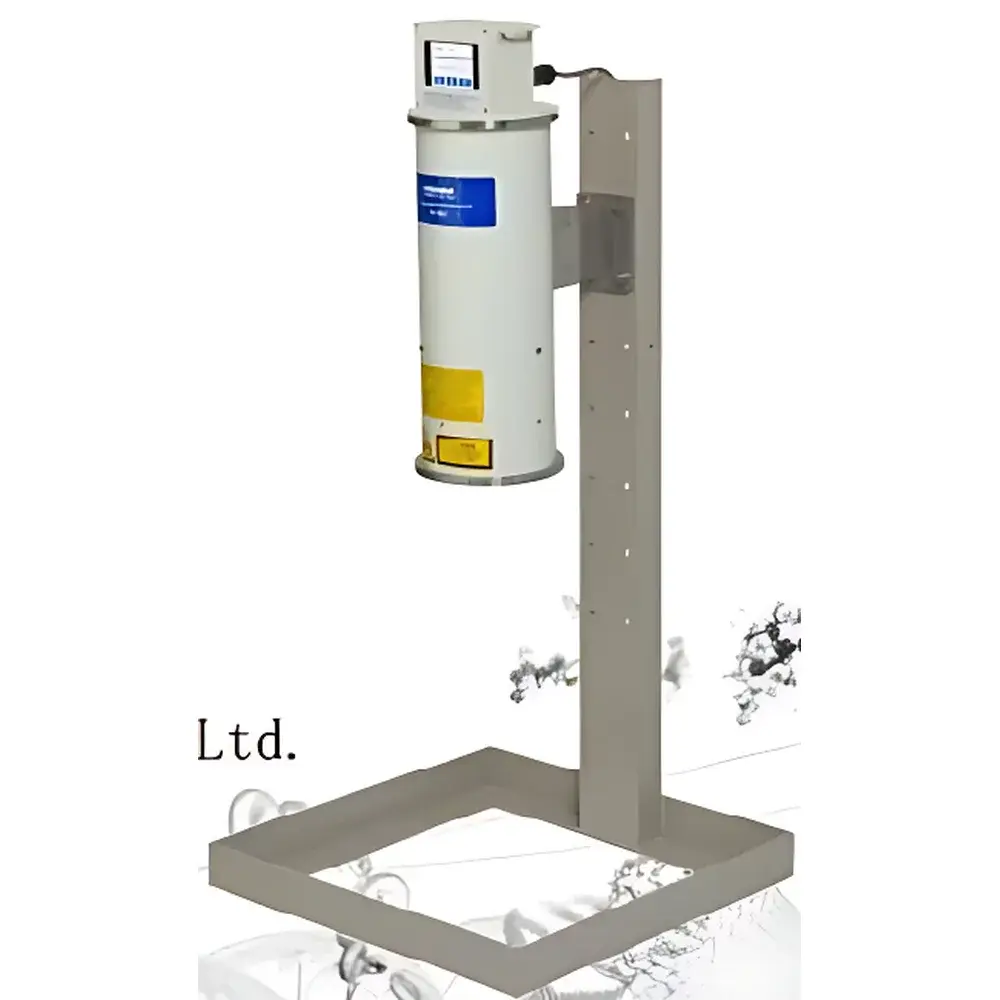
HORIBA LO-300 Online Oil Film Monitor
| Brand | HORIBA |
|---|---|
| Origin | Japan |
| Model | LO-300 |
| Detection Principle | Laser Circular Area Scanning Reflectometry |
| Detection Range | 0.3–4.0 m (up to 6.0 m on still water) |
| Oil Detection Target | Floating/Adherent hydrocarbon films (gasoline, kerosene, diesel, heavy fuel oil, insulating oil, lubricating oil) |
| Output Signals | 4–20 mA analog output (reflected light intensity), 2 dry contact outputs (oil film alarm, system fault) |
| Display | Color touchscreen showing oil coverage (%), threshold level, real-time received light intensity, status indicators |
| Power Supply | AC 100 V ±10%, 50/60 Hz, ≤100 VA |
| Enclosure Rating | IP66 |
| Operating Temperature | –10 to +50 °C |
| Dimensions | Ø185 × 547 mm (H) |
| Weight | ~11 kg |
| Optional | Surveillance camera module (MP4 video recording at 1 or 3 fps |
Overview
The HORIBA LO-300 Online Oil Film Monitor is an industrial-grade, non-contact optical sensor engineered for continuous, real-time detection of hydrocarbon oil films on water surfaces in environmental and industrial effluent monitoring applications. Unlike traditional extractive or fluorescence-based analyzers, the LO-300 employs a Class 2 semiconductor laser (≤1 mW) operating in circular area scanning reflectometry mode. This principle relies on differential reflection characteristics between clean water and hydrocarbon layers—where oil films alter surface reflectivity and scattering patterns across a defined scan zone. The instrument is specifically calibrated for floating or adherent petroleum-based oils including gasoline, diesel, kerosene, heavy fuel oil, transformer insulation oil, and lubricants. It excludes water-miscible or emulsified oils due to insufficient refractive index contrast under this optical configuration. Designed for permanent outdoor deployment, the LO-300 integrates robust mechanical alignment mechanisms—including motorized vertical auto-leveling of emitter/receiver optics—to ensure stable performance across variable installation geometries without manual recalibration.
Key Features
- Non-invasive, maintenance-free operation: No sample extraction, no consumables, no wetted parts—eliminating fouling risk and reducing lifecycle cost.
- Extended detection range: 0.3–4.0 m standard; up to 6.0 m on quiescent water surfaces, enabling flexible mounting on walkways, bridges, or containment bunds.
- Laser-based circular scanning: Provides uniform spatial coverage across the entire field-of-view, mitigating false positives caused by wave motion, ripples, or debris shadows.
- Configurable multi-parameter alarm logic: Users define oil coverage threshold (%), minimum duration (e.g., ≥5 sec), and hysteresis to suppress transient artifacts—ensuring high specificity in dynamic environments.
- IP66-rated sealed enclosure: Certified for direct outdoor exposure; resistant to dust ingress and powerful water jets—suitable for wastewater treatment plants, port facilities, and petrochemical terminals.
- Integrated color touchscreen HMI: Intuitive menu navigation with real-time visualization of reflected light intensity (4–20 mA equivalent), oil coverage percentage, and system status flags.
Sample Compatibility & Compliance
The LO-300 is validated for detecting thin-layer hydrocarbon films (typically >0.1 µm thickness) on freshwater and seawater surfaces. Its optical design inherently excludes water-soluble oils (e.g., certain cutting fluids or synthetic esters) due to minimal refractive index deviation from bulk water. While not certified to ISO 9377-2 or ASTM D3921 as a quantitative gravimetric method, the LO-300 meets functional requirements for early-warning leak detection under EPA 40 CFR Part 112 secondary containment monitoring guidelines and aligns with IEC 61508 SIL 2 conceptual safety integrity targets when integrated into layered process safety systems. Its analog and relay outputs support integration into DCS, SCADA, or PLC architectures compliant with IEC 61131-3 control logic standards.
Software & Data Management
The base unit operates autonomously via embedded firmware with local data logging (non-volatile memory). When equipped with the optional surveillance camera module, the LO-300 records synchronized MP4 video clips (H.264 encoded) triggered by alarm events—capturing 10 seconds pre-alarm and 10 seconds post-alarm at user-selectable frame rates (1 or 3 fps). Each clip is timestamped with UTC-synced metadata and stored locally (6 MB per clip at 3 fps). Video archives are accessible via Ethernet (LAN) using standard HTTP/FTP protocols, enabling remote review, forensic analysis, and audit-ready documentation. All configuration changes—including threshold values, alarm delays, and display units—are logged with timestamps and operator IDs, supporting GLP-compliant recordkeeping where required.
Applications
- Effluent discharge monitoring at industrial outfalls and municipal wastewater treatment plants.
- Secondary containment surveillance in aboveground storage tank (AST) farms and loading/unloading berths.
- Early leak detection in cooling water circuits, hydraulic systems, and transformer oil containment sumps.
- Regulatory compliance reporting for SPCC (Spill Prevention, Control, and Countermeasure) plans and ISO 14001 environmental management systems.
- Process optimization in metalworking fluid management and bilge water separation systems.
FAQ
Does the LO-300 provide quantitative oil concentration values (e.g., ppm or mg/L)?
No. It reports relative oil coverage (%) within the scanned area—not dissolved or emulsified oil concentration. It functions as a qualitative presence/absence and spatial extent monitor.
Can it operate reliably under direct sunlight or rain?
Direct solar irradiance must be avoided; optional sunshades and vapor shields are recommended for installations exposed to glare or condensation. Rain does not impair operation thanks to IP66 sealing and active surface reflection discrimination.
Is calibration required after installation?
No field calibration is needed. Auto-leveling optics and factory-set reflectance baselines ensure consistent performance. Zero-point verification may be performed manually using a clean water reference surface.
What communication protocols does it support?
Standard 4–20 mA analog output and two dry-contact relay outputs. Optional Ethernet interface enables MODBUS TCP or HTTP-based telemetry—no proprietary drivers required.
How is video data secured during remote access?
Video streaming and download require authenticated login credentials. Firmware supports TLS 1.2 encryption for HTTP(S) sessions and configurable password policies aligned with NIST SP 800-63B digital identity guidelines.







