
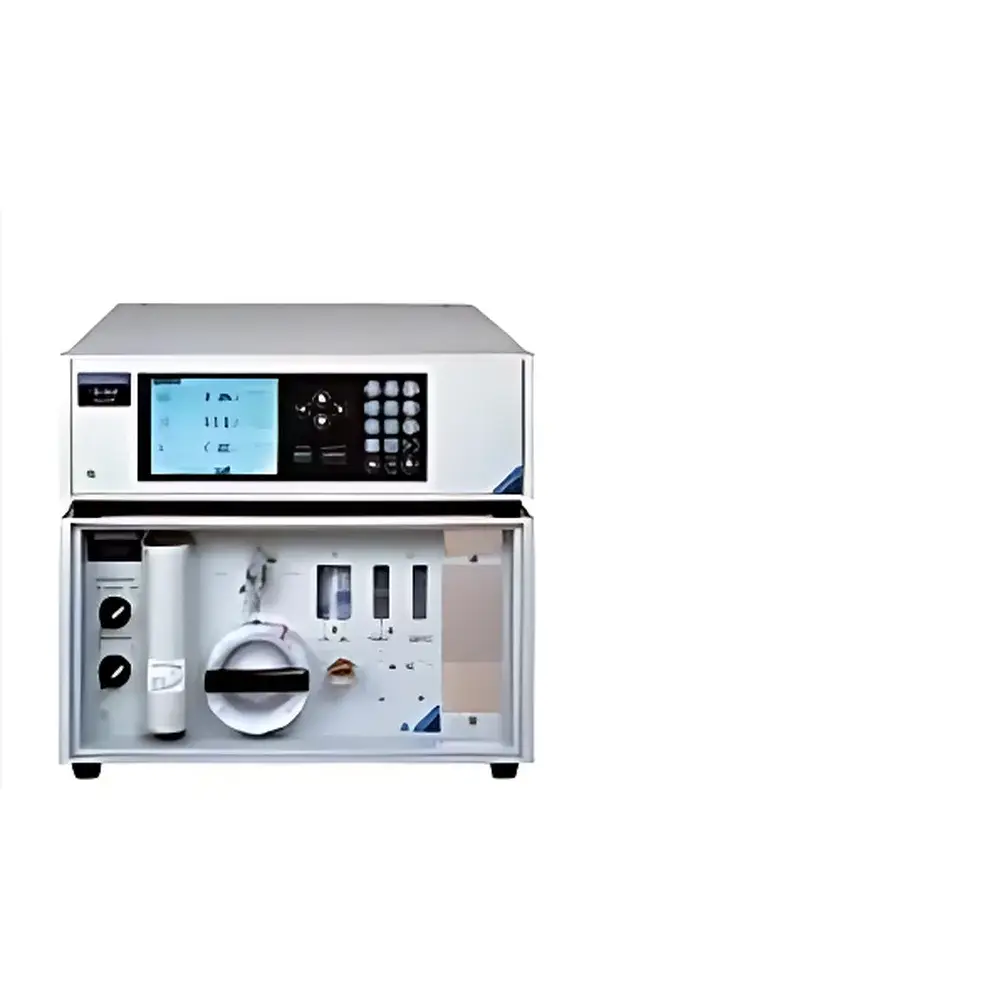
HORIBA VA-3000/VS-3000 Series NDIR & CLA-Based Multi-Gas Flue Gas Analyzer
| Brand | HORIBA |
|---|---|
| Origin | Japan |
| Model | VA-3000 (Analyzer Unit) / VS-3000 (Sampling System) |
| Detection Principle | Non-Dispersive Infrared (NDIR), Chemiluminescence (CLA), Magnetic Pressure (MPA), Electrochemical (Galvanic), Zirconia |
| Repeatability | ±0.5% FS |
| Response Time (T90) | ≤30 s |
| Drift | ±2.0% FS/week (NDIR/CLA/MPA/ZrO₂), ±1.0% FS/day (Galvanic O₂) |
| Linearity | ±1.0% FS (≤10× range), ±1.5% FS (>10× range) |
| Warm-up Time | 20–60 min (varies by sensor type) |
| Analog Outputs | DC 0–1 V, 4–20 mA (optional) |
| Digital Interface | RS-232C |
| Sample Flow Rate | 0.5 L/min (analyzer inlet) |
| Operating Environment | 0–40 °C, RH ≤90% non-condensing |
| Power Supply | AC 100–120 V or 200–240 V, 50/60 Hz |
| Dimensions (VA-3000) | 430 × 132 × 550 mm (W×H×D) |
| Weight (VA-3000) | ~20 kg |
| Compliance | Designed for ISO 14001-aligned monitoring, compatible with EPA Method 6C/7E/10, EN 15267-certified system architecture (sensor modules), supports GLP/GMP data integrity via timestamped analog/digital output logging |
Overview
The HORIBA VA-3000/VS-3000 Series is a modular, multi-technology flue gas and ambient air analysis platform engineered for precision, long-term stability, and operational flexibility in regulatory-compliant emission monitoring, combustion optimization, and R&D applications. At its core, the system integrates complementary analytical principles: Non-Dispersive Infrared (NDIR) spectroscopy for CO, CO₂, CH₄, SO₂, and N₂O; Chemiluminescence Analysis (CLA) for NOₓ (NO, NO₂); Magnetic Pressure (MPA) and electrochemical (galvanic or zirconia) methods for O₂ quantification. This hybrid architecture enables simultaneous, independent measurement of up to three gas components within a single 19-inch rack-mount analyzer unit (VA-3000), eliminating cross-interference through physical and optical isolation of sensor modules. The system is not a generic “multi-gas detector” but a purpose-built analytical instrument—designed from first principles for trace-to-percent-level quantification across dynamic industrial and environmental matrices. Its architecture reflects HORIBA’s four-decade specialization in gas metrology: all optical paths, thermal management, and signal processing are optimized to meet the reproducibility and drift specifications required for continuous emissions monitoring systems (CEMS) and laboratory-grade validation studies.
Key Features
- Modular Sensor Architecture: Up to three independently configurable sensor modules (NDIR, CLA, MPA, galvanic O₂, or zirconia O₂) can be housed in one VA-3000 chassis—enabling custom multi-component configurations without external signal multiplexing or software arbitration.
- Wide Dynamic Range Capability: NDIR channels support up to 20× range expansion (optional); CLA offers up to 100× span ratio (e.g., 20 ppm to 2000 ppm NO). Multiple identical sensors may be installed in parallel to extend upper detection limits while preserving low-end sensitivity.
- High Metrological Stability: Zero and span drift maintained at ±2.0% FS/week for NDIR, CLA, MPA, and zirconia O₂ sensors; ±1.0% FS/day for galvanic O₂. Linearity remains within ±1.0% FS over ≤10× range spans—critical for calibration traceability under ISO/IEC 17025.
- Robust Sampling Integration: The VS-3000 series sampling units (VS-3001 to VS-3004) provide conditioned sample extraction—including heated lines, particulate filtration (<0.1 mg/m³), moisture control (≤60 °C saturation), and corrosion-resistant wetted materials (SUS, PVDF, PTFE, FKM)—to preserve analyte integrity prior to analysis.
- Regulatory-Ready I/O: Standard RS-232C serial interface and analog outputs (0–1 V, 4–20 mA) support integration with DCS, SCADA, and data acquisition systems. Timestamped analog logging satisfies basic FDA 21 CFR Part 11 audit-trail requirements when paired with compliant DAQ hardware.
Sample Compatibility & Compliance
The VA-3000/VS-3000 system is validated for use with flue gases, stack emissions, biogas, syngas, and ambient air—provided sample conditions adhere to defined physicochemical constraints. For NDIR measurements, sample temperature must remain near ambient; CO₂ background stability is required during CO₂ analysis. CLA operation mandates absence of hydrocarbon interference above specified thresholds (THC + CO + H₂ < H₂O + O₂ stoichiometric balance). Zirconia O₂ sensors require coexistence of H₂O and O₂ in reducing gas streams to prevent rapid electrode degradation. All wetted materials comply with EPA Method 6C (SO₂), 7E (NOₓ), and 10 (CO) sampling guidelines. While the VA-3000 itself is not CE-marked as a standalone CEMS, its modular design aligns with EN 15267-3 performance verification protocols when deployed with certified VS-3000 sampling trains and documented calibration procedures.
Software & Data Management
The VA-3000 operates as a stand-alone analyzer with local LCD display (320 × 240 pixels) and menu-driven configuration. No proprietary PC software is required for basic operation—calibration, zero/span adjustment, and range selection are performed directly on-device. Analog outputs enable direct connection to third-party data loggers or historian systems supporting Modbus RTU or custom ASCII protocols over RS-232C. For advanced data handling, HORIBA provides optional PC-based configuration utilities that support batch calibration curve import, alarm threshold definition, and CSV export of time-stamped concentration logs. All digital communications include device ID, measurement timestamp (RTC-synchronized), and sensor status flags—facilitating GLP-compliant recordkeeping and audit readiness. Firmware updates follow controlled release cycles with version-locked calibration coefficients to ensure measurement continuity.
Applications
- Regulatory Emissions Monitoring: Continuous measurement of CO, CO₂, NOₓ, SO₂, CH₄, and O₂ in power plant stacks, cement kilns, and waste incinerators per local air quality regulations (e.g., China’s GB 13223, EU’s IED, U.S. NSPS Subpart Da).
- Combustion Efficiency Optimization: Real-time O₂ and combustibles (CO, CH₄) feedback for boiler tuning, excess air control, and carbon loss minimization—reducing fuel consumption and NOₓ formation.
- Biogas & Landfill Gas Analysis: Quantification of CH₄, CO₂, H₂S (via optional CLA adaptation), and O₂ to assess digester health, energy content, and flare efficiency.
- R&D & Method Development: Flexible module swapping supports method validation, inter-laboratory comparison studies, and development of new gas-phase reaction kinetics models—particularly where multi-analyte temporal correlation is essential.
- Environmental Research: Long-term ambient monitoring of N₂O and CH₄ fluxes in agricultural and urban settings, leveraging the system’s low-drift stability and ppb-level NDIR sensitivity.
FAQ
What gas species can be measured simultaneously?
Up to three gases—selected from CO, CO₂, CH₄, SO₂, N₂O (NDIR); NO, NO₂ (CLA); O₂ (MPA, galvanic, or zirconia)—can be measured concurrently using physically separate modules within one VA-3000 unit.
Is the system suitable for corrosive or high-moisture flue gas?
Yes—when paired with the appropriate VS-3000 sampling unit (e.g., VS-3004 with PTFE/PVDF wetted parts and heated sample line), it handles SO₃ ≤50 ppm, NO₂ ≤6 ppm, and moisture up to 60 °C saturation.
How is calibration performed and how often is it required?
Zero and span calibration is executed manually using certified standard gases; typical intervals are weekly for drift-critical applications and monthly for stable processes—per ISO 14001 and EPA PS-17 guidance.
Can the system meet FDA 21 CFR Part 11 requirements?
While the VA-3000 lacks built-in electronic signatures or role-based access, its analog/digital output timestamps, immutable calibration history, and deterministic response enable compliance when integrated into a validated Part 11–compliant data infrastructure.
What support is available for custom gas matrix challenges?
HORIBA provides application engineering consultation—including sample conditioning schematics, interference mitigation strategies, and pre-installation gas compatibility assessments—leveraging decades of field experience with complex industrial gas streams.
Related Products







