
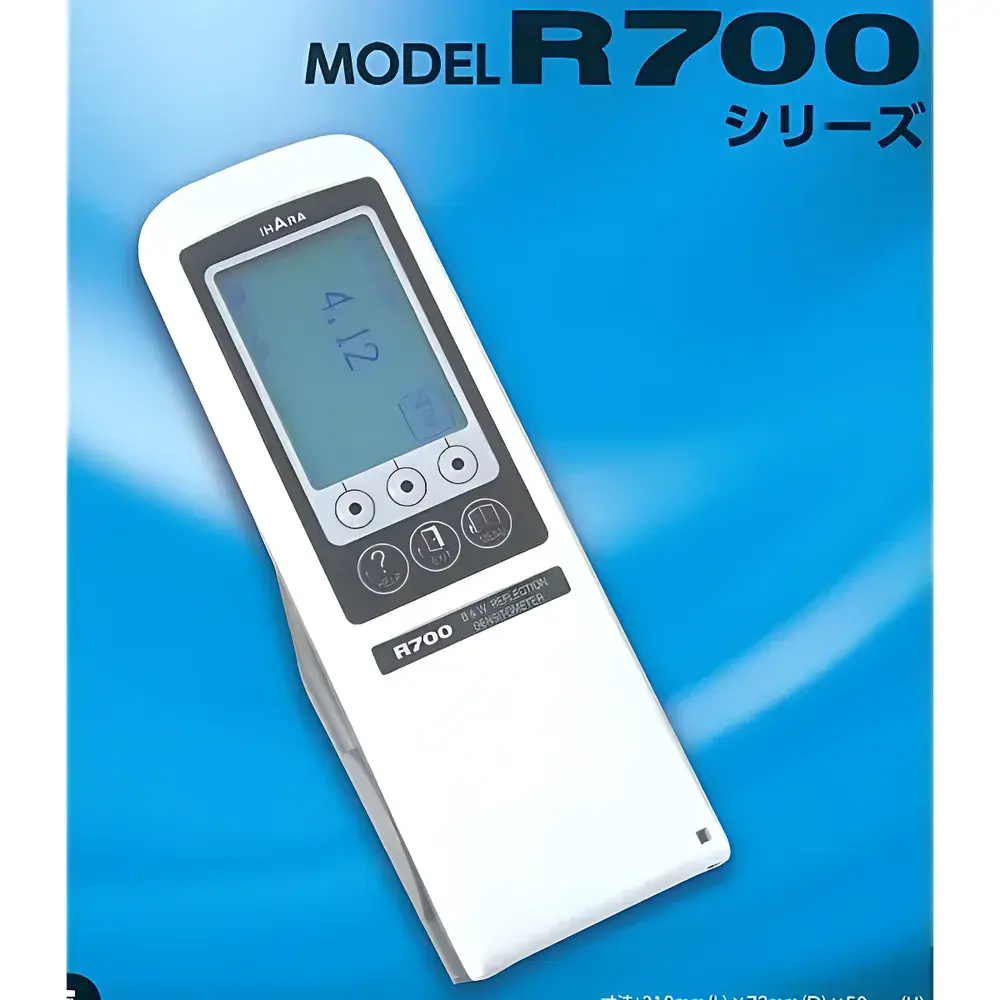
IHARA R700 Reflectance Densitometer
| Brand | Ihara Electronic |
|---|---|
| Origin | Japan |
| Manufacturer Type | Authorized Distributor |
| Product Origin | Imported |
| Model | R700 |
| Product Type | Handheld Densitometer |
| Temperature Control | Yes |
| Digital Display | Yes |
| Measurement Range | 0–2.5 OD (Optical Density) |
| Measurement Accuracy | ±0.02 D |
Overview
The IHARA R700 Reflectance Densitometer is a precision handheld optical measurement instrument engineered for high-reproducibility densitometric analysis in print quality control, prepress verification, and packaging production environments. Operating on the principle of reflectance photometry, the R700 quantifies optical density (D) by measuring the ratio of incident to reflected light intensity from printed or coated surfaces under standardized geometric illumination conditions—specifically vertical illumination with 45° directional reception, compliant with ISO 5/4, ANSI PH2.17, and DIN 16536. Its calibrated halogen light source (2856 K CCT) ensures stable spectral output across repeated measurements, while the integrated photodiode detector provides linear response across the full 0.00–2.50 D range. Designed for field and lab use, the R700 delivers traceable, repeatable readings critical for ISO 12647-2 process control, G7 calibration workflows, and contract proof verification.
Key Features
- Compliant optical geometry: 0°/45° (vertical illumination / 45° reception), meeting ISO 5/4, ANSI PH2.17, and DIN 16536 standards
- Dual-spot measurement capability: Standard Φ3 mm aperture and optional Φ1.7 mm aperture for high-resolution spot analysis
- Integrated temperature-compensated density measurement with ±0.02 D accuracy (≤2.0 D) and repeatability of ±0.01 D (≤2.0 D)
- Full-color graphical LCD (128 × 64 dots) with real-time battery level indicator and display inversion function
- Multi-parameter evaluation: Solid ink density, dot gain (%), ink trap (%), print contrast, tone curve analysis, plate dot area (%), hue error, and graysness
- Auto-function mode: Automatically identifies solid density, dot gain, or ink trap based on measurement target characteristics
- Onboard contrast adjustment, buzzer feedback (configurable ON/OFF), and four-stage auto-power-off timer
- Rechargeable NiCd battery (4.8 V, 800 mAh); full charge in ~90 minutes; AC adapter (9 V, 500 mA) included
- Optional polarizing filter for eliminating specular reflection from glossy substrates
Sample Compatibility & Compliance
The R700 supports reflective measurement on a wide range of substrates including coated/uncoated paper, cardboard, film, metallic foils, and UV-cured inks. Its 45° directional receiver minimizes interference from surface gloss and texture variations, enabling reliable assessment of both matte and high-gloss prints. All optical and electronic components are calibrated using an included NIST-traceable calibration plate. The instrument conforms to international print metrology standards including ISO 12647 series (process control for offset, flexo, gravure), ISO 13655 (spectral measurement conditions), and ISO 10128 (dot gain definitions). Its mechanical design and operational specifications (5–40 °C operating range, IP-rated housing) meet industrial-grade environmental robustness requirements for shop-floor deployment.
Software & Data Management
Data export is supported via RS-232C serial interface (up to 19,200 bps, configurable communication parameters), enabling seamless integration with QC databases, SPC software (e.g., Minitab, InfinityQS), and enterprise MES platforms. The R700 does not include proprietary PC software but outputs ASCII-formatted measurement records compatible with standard CSV parsing and automated import workflows. Audit trail integrity is maintained through timestamped internal storage of calibration events and user-initiated measurement logs. While native 21 CFR Part 11 compliance is not embedded, the device supports GLP/GMP-aligned documentation practices when used with validated third-party data acquisition systems that enforce electronic signature, access control, and change history logging.
Applications
- Prepress validation of color separations and proofing systems against digital press targets
- In-line density monitoring during sheetfed and web offset printing
- Flexographic and gravure press run consistency verification per ISO 12647-6
- Package printing QC for pharmaceutical, food, and cosmetic labeling
- G7 grayscale calibration and neutral print density profiling
- Dot gain mapping across press zones to optimize plate curves and ink key settings
- Post-lamination and varnish application impact assessment on ink density stability
FAQ
What standards does the R700 comply with for optical geometry and density measurement?
It adheres to ISO 5/4 (0°/45° geometry), ANSI PH2.17, DIN 16536, and supports measurement conditions defined in ISO 13655 for spectral reflectance.
Can the R700 measure both CMYK and spot colors accurately?
Yes—the halogen source and photodiode spectral response are optimized for conventional process inks and opaque spot colors; spectral mismatch errors remain within ±0.02 D for typical offset and flexo inks.
Is calibration traceable to national standards?
Yes—each unit ships with a factory-calibrated reference plate traceable to JIS Z 8722 and ISO 5/3 standards; periodic recalibration is recommended annually or after 10,000 measurements.
Does the R700 support multiple languages in the field?
Yes—English and Japanese language interfaces are switchable directly on-device without firmware update.
What is the minimum measurable dot area and resolution for tone curve analysis?
With the Φ1.7 mm aperture, the R700 resolves dot areas down to 1% and supports 10-point tone curve generation from 0% to 100% screen tints.





