
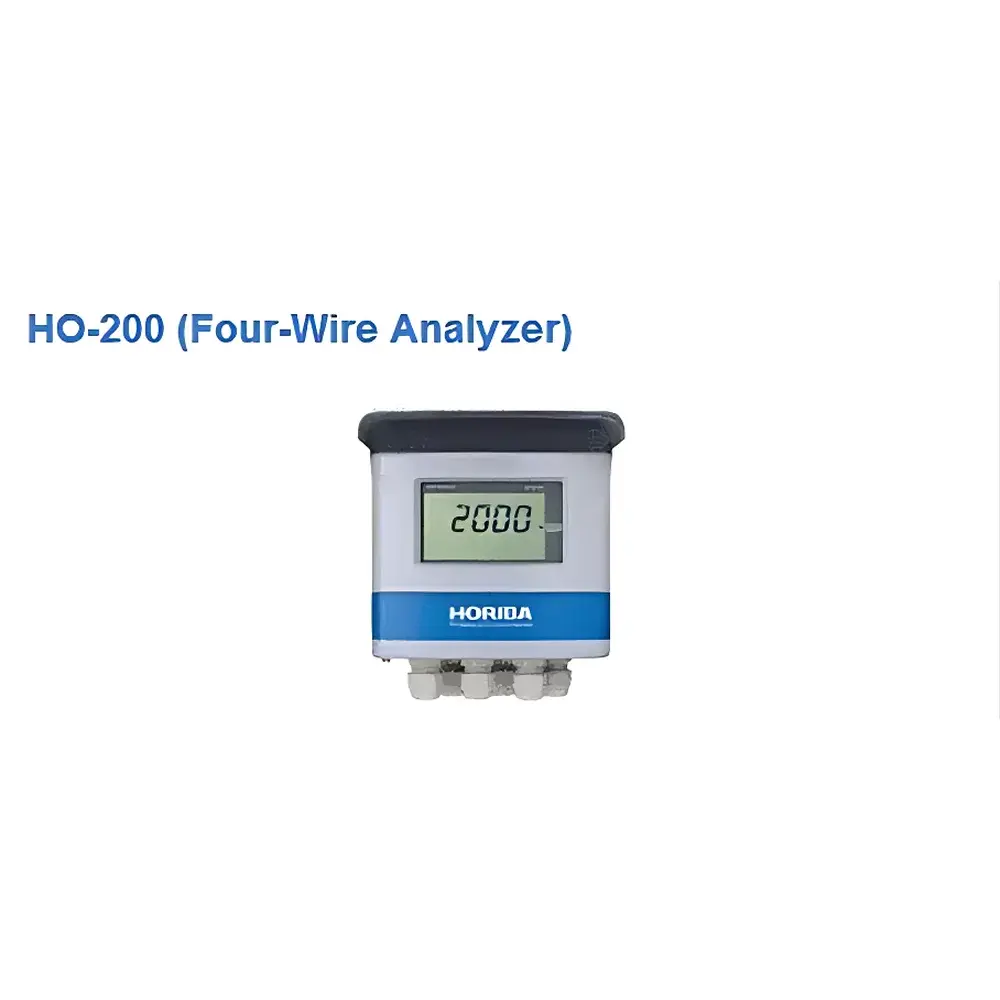
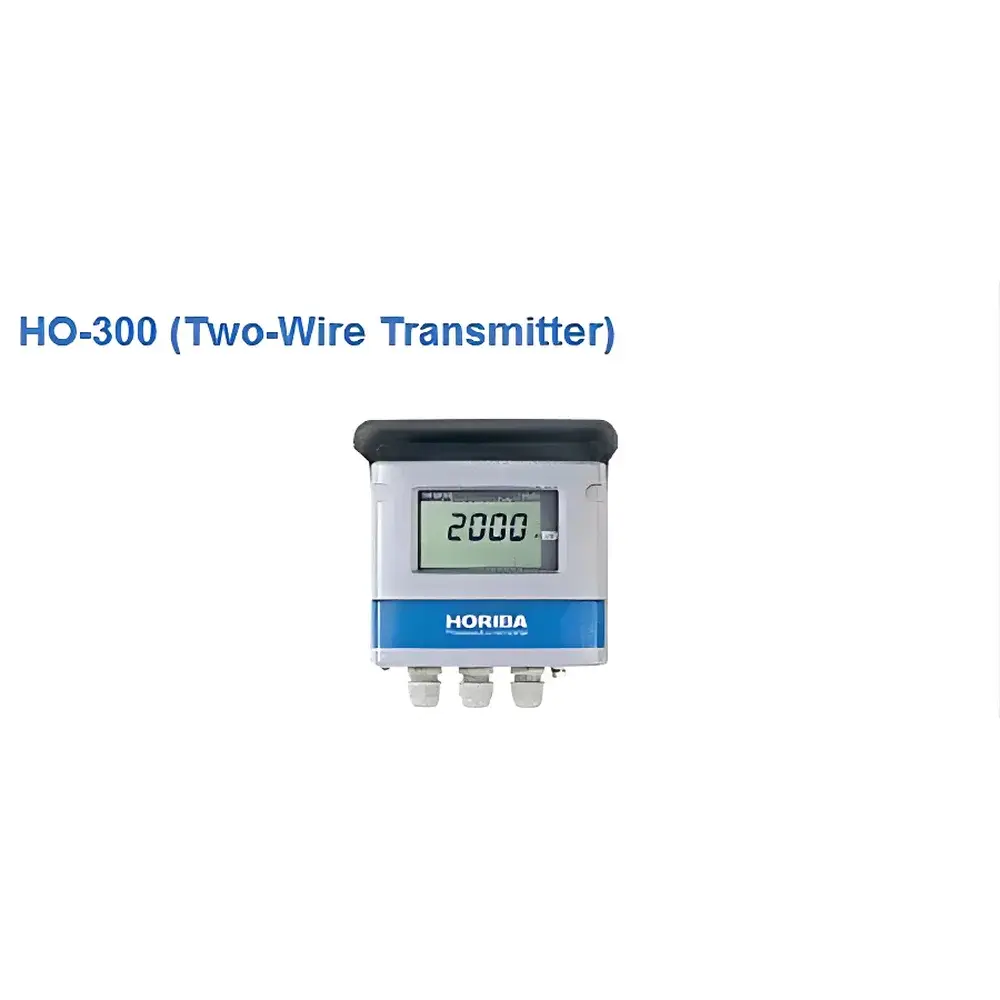
HORIBA HO-300 Industrial Online ORP Monitor
| Brand | HORIBA |
|---|---|
| Origin | Japan |
| Model | HO-300 |
| ORP Range | −2000 to +2000 mV |
| ORP Resolution | 1 mV |
| ORP Repeatability | ±5 mV (max) |
| ORP Linearity | ±5 mV (max) |
| Temperature Range | 0–100 °C |
| Temperature Resolution | 0.1 °C |
| Temperature Accuracy | ±0.3 °C (equivalent input) |
| Output | 4–20 mA DC, isolated, max load resistance 600 Ω |
| Digital Interface | RS-485 (2-wire, isolated I/O) |
| Power Supply | 24 V DC (21–32 V DC), max 0.6 W |
| Enclosure Rating | IP65 |
| Ambient Operating Temperature | −20 to +60 °C |
| Housing Material | Aluminum alloy |
| Mounting | 50A pipe or wall-mount |
| Weight | ~4 kg |
Overview
The HORIBA HO-300 is a rugged, outdoor-rated industrial online ORP (Oxidation-Reduction Potential) monitor engineered for continuous, real-time monitoring of redox activity in water and wastewater streams. It operates on the principle of potentiometric measurement using a noble metal reference electrode system—typically platinum or gold—paired with a stable reference electrode (e.g., Ag/AgCl or calomel) to detect the thermodynamic tendency of a solution to gain or lose electrons. This electrochemical potential, reported in millivolts (mV), serves as a critical process indicator in disinfection control (e.g., chlorine, ozone, or peroxide dosing), electrochemical treatment systems, cyanide destruction, and redox-based biological nutrient removal. Designed for deployment in harsh environments—including effluent channels, cooling towers, chemical dosing points, and municipal or industrial pre-treatment basins—the HO-300 delivers stable, drift-resistant readings under variable flow, temperature, and fouling conditions. Its architecture complies with fundamental requirements for continuous emission monitoring systems (CEMS) and supports integration into SCADA and DCS platforms via standardized analog and digital interfaces.
Key Features
- Rugged IP65-rated aluminum alloy enclosure suitable for unsheltered outdoor installation, resistant to dust ingress and low-pressure water jets
- Large backlit LCD display with simultaneous dual-parameter readout (ORP and temperature), enabling immediate field verification without external instrumentation
- Integrated Pt1000 temperature sensor (standard) with optional interchangeable thermistor modules (500 Ω, 6.8 kΩ, or 10 kΩ at 25 °C) for precise automatic temperature compensation across 0–100 °C
- Self-diagnostic capability including electrode health assessment, signal integrity monitoring, and output fault detection—loggable via serial interface
- Manual offset adjustment (−200 to +200 mV) and sensitivity calibration (0.500–1.500) to accommodate aging electrodes or non-standard reference conditions
- Galvanically isolated 4–20 mA analog output (600 Ω max load) compliant with NAMUR NE43 signaling conventions; RS-485 Modbus RTU interface for bidirectional data exchange and remote configuration
- Compliance with CE (EMC & LVD), FCC Part 15 Class B, RoHS Directive 2011/65/EU, and WEEE Directive 2012/19/EU
Sample Compatibility & Compliance
The HO-300 is validated for use in aqueous matrices typical of industrial process water, municipal wastewater, cooling water, and treated effluent. It accommodates moderate suspended solids and organic loading but requires periodic electrode cleaning per HORIBA’s maintenance protocol to maintain measurement fidelity. While not certified for drinking water compliance under NSF/ANSI 61 or EPA Method 150.1, its performance characteristics meet functional requirements outlined in ISO 10523 (water quality — determination of pH) and ASTM D1293 (Standard Test Methods for pH of Water), by extension supporting redox-related interpretations within those frameworks. The device supports GLP-aligned data traceability when paired with HORIBA’s optional data logger or third-party historian systems that enforce audit trails and user access controls.
Software & Data Management
The HO-300 operates as a stand-alone transmitter with embedded firmware; no PC software is required for basic operation. Configuration and diagnostics are performed locally via front-panel keys or remotely via Modbus RTU over RS-485. When integrated into enterprise-level SCADA or MES environments, the unit supports timestamped analog output scaling and discrete status reporting (e.g., “electrode fault”, “out-of-range”). All calibration events—including date, operator ID (if entered manually), offset/sensitivity values, and measured check standards—are retained in non-volatile memory for up to 100 entries. Though the HO-300 itself does not implement FDA 21 CFR Part 11 electronic signature or audit trail functionality, its output signals and diagnostic flags are compatible with downstream systems that do—enabling full regulatory alignment in GMP or ISO 17025-accredited laboratories and treatment facilities.
Applications
- Chlorination and ozonation control in potable water and wastewater disinfection processes
- Redox monitoring during electrocoagulation, Fenton oxidation, and advanced oxidation process (AOP) reactors
- Process optimization in plating rinse tanks, etching baths, and semiconductor ultrapure water loops
- Biological denitrification and sulfide oxidation monitoring in activated sludge and anaerobic digesters
- Real-time verification of chemical reduction steps in hazardous waste treatment (e.g., Cr(VI) to Cr(III))
- Performance validation of membrane filtration integrity via redox shift detection upstream/downstream
FAQ
What reference electrode types are compatible with the HO-300?
The HO-300 is designed for use with standard Ag/AgCl (3 M KCl) or double-junction reference electrodes; HORIBA recommends the 9530-10D or 9531-10D series for optimal long-term stability in industrial applications.
Can the HO-300 be used in seawater or high-salinity brines?
Yes, but electrode selection and maintenance frequency must be adjusted—platinum sensing elements are preferred, and reference junction clogging must be mitigated via regular cleaning or flow-through cell integration.
Is temperature compensation automatic and mandatory?
Temperature compensation is automatic and enabled by default using the built-in Pt1000 sensor; disabling it is possible via configuration but not recommended, as ORP is intrinsically temperature-dependent per the Nernst equation.
Does the HO-300 support HART communication?
No—the HO-300 provides only 4–20 mA analog output and RS-485 Modbus RTU; HART-capable variants (e.g., the HL-300 series) are available separately.
What is the expected service life of the ORP electrode under continuous operation?
With proper maintenance—including weekly cleaning and quarterly calibration—the sensing element typically maintains specification for 12–18 months in typical municipal wastewater; lifespan decreases significantly in high-foulant or strongly oxidizing environments.
Related Products







