
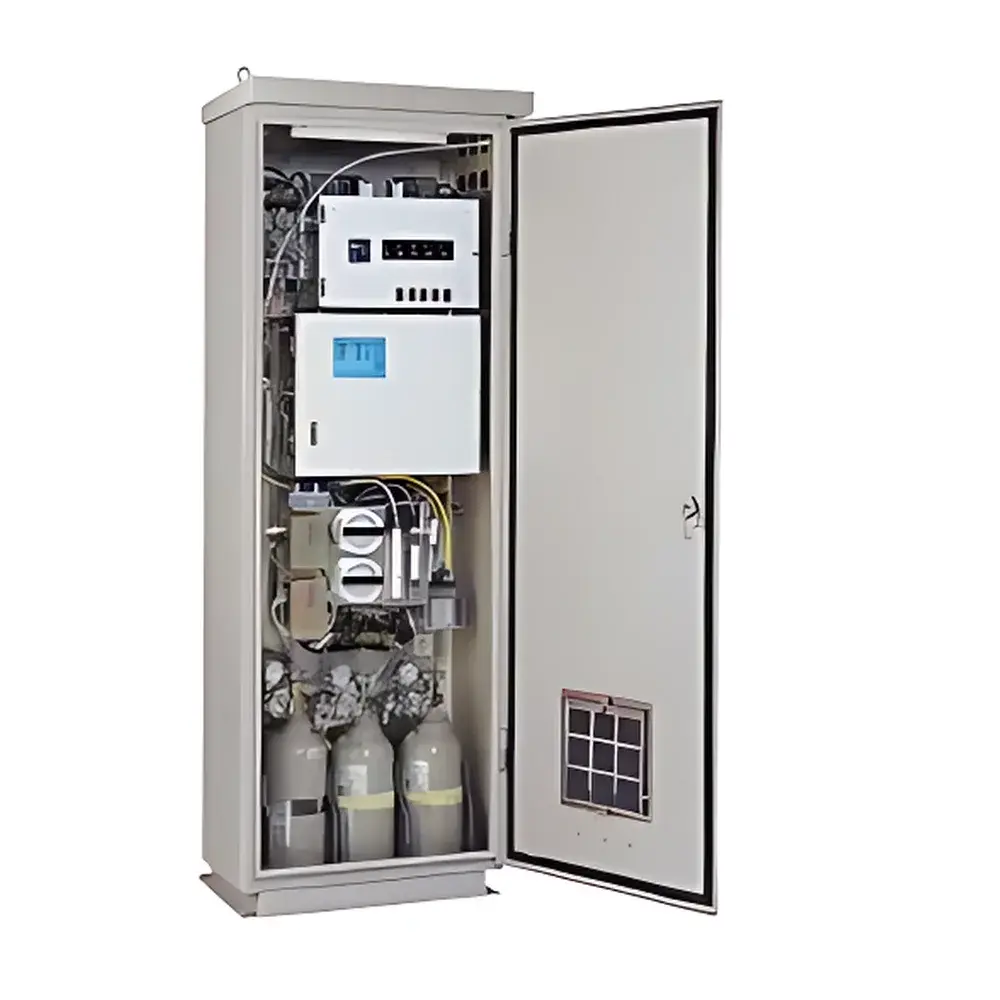
HORIBA ENDA-600ZG Series Continuous Emission Monitoring System (CEMS) for Flue Gas Analysis
| Brand | HORIBA |
|---|---|
| Origin | Japan |
| Model | ENDA-600ZG |
| Instrument Type | Continuous Emission Monitoring System (CEMS) |
| Measurement Accuracy | ±2.0% of reading |
| Repeatability | ±0.5% F.S. |
| Response Time (SO₂) | 60–240 s (T₉₀) |
| Long-Term Stability | ±2.0% F.S./week |
Overview
The HORIBA ENDA-600ZG Series is a compact, high-reliability Continuous Emission Monitoring System (CEMS) engineered for real-time, simultaneous quantification of up to five key flue gas constituents: NOx, SO2, CO, CO2, and O2. Designed for compliance-critical industrial environments—including power generation, waste-to-energy incineration, steelmaking, glass melting, sulfuric acid production, and steam boiler operations—the system integrates dual physical detection principles: alternating-flow non-dispersive infrared (NDIR) spectroscopy for NOx, SO2, CO, and CO2, and paramagnetic oxygen detection for O2. This hybrid architecture eliminates optical drift, negates the need for periodic optical alignment, and ensures zero-point stability through synchronized 1-second alternation between sample and reference gas streams. The system operates without carrier gas for O2 measurement—leveraging ambient air as the reference medium—reducing operational complexity and consumables dependency. Its fully integrated design meets the functional requirements of EPA Method 6C, 7E, 10, and ISO 12039, supporting regulatory reporting under EU IED, US Clean Air Act Title V, and China’s HJ 75–2017 and HJ 76–2017 standards.
Key Features
- Single-Unit Five-Component Monitoring: Simultaneous, continuous analysis of NOx, SO2, CO, CO2, and O2 within one analyzer housing—eliminating inter-unit calibration drift and reducing footprint by >50% versus prior-generation CEMS.
- Drift-Free NDIR Architecture: Alternating-flow modulation enables automatic in-situ cleaning of optical cells via cyclic sample/reference gas exchange, suppressing cell contamination-induced span shift and maintaining long-term measurement integrity.
- Paramagnetic O2 Detection: Contactless magnetic pressure sensing avoids sensor corrosion from acidic or humid flue gases; no external N2 supply required.
- Interference Compensation: Dedicated H2O and CO2 compensation channels with proprietary interference-filter optics minimize cross-sensitivity—critical for accurate NOx and SO2 quantification in high-moisture, multi-component streams.
- Touchscreen Human-Machine Interface (HMI): 10.4-inch capacitive LCD display supports intuitive navigation across real-time concentration plots, calibration logs, alarm history, correction factor settings, and diagnostic menus—all accessible from the front panel.
- Reduced Maintenance Footprint: All service actions—including filter replacement, calibration gas connection, and module access—are performed from the instrument’s frontal plane; auto-blowback controller dimensions reduced to 350 × 550 × 180 mm (W×H×D), enabling wall-mount installation in constrained spaces.
Sample Compatibility & Compliance
The ENDA-600ZG accommodates diverse flue gas matrices through application-specific sampling subsystems. For waste incineration, an integrated Cl2 scrubber prevents halogen-induced corrosion, while a three-stage electronic cooler (primary + dual secondary stages) achieves dew point ≤2 °C—minimizing aqueous-phase loss of SO2 and NO2. In coal-fired power plants, optional NH3 removal units suppress ammonium sulfate salt deposition during selective catalytic reduction (SCR) stack monitoring. A high-efficiency particulate prefilter—directly coupled to the probe—is field-replaceable without tools. All sampling trains comply with ISO 16146-1 for representative isokinetic extraction and meet ASTM D6784-22 requirements for mercury-free particulate conditioning. The full system satisfies GLP/GMP data integrity expectations via audit-trail-enabled firmware and time-stamped event logging aligned with FDA 21 CFR Part 11 Annex 11 principles.
Software & Data Management
Firmware v3.2+ supports configurable output protocols including 4–20 mA analog (up to 12 channels), RS-232/485 Modbus RTU, and Ethernet TCP/IP. Outputs include raw concentrations, O2-corrected values (per EN 14181 QAL1/QAL2), and dynamically averaged 1-hour rolling means. Internal memory stores ≥12 months of 1-minute interval data with CRC-32 error checking. Remote diagnostics and firmware updates are supported via secure HTTPS interface with TLS 1.2 encryption. Calibration logs retain full traceability: date/time, standard gas lot number, operator ID, pre-/post-calibration deviations, and pass/fail status per ISO/IEC 17025 clause 7.7. Data export complies with EPA 40 CFR Part 60 Appendix B formats for electronic submission to state and federal emissions portals.
Applications
- Coal-, gas-, and biomass-fired power plant stacks (NOx/SO2 compliance reporting)
- Municipal solid waste and hazardous waste incinerators (Cl2/SO2/CO control)
- Steel sintering plants and blast furnace gas cleaning systems
- Glass melting furnaces (O2 excess control + SO2 emission tracking)
- Sulfuric acid production contact process tail-gas monitoring
- Industrial steam boilers subject to local air quality ordinances
FAQ
What detection principles does the ENDA-600ZG employ for each gas?
NOx, SO2, CO, and CO2 are measured using alternating-flow NDIR spectroscopy; O2 is quantified via paramagnetic pressure detection.
Does the system require external carrier gas?
No—ambient air serves as the reference gas for O2 measurement; no N2 or synthetic air supply is needed.
How is moisture interference mitigated during SO2 and NO2 analysis?
A three-stage electronic cooling system maintains sample dew point ≤2 °C, and dedicated H2O compensation optics correct for residual spectral overlap.
What is the recommended calibration frequency?
Automatic zero/span verification is scheduled every 7 days; manual calibration intervals follow EN 14181 QA/QC schedules based on site-specific risk assessment.
Can the ENDA-600ZG integrate with existing DCS or SCADA systems?
Yes—via native Modbus RTU over RS-485 or TCP/IP Ethernet, supporting tag-based data mapping and alarm forwarding per IEC 61850-7-420 profiles.
Related Products







