
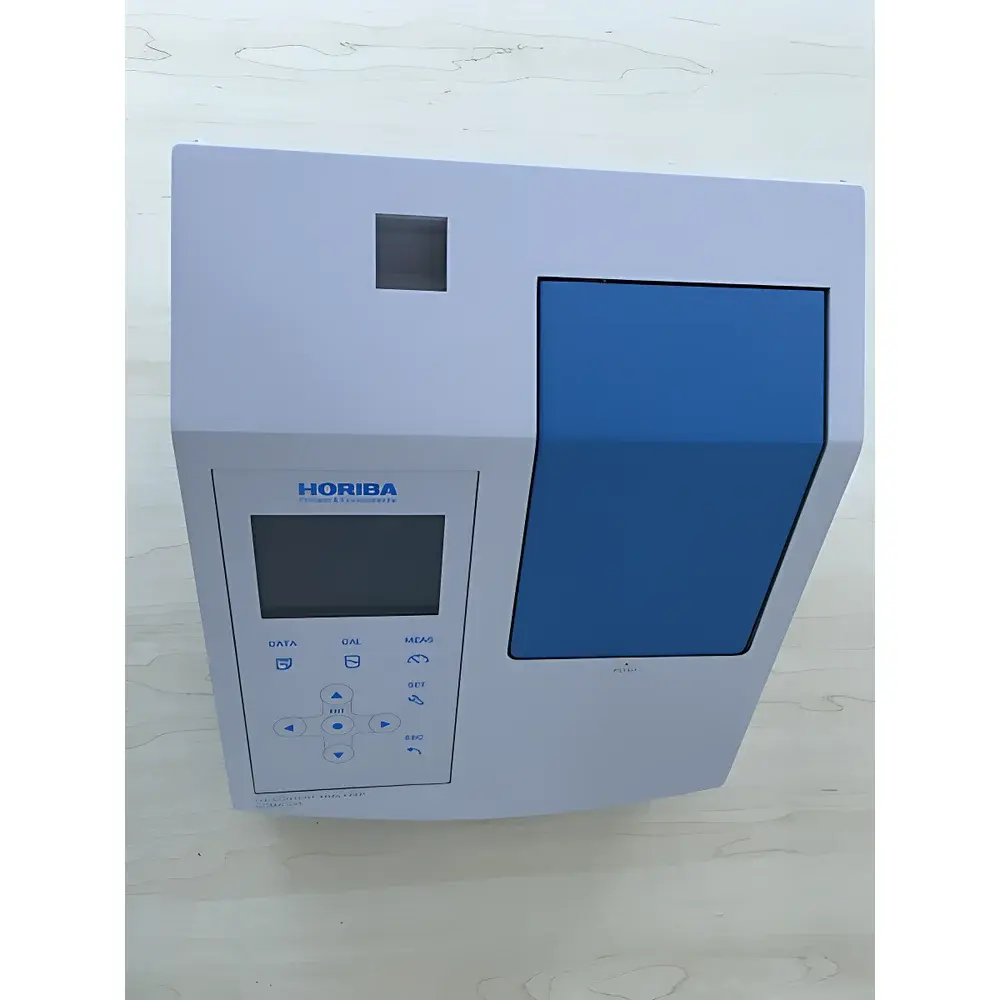
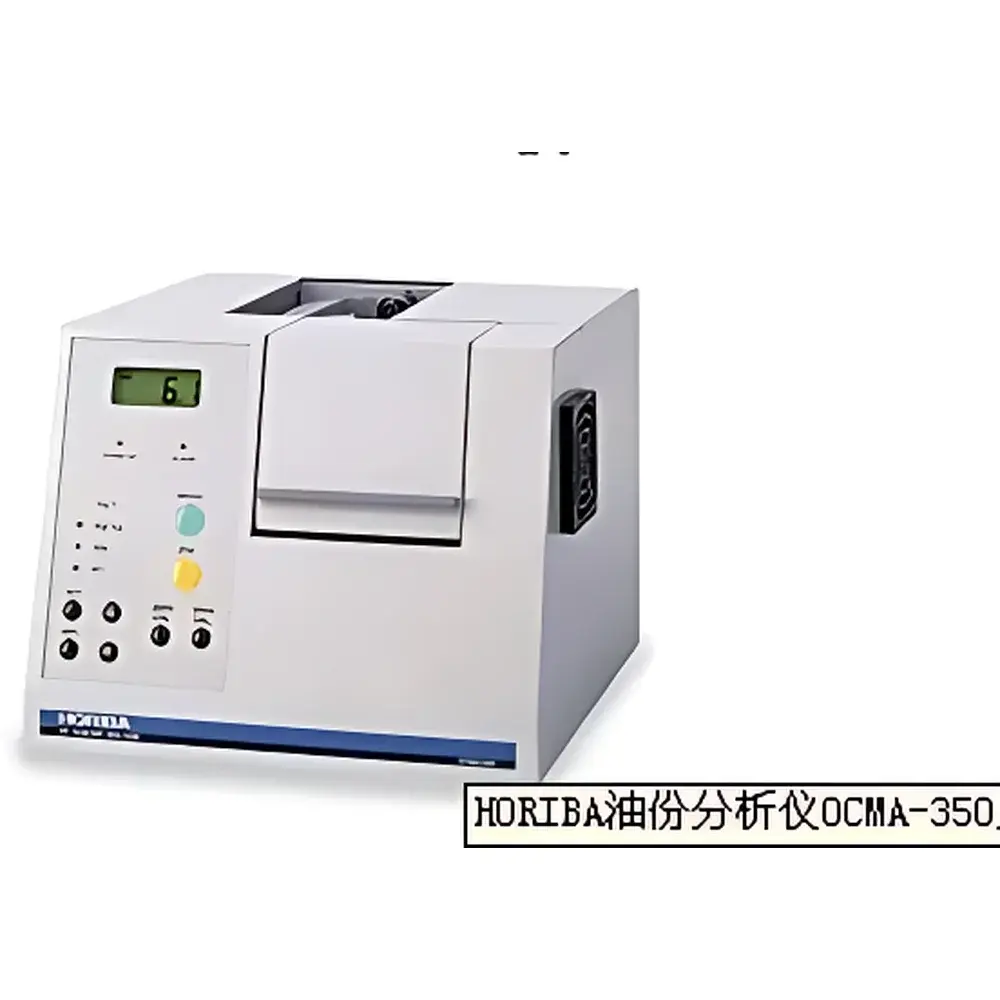
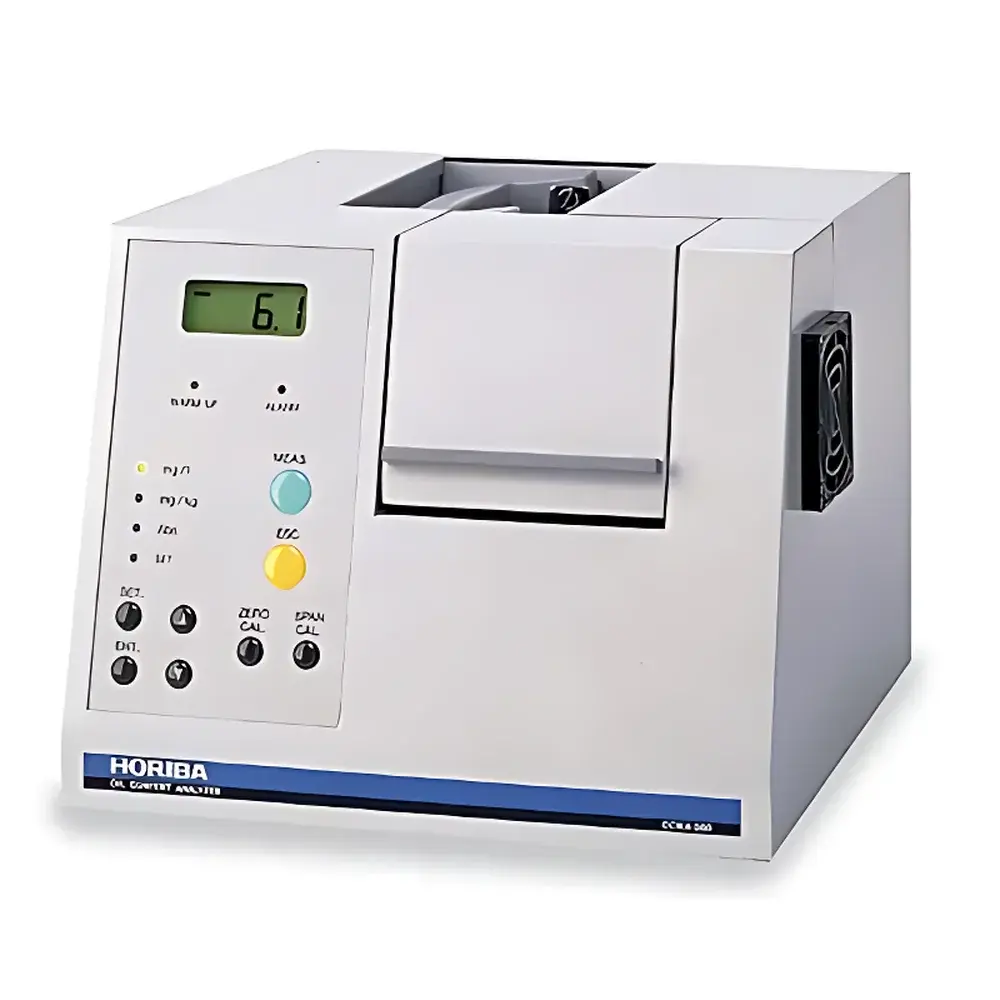
HORIBA OCMA-550/555 Oil Content Analyzer
| Brand | HORIBA |
|---|---|
| Origin | Japan |
| Model | OCMA-550 / OCMA-555 |
| Measurement Principle | Non-Dispersive Infrared (NDIR) Absorption Spectrophotometry |
| Measurement Range | 0–200 mg/L (water), 0–1000 mg/kg (soil), 0–1 Abs |
| Accuracy | ±0.4 mg/L (0–9.9 mg/L), ±2.0 mg/L (10.0–99.9 mg/L), ±4 mg/L (100–200 mg/L), ±1% F.S. (0–1 Abs) |
| Resolution | 0.1 mg/L (equivalent to 0.1 ppm in aqueous phase) |
| Detector Type | Thermoelectric Sensor |
| Wavelength | ~3.4 µm (C–H stretching absorption band) |
| Solvent Compatibility | S-316 (OCMA-550), H-997 (OCMA-555) |
| Display | Backlit LCD with timestamping |
| Interface | RS-232C, Parallel Printer Port |
| Power Supply | 230 V AC, 50 Hz |
| Dimensions | 250 × 200 × 285 mm (W × H × D) |
| Standard Cell | 200-mm pathlength quartz cuvette |
Overview
The HORIBA OCMA-550 and OCMA-555 Oil Content Analyzers are laboratory-grade instruments engineered for precise, trace-level quantification of hydrocarbon-based oil contaminants in water, soil, and solid surface extracts. Both models operate on the principle of non-dispersive infrared (NDIR) absorption spectrophotometry—specifically targeting the fundamental C–H stretching vibration band near 3.4 µm. This spectral region exhibits strong, characteristic absorbance for aliphatic and aromatic hydrocarbons while remaining minimally affected by common interferents such as water, chlorinated solvents, or particulate matter. Unlike broad-spectrum UV-Vis methods, NDIR at 3.4 µm delivers high selectivity for total petroleum hydrocarbons (TPH), enabling reliable compliance monitoring against regulatory thresholds (e.g., EPA Method 1664, ISO 9377-2, ASTM D7066). The OCMA-550 employs S-316 (1,1,2-trichloro-1,2,2-trifluoroethane) as the extraction solvent, whereas the OCMA-555 utilizes H-997 (a proprietary, low-toxicity alternative compatible with modern environmental safety requirements). Both solvents exhibit negligible IR absorbance at the measurement wavelength, ensuring that only extracted oil contributes to the signal.
Key Features
- Triple-unit display capability: simultaneous selection among mg/L (aqueous phase), mg/kg (soil/solid matrix), and Abs (absorbance)—enabling direct reporting aligned with regulatory submission formats.
- High-sensitivity thermoelectric detector optimized for stability and low drift over extended operational cycles.
- Integrated real-time timestamping for each measurement, supporting GLP-compliant data integrity and audit readiness.
- Backlit LCD interface with intuitive menu navigation—designed for use in field-deployable labs or controlled cleanroom environments.
- Single-button operation after sample introduction: eliminates procedural variability and reduces operator-dependent error.
- Automated zero-point calibration upon power-up and user-initiated reference adjustment—ensuring baseline consistency across multi-shift operations.
- Compact benchtop footprint (250 × 200 × 285 mm) with robust mechanical housing suitable for ISO 17025-accredited laboratories.
Sample Compatibility & Compliance
The OCMA series is validated for use with liquid-phase extracts from aqueous effluents, leachates, groundwater, and wastewater treatment plant influents/effluents. It also supports semi-quantitative analysis of solvent-extracted residues from metal parts, machined components, textiles, and soil cores. Extraction protocols follow standardized methodologies—including EPA SW-846 Method 3510C (separatory funnel extraction) and ISO 16703:2004 (oil-in-water determination). When used with certified reference materials (e.g., NIST SRM 2781 or HORIBA B-grade heavy oil standard), the system meets accuracy requirements for ISO/IEC 17025 method validation. Data output complies with FDA 21 CFR Part 11 when paired with validated LIMS integration via RS-232C; audit trails, electronic signatures, and user-access logs can be implemented externally through compliant software platforms.
Software & Data Management
While the OCMA-550/555 operates as a standalone instrument, its RS-232C serial interface enables bidirectional communication with external PCs running custom or third-party data acquisition software. ASCII-formatted output includes measurement value, unit, timestamp, and instrument ID—structured for direct import into Excel, LabArchives, or ELN systems. The parallel printer port supports direct hardcopy generation using industry-standard dot-matrix or thermal printers. No proprietary drivers or closed-format databases are required. All firmware updates are delivered via physical EPROM replacement (per HORIBA service bulletin), ensuring long-term compatibility and cybersecurity resilience in regulated environments where network connectivity is restricted.
Applications
- Regulatory compliance testing for industrial discharge permits (e.g., NPDES, EU WFD Annex X).
- Process validation of aqueous cleaning baths in semiconductor fabrication and precision machining lines.
- Residual oil verification on stamped, milled, or electroplated components prior to coating or assembly.
- Soil contamination screening at brownfield sites under ASTM D5369 or ISO 16703 protocols.
- Quality control of solvent recycling efficiency in closed-loop degreasing systems.
- Research-grade TPH quantification in environmental fate and transport studies.
FAQ
What extraction solvents are required for each model?
The OCMA-550 requires S-316 (1,1,2-trichloro-1,2,2-trifluoroethane); the OCMA-555 uses H-997—a halogenated solvent formulated to reduce ozone depletion potential while maintaining equivalent spectral transparency at 3.4 µm.
Can the instrument measure emulsified or dissolved oil fractions?
No—the OCMA measures only solvent-extractable, non-polar hydrocarbons. Emulsified or surfactant-stabilized oil must first undergo phase separation or acidification per EPA Method 1664 before extraction.
Is the 200-mm quartz cell included with purchase?
Yes—a matched pair of sealed, high-transmission quartz cells (with lids) is supplied as standard equipment.
Does the analyzer support multi-point calibration?
It performs automatic zero calibration and single-point reference adjustment using the provided B-grade heavy oil standard; multi-point calibration curves require external software integration.
What maintenance is required to ensure long-term accuracy?
Annual verification of optical alignment and detector responsivity is recommended; quartz cell cleaning with methanol and lint-free wipes is performed between samples to prevent carryover.
Related Products







