
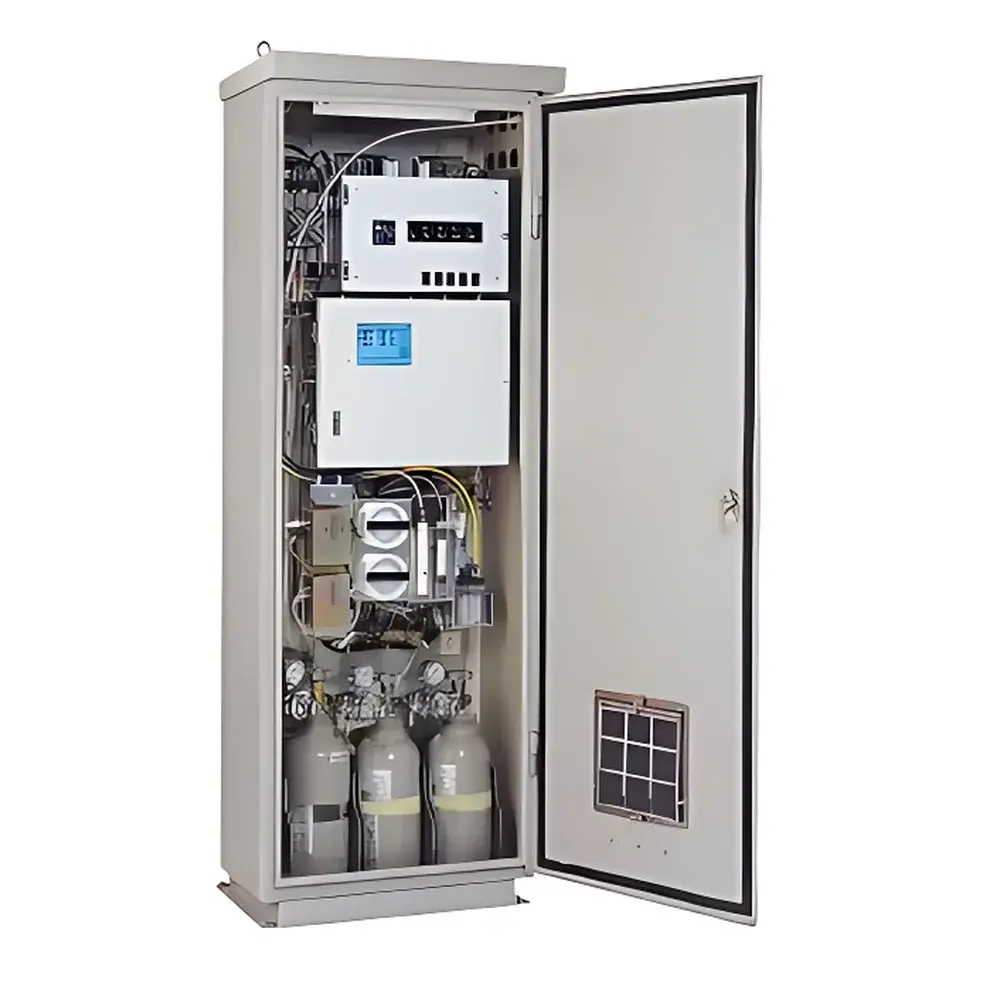
HORIBA ENDA-600ZG Continuous Emission Monitoring System (CEMS) for Flue Gas Analysis
| Brand | HORIBA |
|---|---|
| Origin | Japan |
| Model | ENDA-600ZG |
| Instrument Type | Continuous Emission Monitoring System (CEMS) |
| Measurement Principle | Alternating Flow NDIR + Magnetic Pressure O₂ Detection |
| Accuracy | ±0.5% F.S. |
| Repeatability | ±0.5% F.S. |
| Response Time | Td + T90 ≤ 60 s |
| Stability | ±1.0% F.S. |
| Measured Gases | SO₂, NOₓ (as NO), CO, CO₂, O₂ |
Overview
The HORIBA ENDA-600ZG is a compact, high-integrity Continuous Emission Monitoring System (CEMS) engineered for regulatory-compliant, long-term flue gas analysis in industrial combustion sources. It employs alternating flow non-dispersive infrared (NDIR) spectroscopy for simultaneous, real-time quantification of SO₂, NOₓ (reported as NO), CO, and CO₂—combined with magnetic pressure oxygen detection for O₂—within a single analyzer unit. Unlike conventional dual-beam or single-beam NDIR systems, the ENDA-600ZG’s patented alternating flow architecture introduces sample and reference gas streams into the same detection cell in rapid, synchronized 1-second cycles. This eliminates optical misalignment sensitivity, negates zero-point drift, and obviates routine optical recalibration—key requirements for unattended operation under EPA Method 6C, EN 15267, and ISO 12039 compliance frameworks. The system is designed to meet Tier 2 performance specifications per EU Directive 2010/75/EU (IED) and supports data integrity protocols aligned with FDA 21 CFR Part 11 when integrated with validated software environments.
Key Features
- Single-unit, five-parameter monitoring: SO₂, NOₓ, CO, CO₂, and O₂—reducing footprint, calibration complexity, and cross-gas interference risk.
- Zero-drift NDIR architecture: Alternating flow modulation ensures intrinsic stability; no manual optical alignment required after transport, maintenance, or vibration exposure.
- Magnetic pressure O₂ sensor: Measures O₂ without consumable carrier gas (e.g., N₂); utilizes ambient air as reference—lowering operational cost and eliminating gas supply infrastructure.
- Integrated interference compensation: Dedicated H₂O and CO₂ correction channels, plus proprietary interference filter optics, mitigate spectral overlap effects—particularly critical for accurate NOₓ measurement in high-moisture, high-CO₂ flue streams.
- Front-access modular design: All service operations—including filter replacement, calibration valve actuation, and detector inspection—are performed from the instrument’s front panel. Unit volume reduced by 50% versus prior-generation ENDA platforms.
- Enhanced SO₂ calibration efficiency: Dry-gas calibration completes in ≤3 minutes—versus 15 minutes for legacy wet-calibration protocols—minimizing downtime during QA/QC verification.
Sample Compatibility & Compliance
The ENDA-600ZG accommodates demanding flue gas matrices across diverse thermal processes. Its sampling subsystem is configurable per application-specific challenges: a three-stage electronic cooling dehydration train (primary + dual secondary coolers) minimizes soluble gas loss (SO₂, NO₂) during condensate formation; an inline SO₃ mist eliminator prevents acid corrosion downstream; optional NH₃ scrubbers suppress ammonium sulfate salt deposition in power plant applications; and Cl₂ removal modules protect optics and sensors in waste incineration. Particulate-laden streams are managed via an integrated wall-mountable auto-blowback controller (350 × 550 × 180 mm), now 23% smaller than predecessor units. The system meets emission reporting requirements under US EPA PS-11, EN 14181 (QAL1–QAL3), and China’s HJ 75–2017 and HJ 76–2017 standards. Full audit trail logging, secure user authentication, and electronic signature capability support GLP/GMP-aligned data governance.
Software & Data Management
The ENDA-600ZG runs on embedded firmware supporting configurable output modes: real-time analog (4–20 mA) and digital (RS-485/Modbus RTU, optional Ethernet) signals for up to 12 parameters—including raw concentrations, O₂-dilution corrected values (per EN 14792), and rolling 1-hour dynamic averages. Internal memory logs second-by-second measurements with timestamped event flags for calibration, alarm, and maintenance actions. Optional HORIBA CEMS Manager software enables remote configuration, diagnostic trending, and automated report generation compliant with EU MRV and US EPA e-GGRT submission formats. All data modifications are recorded with operator ID, timestamp, and reason code—satisfying ALCOA+ principles (Attributable, Legible, Contemporaneous, Original, Accurate, Complete, Consistent, Enduring, Available) for regulatory audits.
Applications
The ENDA-600ZG is deployed globally in fixed-source emission monitoring for steam boilers (coal, biomass, natural gas), municipal solid waste and hazardous waste incinerators, combined-cycle and coal-fired power plants, iron and steel sintering/pelletizing lines, sulfuric acid production furnaces, glass melting tanks, and cement kilns. Its compact form factor enables installation in space-constrained retrofit scenarios where legacy CEMS cabinets were impractical. The system’s robustness against high-humidity, high-acid-gas, and variable particulate loads—coupled with low-power consumption (200 VA reduction vs. prior models)—makes it suitable for both greenfield installations and brownfield upgrades requiring minimal civil works.
FAQ
What gas species does the ENDA-600ZG measure simultaneously?
SO₂, NOₓ (reported as NO), CO, CO₂, and O₂—all within one analyzer housing.
Does the system require external carrier gas for O₂ measurement?
No. The magnetic pressure O₂ sensor uses ambient air as its reference medium—eliminating nitrogen supply infrastructure and associated costs.
How is water vapor interference mitigated during NOₓ and SO₂ analysis?
Through hardware-level compensation: dedicated H₂O detection channels feed real-time correction algorithms, and interference-filtered NDIR detectors minimize spectral crosstalk.
What is the maximum allowable particulate concentration at the probe inlet?
With optional auto-blowback control and heated probe filtration, the system operates reliably at inlet dust loads up to 10 g/Nm³—subject to site-specific sampling system design.
Can the ENDA-600ZG comply with 21 CFR Part 11 for pharmaceutical or biotech facility emissions reporting?
Yes—when paired with validated HORIBA CEMS Manager software configured with electronic signatures, audit trails, and role-based access controls.
Related Products







