
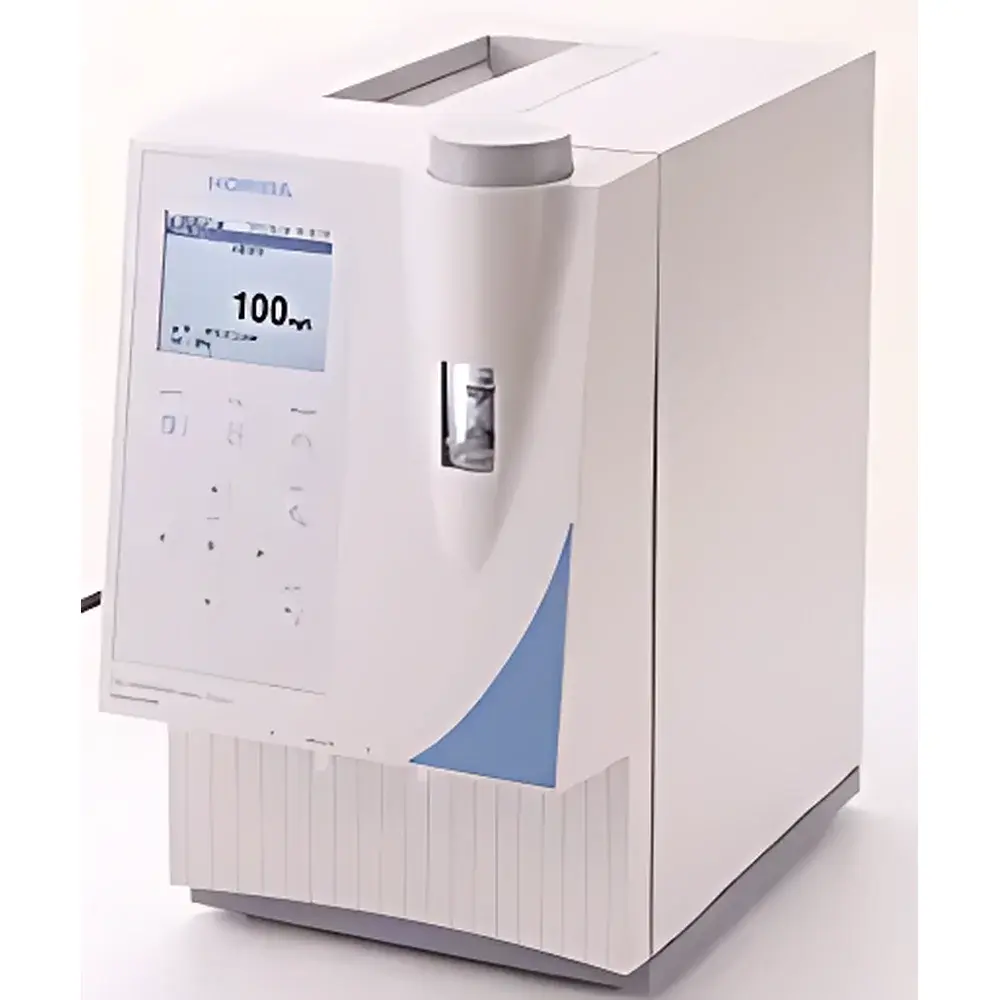
HORIBA OCMA-505 Portable Oil-in-Water Analyzer
| Brand | HORIBA |
|---|---|
| Origin | Japan |
| Model | OCMA-505 |
| Instrument Type | Portable |
| Measurement Principle | Non-Dispersive Infrared (NDIR) Spectrophotometry |
| Measurement Range | 0–200 mg/L (oil in water), 0–1000 mg/kg (oil in soil/sludge), 0–1 Abs (absorbance) |
| Accuracy | ±1 mg/L (at 10–100 mg/L range) |
| Resolution | 0.1 mg/L (0–99.9 mg/L), 1 mg/L (100–200 mg/L) |
| Repeatability | ±0.2 mg/L ±1 digit (0–10 mg/L) |
| Extractant | HORIBA H-997 solvent |
| Optional Accessory | Solvent Regenerator SR-305 (activated carbon + activated alumina column) |
Overview
The HORIBA OCMA-505 is a fully integrated, portable oil-in-water analyzer engineered for rapid, field-deployable quantification of hydrocarbon contamination in aqueous matrices—including freshwater, seawater, wastewater effluents, and industrial process water. It operates on the principle of non-dispersive infrared (NDIR) absorption spectroscopy, targeting the characteristic C–H stretching vibrations near 2960 cm⁻¹ (3.39 µm) to selectively detect aliphatic and aromatic hydrocarbons. Unlike conventional benchtop IR analyzers requiring manual liquid–liquid extraction and cell loading, the OCMA-505 incorporates an automated, syringe-driven solvent extraction module that precisely delivers fixed volumes of sample water and proprietary H-997 extractant (a chlorinated hydrocarbon-free, low-toxicity solvent optimized for NDIR response and phase separation). The extracted oil-solvent mixture is then drawn into a fixed-pathlength flow cell, where absorbance is measured against a solvent blank. Its 0–200 mg/L dynamic linear range eliminates manual range switching—enabling trace-level detection (sub-1 mg/L) and high-concentration screening (up to 200 mg/L) within a single measurement cycle—making it suitable for regulatory compliance monitoring at discharge points, spill response sites, and routine environmental surveillance.
Key Features
- Integrated solvent extraction and NDIR detection in a single compact unit—no external separatory funnels, glassware, or spectrometer required.
- Automated, microprocessor-controlled fluid handling with precision syringe pumps ensuring reproducible 10 mL sample and 10 mL H-997 solvent delivery (±0.5% volumetric accuracy).
- Real-time digital display with English-language UI showing status codes, error diagnostics (e.g., “LOW SOLVENT”, “PHASE SEPARATION FAILURE”, “CALIBRATION EXPIRED”), and live absorbance readings.
- Self-contained calibration verification using built-in reference standards; supports user-defined calibration curves per ASTM D7066 and ISO 9377-2 protocols.
- Ruggedized housing rated IP65 for dust/water resistance; battery-operated (optional 12 V DC operation) enabling >8 hours continuous field use.
- Compliance-ready audit trail: timestamped measurement logs stored internally (up to 1000 records) with operator ID input and calibration history—aligned with GLP documentation requirements.
Sample Compatibility & Compliance
The OCMA-505 is validated for direct analysis of clarified or filtered water samples containing free-phase, dispersed, or emulsified petroleum hydrocarbons—including gasoline, diesel, lubricating oils, and crude oil fractions. It accommodates turbid or saline matrices (up to 3.5% NaCl) without performance degradation, thanks to dual-wavelength background correction and robust phase-separation kinetics. Methodologically, it conforms to the technical framework of EPA Method 1664A (revision B) for n-hexane extractable material (HEM), and aligns with ISO 9377-2:2000 (Water quality — Determination of hydrocarbon oil index — Part 2: Infrared spectrometric method) when used with H-997 solvent and certified calibration standards. All measurements meet traceability requirements under ISO/IEC 17025:2017 via NIST-traceable reference oils (e.g., IRM-811, IRM-910). Optional SR-305 solvent regenerator extends H-997 reuse over ≥200 extractions while maintaining extractant purity—reducing hazardous waste generation and operational cost per test.
Software & Data Management
Data output is supported via USB 2.0 interface for direct export of CSV-formatted measurement reports including date/time stamp, sample ID, absorbance value, calculated concentration (mg/L), operator code, and instrument serial number. No proprietary software installation is required—files are readable in Excel or LIMS-compatible platforms. Internal memory retains full measurement metadata with tamper-evident timestamps; data integrity complies with FDA 21 CFR Part 11 Annex 11 principles for electronic records (user authentication, audit trail, and secure export). Firmware updates are delivered via signed .bin files to prevent unauthorized modification. Calibration certificates include uncertainty budgets calculated per GUM (JCGM 100:2008) guidelines.
Applications
- Regulatory discharge monitoring at municipal wastewater treatment plants (WWTPs) and industrial outfalls per local environmental agency mandates (e.g., EU WFD, US Clean Water Act).
- Rapid assessment of oil spills in marine, estuarine, and riverine environments during emergency response operations.
- In-process control of oily wastewater streams in petrochemical, metalworking, and food processing facilities.
- Field validation of oil–water separator efficiency and membrane filtration performance.
- Research-grade hydrocarbon partitioning studies in sediment–water systems and biodegradation assays.
FAQ
What solvent is required for OCMA-505 operation, and why is H-997 specified?
HORIBA H-997 is a proprietary, low-toxicity, non-chlorinated extractant formulated to maximize IR absorbance response at 2960 cm⁻¹ while ensuring rapid, complete phase separation from aqueous samples—even in high-salinity or low-temperature conditions. Its spectral purity minimizes baseline drift and interferences from common co-extractives (e.g., humic substances). Substitution with alternative solvents (e.g., CCl₄, n-hexane) invalidates calibration and violates ISO 9377-2 compliance.
Can the OCMA-505 measure oil in soil or sludge?
Yes—the instrument supports solid-phase analysis via optional solid extraction kit (not included), enabling quantification in the range 0–1000 mg/kg dry weight using Soxhlet-assisted or ultrasonic extraction followed by H-997 dilution and NDIR readout per ISO 16703:2004.
Is the SR-305 solvent regenerator compatible with all OCMA models?
SR-305 is specifically designed for OCMA-505 and OCMA-550 series instruments. It is not backward-compatible with legacy OCMA-300/400 units due to differences in solvent volume management and pressure regulation architecture.
How frequently must the system be calibrated?
Initial calibration is performed using three certified reference standards (0, 10, and 100 mg/L). Daily verification with a mid-range check standard (e.g., 50 mg/L) is recommended before sample analysis. Full recalibration is required after solvent cartridge replacement, firmware update, or if drift exceeds ±2% of full scale over 24 hours.
Does the OCMA-505 support multi-point calibration curves?
Yes—up to five-point user-defined calibration curves can be stored in instrument memory, each with unique slope, intercept, and R² validation parameters. Curve selection is assignable per sample group or project ID.
Related Products







