
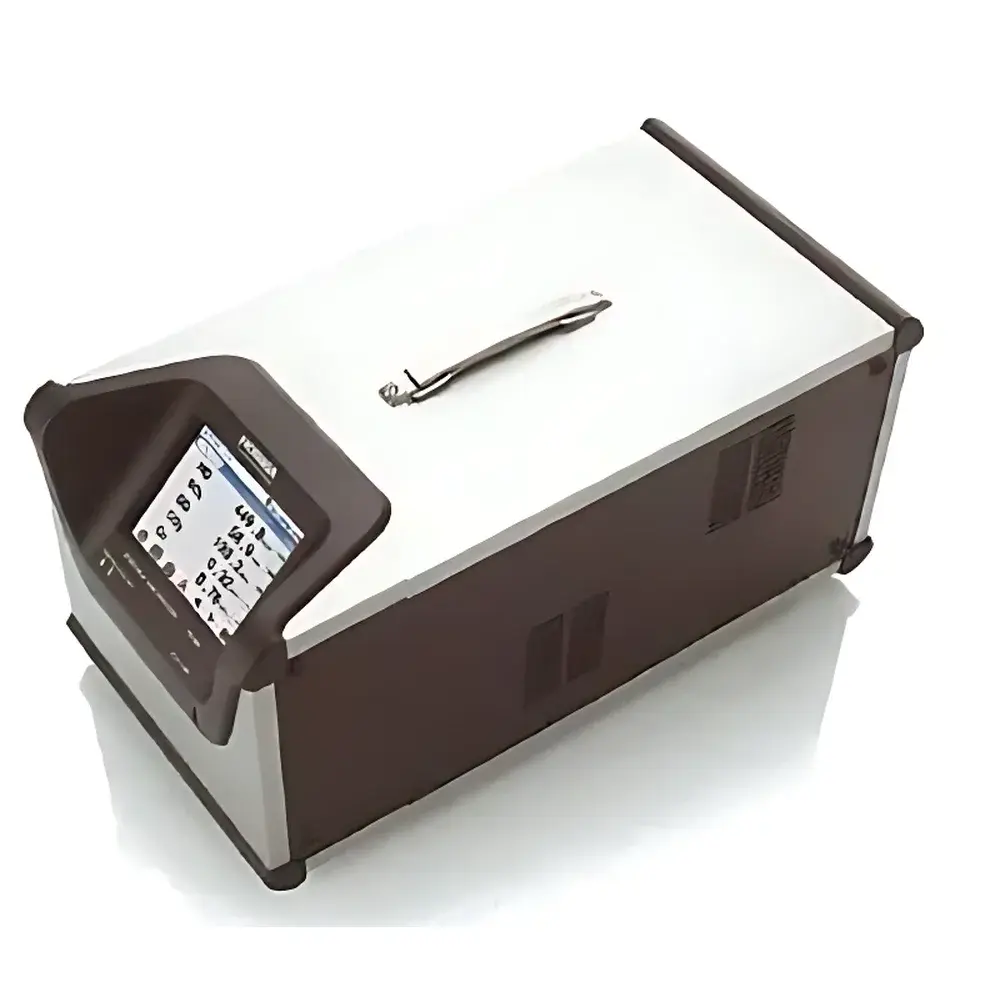
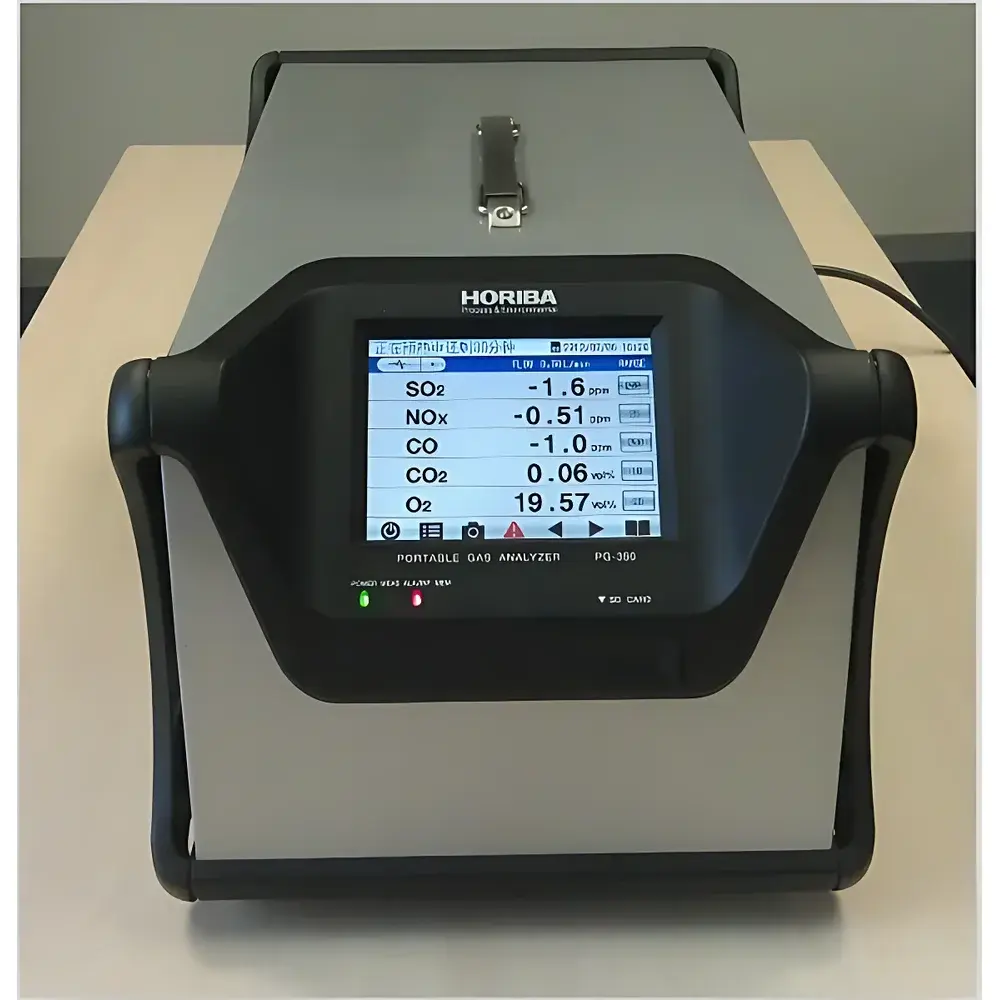
HORIBA PG-300 Series Portable Flue Gas Analyzer
| Brand | HORIBA |
|---|---|
| Origin | Japan |
| Model | PG-300 Series |
| Instrument Type | Portable Flue Gas Analyzer |
| Measurement Accuracy | ≤2.0% F.S. |
| Repeatability | ±1.0% F.S. |
| Response Time (T90) | ≤45 s (SO₂: ≤180 s) |
| Drift | ±1.0% F.S./day (SO₂: ±2.0% F.S./day) |
| Linearity | ±2.0% F.S. |
| Sample Flow Rate | ~0.5 L/min |
| Operating Temperature | 5–40 °C |
| Relative Humidity | ≤85% RH |
| Weight | ~14 kg |
| Dimensions | 226(W) × 265(H) × 510(D) mm |
| Power Supply | 100–120 VAC / 200–240 VAC, 50/60 Hz |
| Data Storage | SD card |
| Output Interfaces | 4–20 mA DC, Ethernet |
| Certified Standards | TÜV (EU), MCERTS (UK), GOST (Russia), ETV (US), China Metrology Certification, Korea KOLAS, Japan JIS/JCSS |
Overview
The HORIBA PG-300 Series Portable Flue Gas Analyzer is an engineered field-deployable solution for high-fidelity, multi-component flue gas measurement in compliance with international environmental monitoring standards. Designed for regulatory-grade accuracy and operational robustness, the PG-300 employs a combination of proven optical and electrochemical detection principles: alternating flow modulation chemiluminescence (AFM-CLD) for NOx; alternating flow modulation non-dispersive infrared (AFM-NDIR) for SO2, CO, and CH4; conventional non-dispersive infrared (NDIR) for CO2; and galvanic cell technology for O2. This hybrid sensor architecture ensures minimal cross-sensitivity, stable baseline performance, and trace-level detection capability across dynamic combustion environments — from industrial boiler stacks to mobile emissions testing platforms. Unlike benchtop analyzers requiring controlled lab conditions, the PG-300 delivers laboratory-equivalent precision (<2.0% F.S. accuracy) under real-world field constraints, including variable ambient temperature (5–40 °C), high humidity (≤85% RH), and mechanical vibration.
Key Features
- Modular multi-gas configuration supporting simultaneous quantification of NOx, SO2, CO, CO2, O2, and optionally CH4 — configurable per application requirements (e.g., PG-350: 5-channel; PG-337: 3-channel)
- Optimized thermal and mechanical design: 20% weight reduction vs. predecessor models (14 kg total); shock- and vibration-resistant chassis validated for transport and on-site deployment
- Intuitive 7-inch color TFT-LCD touchscreen with graphical trend display, step-by-step on-screen guidance, and contextual help menus — eliminating reliance on external documentation during field operation
- Integrated electronic condensate management: automatic/manual drainage and Peltier-cooled dew point control ensure consistent sample conditioning without external chillers or manual intervention
- Full-system calibration capability — including pre-analyzer sampling probe, heated line, and analyzer core — traceable to NIST-certified reference gases and aligned with ISO 12039, EN 15267, and US EPA Method 6C/7E protocols
- Preheat time reduced to 30 minutes; T90 response ≤45 s for most gases (SO2: ≤180 s), enabling rapid turnaround during sequential stack surveys
- Dual data output architecture: isolated 4–20 mA analog channels (per gas) plus Ethernet interface compliant with Modbus TCP and HTTP-based API for integration into SCADA, CEMS redundancy systems, or cloud-based QA/QC dashboards
Sample Compatibility & Compliance
The PG-300 is validated for direct sampling of hot, humid, and particulate-laden flue gases up to 200 °C (with optional high-temp probe). Its internal heated sampling path (maintained at >180 °C) prevents condensation-induced bias and sulfate deposition in SO2 measurement. All gas-specific optical paths are sealed and pressure-compensated to minimize drift under fluctuating stack backpressure. The instrument meets or exceeds certification requirements for regulatory enforcement use, including TÜV Rheinland Type Approval (EU Directive 2010/75/EU), MCERTS (UK Environment Agency), GOST R IEC 61508 (Russia), ETV verification (US EPA), China’s JJG 968–2019 metrological verification regulation, Korea’s KOLAS ILAC accreditation, and Japan’s JIS B 7982 and JCSS traceability framework. It supports GLP-compliant audit trails via timestamped SD card logging (user-configurable intervals) and full calibration history retention — essential for FDA 21 CFR Part 11–aligned quality systems.
Software & Data Management
Data acquisition and system diagnostics are managed through HORIBA’s proprietary PG-Manager software suite, compatible with Windows OS and accessible via Ethernet or USB. The software enables remote configuration of measurement parameters (e.g., range switching, alarm thresholds, auto-zero cycles), real-time visualization of concentration trends with overlay comparison against reference standards, and automated generation of PDF-formatted compliance reports per ISO 14064 or EN 14181 QA/QC requirements. All raw sensor outputs, calibration events, diagnostic flags (e.g., low flow, high dew point, optical misalignment), and user actions are logged with cryptographic timestamps to support forensic root-cause analysis. SD card exports include CSV-compatible datasets with metadata headers (gas name, unit, range, serial number, operator ID, GPS coordinates if equipped), facilitating third-party statistical process control (SPC) or machine learning–based emission anomaly detection.
Applications
- CEMS backup verification and periodic stack testing per EN 14181 QAL2/QAL3 protocols
- Combustion optimization studies in utility boilers, cement kilns, and waste-to-energy incinerators
- Catalyst efficiency evaluation in SCR/SNCR de-NOx and FGD desulfurization systems
- Mobile source emissions auditing for marine engines, locomotives, and heavy-duty diesel generators
- Fuel cell exhaust characterization (H2 crossover impact on O2/CO readings)
- Academic research in atmospheric chemistry, carbon capture pilot plants, and methane leakage detection in natural gas infrastructure
- Third-party environmental testing laboratories requiring accredited field instrumentation for ISO/IEC 17025 scope expansion
FAQ
What gas species can the PG-300 measure simultaneously?
The base configuration measures NOx, SO2, CO, CO2, and O2 concurrently. Methane (CH4) is available as an optional sixth channel.
Is the PG-300 suitable for high-moisture flue gas sampling?
Yes — its integrated Peltier-cooled condensate trap and heated sample line (180 °C) maintain sample integrity across dew points up to 90 °C, preventing water interference in IR absorption measurements.
How is calibration traceability maintained in the field?
The system supports full-path calibration using certified span gases; all calibrations are digitally signed, time-stamped, and stored on SD card with operator ID and gas certificate numbers — meeting ISO/IEC 17025 documentation requirements.
Does the PG-300 comply with US EPA Methods?
It satisfies performance criteria for EPA Methods 6C (SO2), 7E (NOx), 10 (O2), and 3A (CO2); formal Method 301 validation data packages are available upon request.
Can data be exported for integration into enterprise LIMS or cloud platforms?
Yes — via Ethernet using Modbus TCP or RESTful API; CSV exports from SD card include ISO 8601 timestamps, units, and metadata fields required for automated ingestion into LabVantage, Thermo Fisher SampleManager, or AWS IoT Core.
Related Products







