
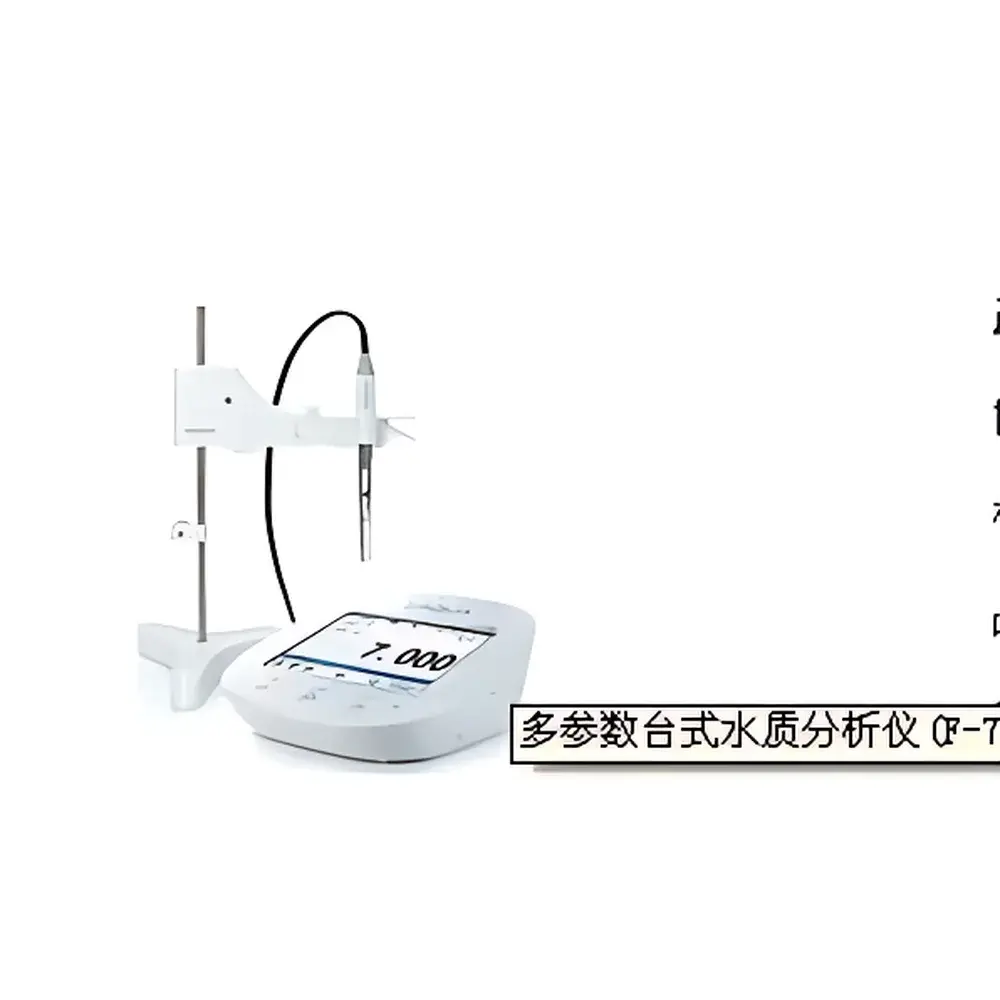
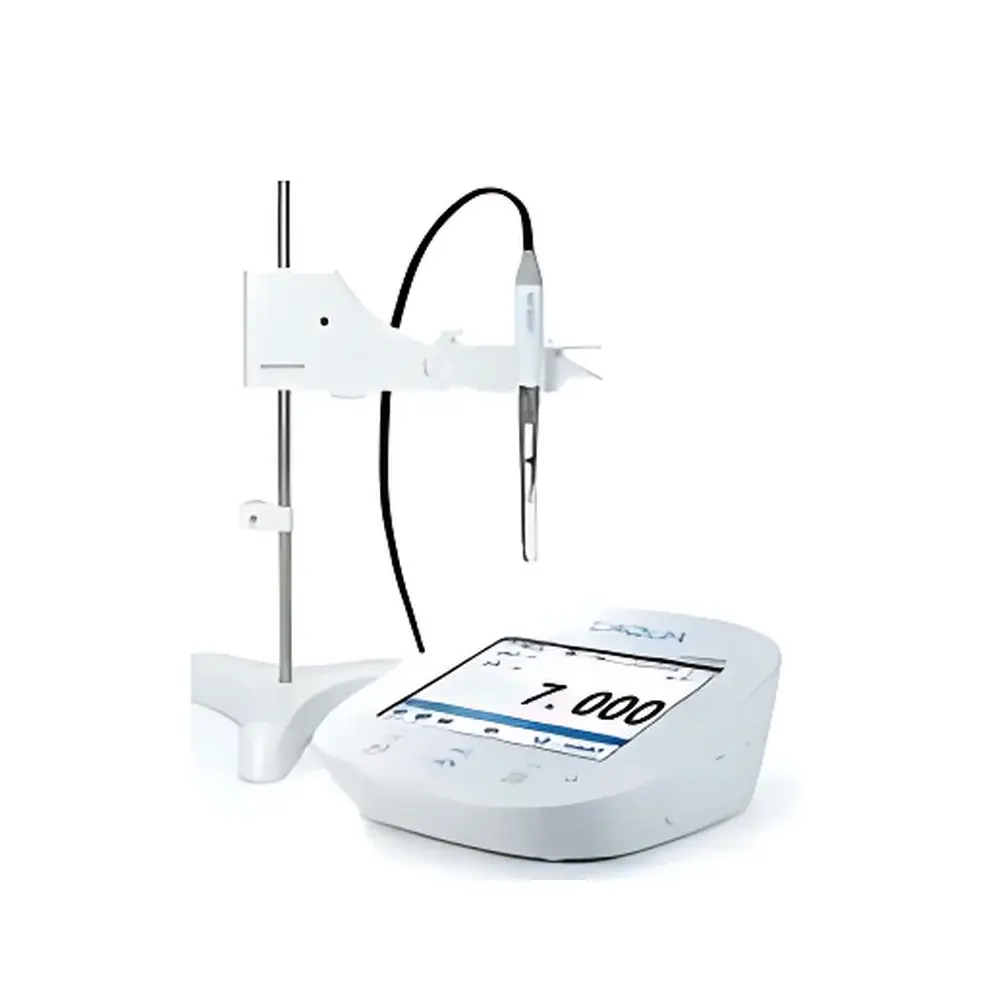
HORIBA F-70 Series Multi-Parameter Laboratory Water Quality Analyzer
| Brand | HORIBA |
|---|---|
| Origin | Japan |
| Model | F-70 Series |
| Instrument Type | Laboratory Water Quality Analyzer |
| Key Parameters | pH (0.000–14.000, resolution 0.001), ORP (±1999.9 mV, resolution 0.1 mV), Temperature (−30.0–130.0 °C, resolution 0.1 °C), Ion Concentration (0.00 µg/L–999 g/L), Conductivity (0.000 mS/m–199.9 S/m, 3 cell constants), Resistivity (0.000 Ω·m–1.999 MΩ·m), Salinity (0.00–80.00 ppt), TDS (0.01 mg/L–1000 g/L) |
| Compliance | JIS, USP <645>, EP 2.2.38, JP/CP Pharmacopoeial Standards |
| Data Storage | Up to 2000 measurements |
| Connectivity | USB host/device, GLP/GMP-compliant data export |
| Display | Capacitive touchscreen (F-74BW), multilingual UI (EN/JP/ZH/KO) |
Overview
The HORIBA F-70 Series is a modular, high-precision multi-parameter laboratory water quality analyzer engineered for rigorous compliance-driven environments—including pharmaceutical QC labs, environmental testing facilities, and university research centers. It employs standardized electrochemical measurement principles: pH and ORP are determined via glass and noble-metal reference electrodes following ISO 3696 and ASTM D1125; ion concentration is quantified using selective ion electrodes (e.g., fluoride, nitrate, ammonium) calibrated per ISE standard practice; conductivity, resistivity, salinity, and TDS are derived from dual-electrode AC conductometric measurement (IEC 60746-3), with automatic temperature compensation (ATC) referenced to 25 °C and configurable linear or non-linear compensation algorithms. The system’s architecture supports traceable metrology workflows by embedding real-time electrode diagnostics, calibration history logging, and full audit trails—critical for laboratories operating under FDA 21 CFR Part 11, EU Annex 11, and ISO/IEC 17025 requirements.
Key Features
- Modular channel configuration: F-71 (1-channel pH/ORP), F-72/F-73 (2-channel pH/ORP + ion/conductivity), F-74/F-74BW (dual-channel with full parameter support and capacitive touchscreen interface)
- Pharmacopoeia-compliant operation modes: Preconfigured templates for USP Purified Water & Water for Injection, EP 2.2.38, JP/CP Chapter 2.22, and JIS K 0107 validation protocols
- Intelligent guided diagnostics: On-screen step-by-step navigation for calibration verification, electrode conditioning, error troubleshooting, and maintenance scheduling
- GLP/GMP-ready data integrity: Automatic timestamping, user ID assignment, instrument/electrode ID logging, and tamper-evident measurement records
- Robust electrode ecosystem: Autoclavable and cleanable glass pH electrodes (e.g., 9615S-10D), platinum ORP sensors, and interchangeable conductivity cells (K = 0.1, 1.0, 10 cm⁻¹) with integrated temperature sensors
- Secure data handling: Local storage of up to 2000 measurements (F-72/F-73/F-74), USB mass storage export (CSV/Excel-compatible), and direct printing via RS-232 or USB thermal printers compliant with 21 CFR Part 11 electronic signature requirements
Sample Compatibility & Compliance
The F-70 Series accommodates aqueous samples across a broad physicochemical range—from ultrapure water (resistivity >18.2 MΩ·cm) to high-salinity brines (up to 80 ppt) and aggressive industrial effluents. All measurement modules meet the performance criteria defined in ISO 5667-3 (water sampling), ISO 7888 (conductivity), and ISO 10523 (pH). For regulated pharmaceutical applications, the F-74 and F-74BW models provide built-in validation support for USP conductivity acceptance limits (e.g., Stage 1–3 testing), automatic temperature correction per EP 2.2.38, and configurable alarm thresholds aligned with JP/CP water quality specifications. Electrode calibration certificates are traceable to NIST SRMs, and system suitability tests (SST) can be executed prior to each analytical run to confirm sensor responsiveness and signal stability.
Software & Data Management
Data acquisition and reporting are managed through HORIBA’s proprietary PC software (compatible with Windows 10/11), which enables secure import of measurement logs, generation of PDF reports with embedded metadata (operator, date/time, electrode IDs, calibration status), and batch export for LIMS integration. Each record includes raw sensor outputs, compensated values, uncertainty estimates, and pass/fail flags against user-defined specification limits. Audit trail functionality complies with ALCOA+ principles: attributable, legible, contemporaneous, original, accurate, complete, consistent, enduring, and available. USB device mode allows firmware updates and configuration backup without network dependency—ensuring air-gapped security in classified or validated lab environments.
Applications
- Pharmaceutical water system monitoring: Purified Water (PW), Water for Injection (WFI), and Clean Steam condensate testing per USP/EP/JP pharmacopoeias
- Environmental compliance: EPA Method 120.1 (pH), 121.1 (conductivity), and ISO 5667-22 (field/lab water sampling QA/QC)
- Academic and industrial research: Kinetic studies of ion exchange resins, membrane fouling assessment, and electrolyte behavior modeling
- Food & beverage QC: Conductivity-based total solids estimation, brine concentration control, and rinse water validation
- Calibration laboratory services: Reference standard verification, inter-laboratory comparison exercises, and proficiency testing sample analysis
FAQ
Does the F-70 Series support 21 CFR Part 11 compliance?
Yes—the F-74 and F-74BW models include electronic signature capability, audit trail logging, and role-based access control when used with HORIBA’s validated software suite and compatible peripherals (e.g., USB HID keyboards, biometric readers).
Can I use third-party conductivity cells with the F-70 instruments?
No—only HORIBA-certified conductivity cells (e.g., 3550-10D, 3551-10D) are supported to ensure correct cell constant recognition, ATC integration, and traceable calibration.
What is the maximum allowable sample temperature for continuous measurement?
The standard temperature probe (e.g., 9551-10D) operates continuously from −30 °C to 130 °C; however, prolonged exposure above 80 °C may affect pH electrode lifetime and requires use of high-temperature glass bodies (e.g., 9618S-10D).
How is measurement uncertainty calculated and reported?
Uncertainty is derived per GUM (JCGM 100:2008) using combined contributions from electrode repeatability, calibration standard uncertainty, temperature sensor drift, and instrument A/D resolution—displayed as ±X.XX% of reading in report footers.
Is firmware update capability available over USB?
Yes—firmware updates are distributed as signed binary packages and installed via USB device mode; all updates preserve existing calibration data and user configurations.
Related Products







