
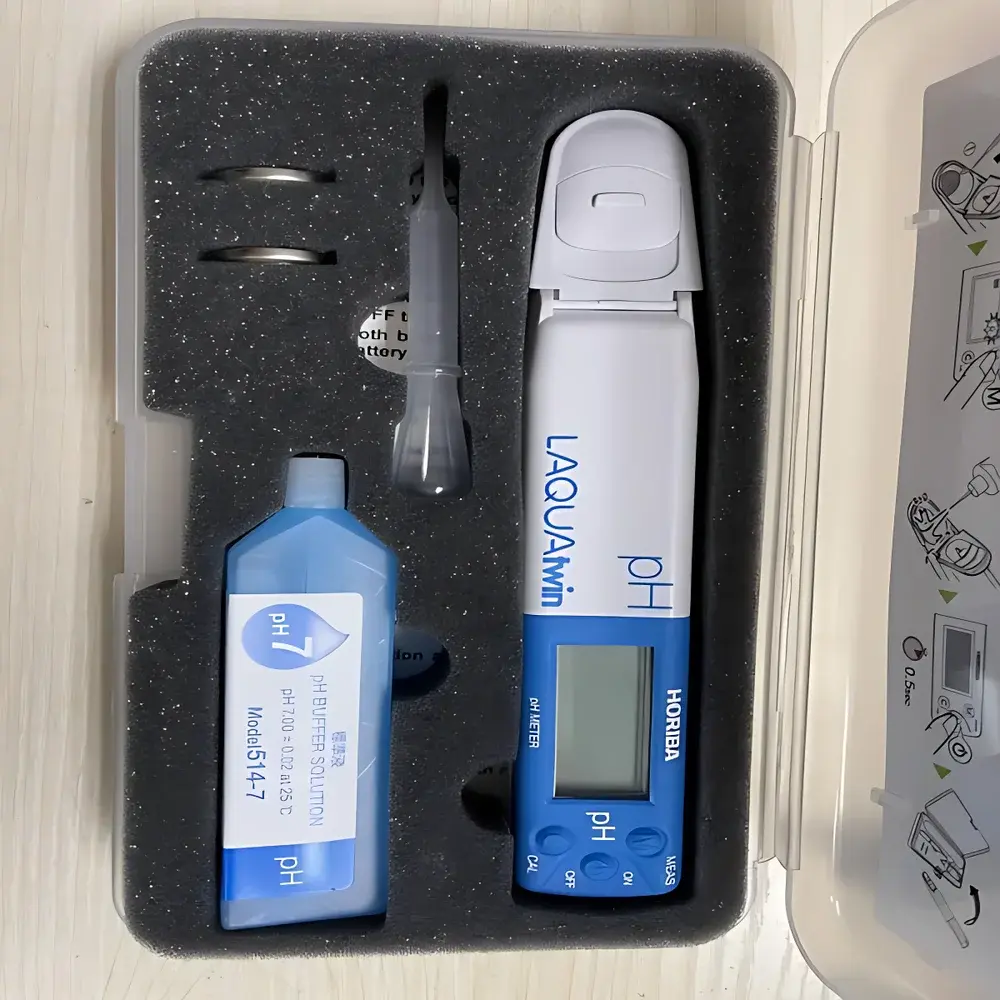
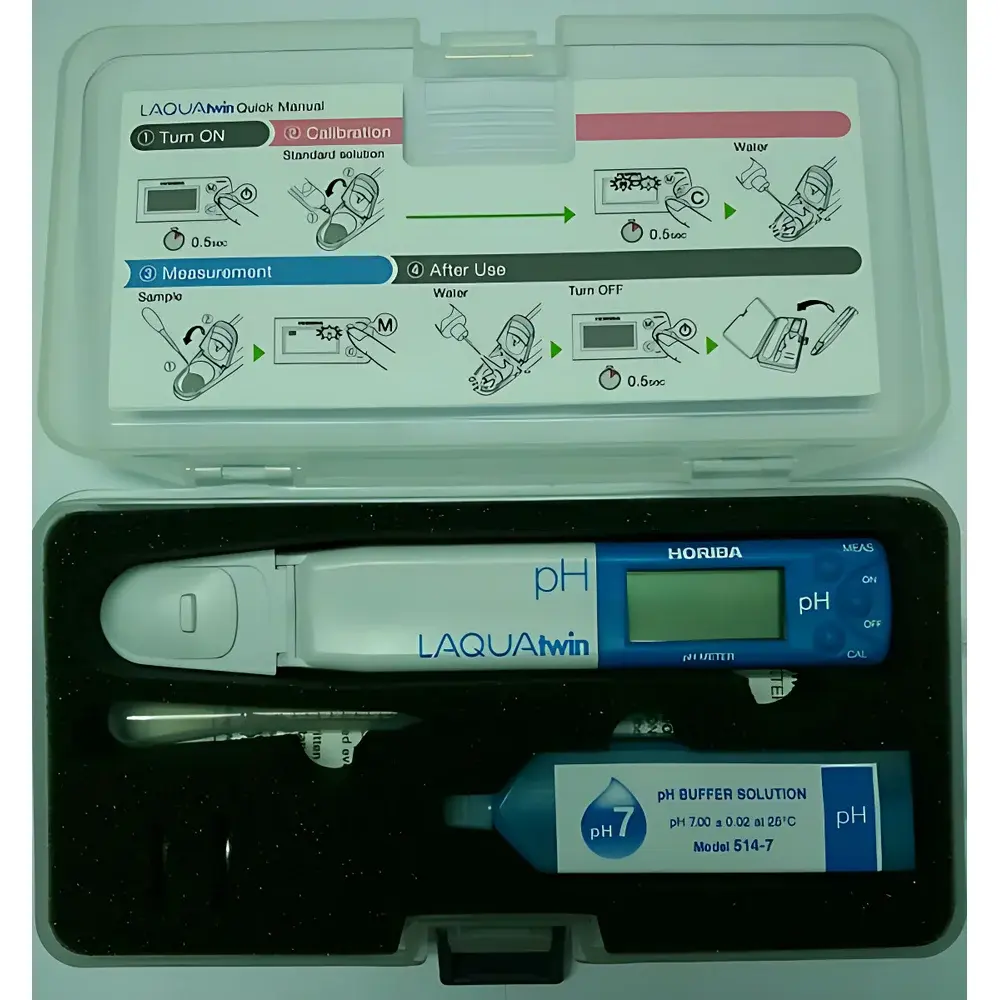
HORIBA PH11 Portable Pen-Style pH Meter
| Brand | HORIBA |
|---|---|
| Origin | Japan |
| Instrument Type | Pen-Style pH Meter |
| Parameter Type | Single-Parameter (pH) |
| Measurement Range | 0–14 pH |
| Resolution | ±0.01 pH |
| Accuracy | ±0.01 pH |
| Calibration Solutions | pH 4.01 and pH 7.00 standard buffers |
| Temperature Compensation | Automatic (ATC) |
| Electrode Type | Flat-Surface pH Sensor |
| Minimum Sample Volume | 100 µL |
Overview
The HORIBA PH11 is a compact, precision-engineered pen-style pH meter designed for field-deployable and benchtop spot-checking applications across environmental, agricultural, food safety, and quality control laboratories. It operates on the fundamental electrochemical principle of potentiometric measurement: the potential difference between a pH-sensitive glass membrane electrode and a stable reference electrode is converted into a logarithmic pH value via the Nernst equation (−59.16 mV/pH unit at 25 °C). Engineered for robustness and operational simplicity, the PH11 integrates a flat-surface pH sensor—optimized for direct contact with semi-solid matrices such as soil slurries, food surfaces, and gel-based samples—eliminating the need for sample dilution or filtration in many routine assays. Its micro-volume capability (as low as 100 µL) supports high-efficiency testing where sample conservation is critical, including aquaculture water profiling and small-batch product verification.
Key Features
- Flat-surface pH electrode architecture enabling reliable measurements on non-homogeneous, viscous, or surface-limited samples—including moist soil, cheese rinds, fruit skins, and agar plates.
- Integrated automatic temperature compensation (ATC) using a built-in thermistor, ensuring pH readings are corrected to 25 °C across the operational range (0–50 °C), minimizing thermal drift errors per ISO 7888 and ASTM D1293 requirements.
- High-precision analog-to-digital conversion with 0.01 pH resolution and ±0.01 pH accuracy (at 25 °C, calibrated with traceable NIST-traceable pH 4.01 and 7.00 buffer standards).
- Ergonomic, waterproof (IP67-rated) pen-form factor with one-hand operation, LCD backlight, and auto-power-off after 10 minutes of inactivity—ideal for glove-compatible use in production environments.
- No external probe cables or connectors; all electronics and sensing elements are fully encapsulated within the stainless-steel and ABS housing, reducing contamination risk and maintenance overhead.
Sample Compatibility & Compliance
The PH11 is validated for direct immersion or surface-contact measurement in aqueous solutions, buffered media, soil extracts (1:5 w/v), homogenized food pastes, and hydroponic nutrient reservoirs. Its flat electrode design conforms to IUPAC recommendations for non-standard sample geometries and avoids junction clogging commonly observed with conventional bulb-type electrodes. While not intended for continuous online monitoring, the device meets essential performance criteria outlined in ISO 10523 (water quality — determination of pH) and supports GLP-compliant documentation when used with calibrated buffers certified to ISO/IEC 17025-accredited reference material providers. All calibration and measurement data can be manually recorded in accordance with FDA 21 CFR Part 11 principles for audit-ready paper-based workflows.
Software & Data Management
The PH11 operates as a standalone instrument without proprietary software dependencies or Bluetooth connectivity. This architecture ensures deterministic response time (<2 seconds to stable reading), immunity to wireless interference, and full compatibility with regulated environments where IT infrastructure restrictions apply (e.g., cleanrooms, pharmaceutical QC labs). Users maintain full traceability through manual logbook entries referencing batch numbers of calibration buffers, ambient temperature, and operator ID—aligning with GMP Annex 11 and ISO/IEC 17025 documentation expectations. Optional accessories include a dedicated calibration stand, protective cap with integrated buffer wells, and NIST-traceable certificate kits for metrological validation.
Applications
- Aquaculture and wastewater treatment: Rapid pH verification of pond water, recirculating aquaculture systems (RAS), and effluent streams prior to discharge.
- Food and beverage QA/QC: Surface pH screening of dairy products (yogurt, cheese), fermented foods (kimchi, sauerkraut), and fresh produce to verify acidification endpoints and microbial stability.
- Agricultural extension services: On-site assessment of soil extract pH for lime requirement calculations and fertilizer optimization.
- Education and teaching labs: Low-cost, durable platform for introducing core electrochemical concepts—Nernst equation, liquid junction potential, and calibration protocol rigor—to undergraduate chemistry and environmental science students.
- Field-based environmental monitoring: Complementary tool for USGS-style stream surveys, wetland assessments, and EPA Region-specific water quality screening under Method 150.1.
FAQ
What calibration standards are required for daily use?
The PH11 requires two-point calibration using certified pH 4.01 and pH 7.00 standard buffer solutions at 25 °C. Buffers must be replaced every 24 hours if exposed to air or contamination.
Can the flat electrode be cleaned and regenerated?
Yes—the flat glass surface may be gently rinsed with deionized water and wiped with lint-free tissue; for protein or lipid fouling, soak in 0.1 M HCl for 2 minutes followed by thorough rinsing. Electrode lifetime exceeds 18 months under typical usage conditions.
Is the instrument compliant with ISO/IEC 17025 calibration requirements?
While the PH11 itself is not a certified reference instrument, its measurement uncertainty (±0.015 pH, k=2) is quantifiable using accredited buffer standards and documented calibration procedures—fully supporting laboratory accreditation under Clause 6.4 of ISO/IEC 17025:2017.
Does it support measurement in non-aqueous solvents?
No. The PH11 is validated exclusively for aqueous and aqueous-miscible media (e.g., ≤20% ethanol). Non-aqueous solvents disrupt the hydration layer of the glass membrane and invalidate Nernstian response.





