
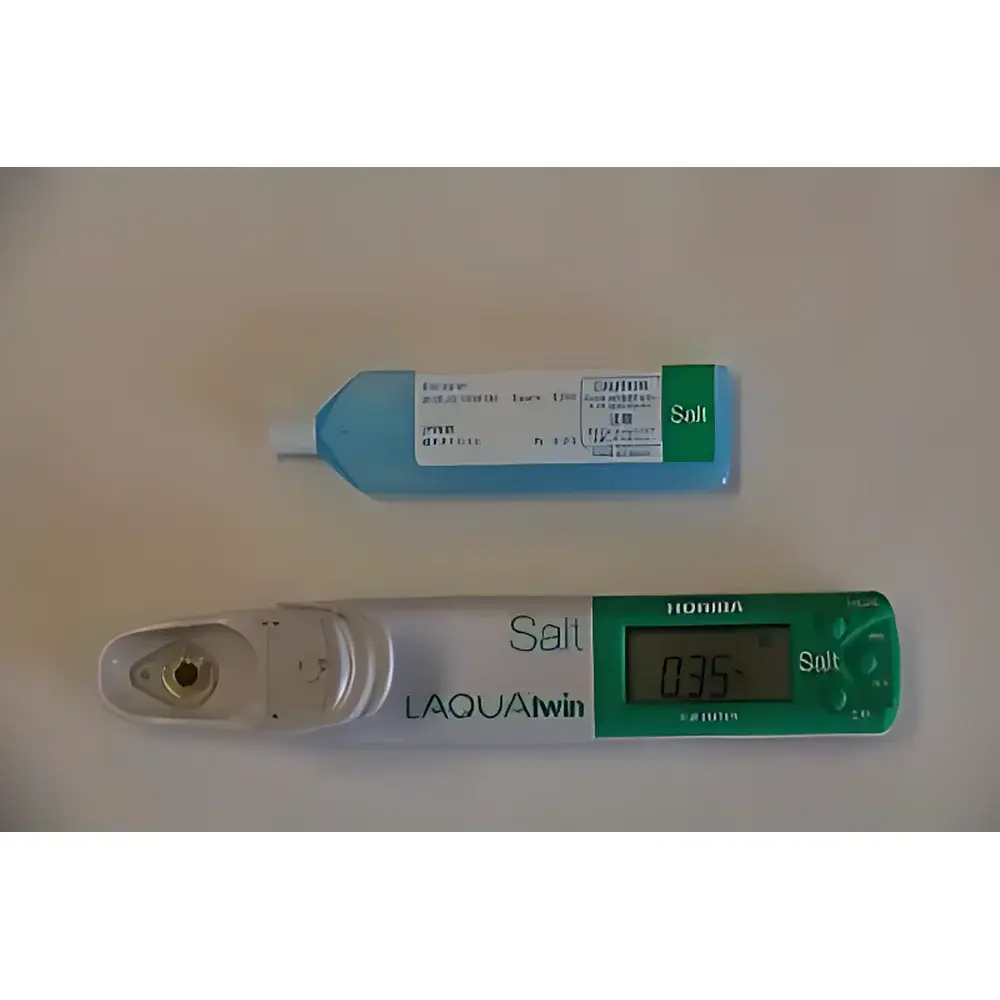
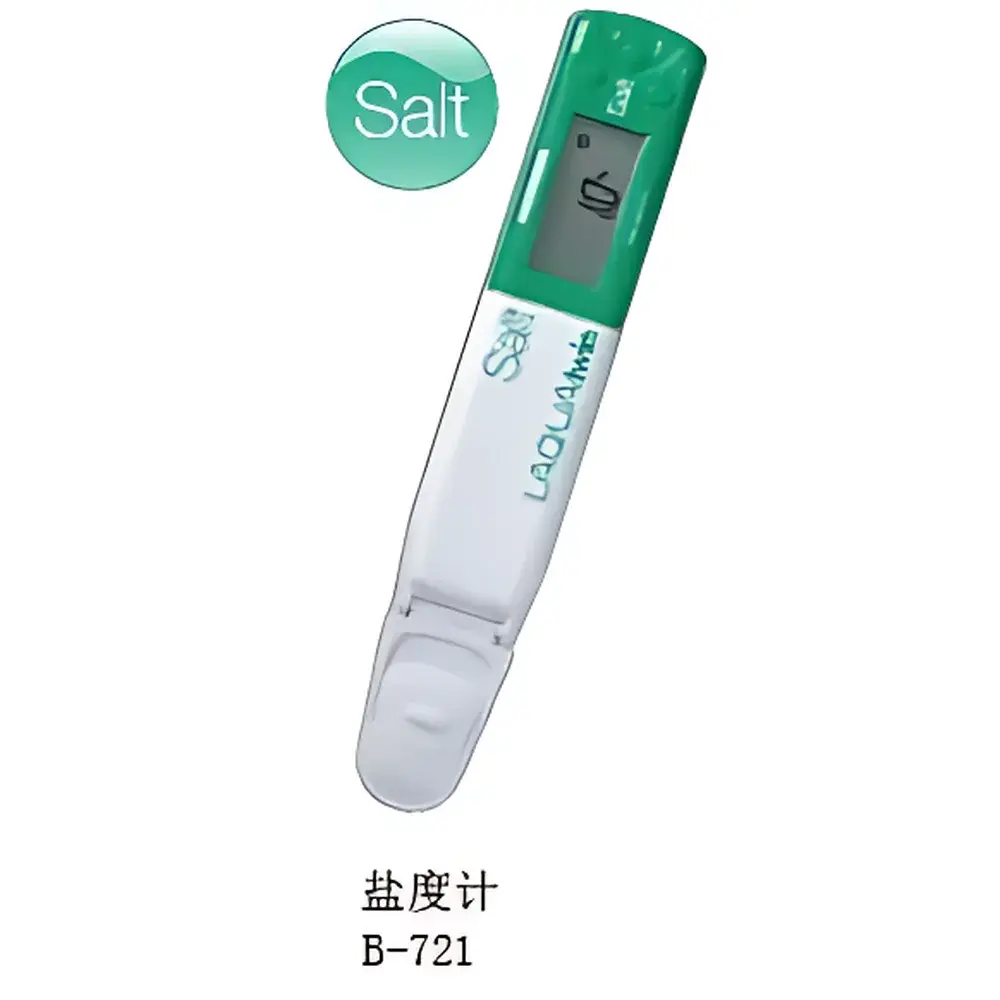
HORIBA B-721 Portable Salinity Meter (NaCl)
| Brand | HORIBA |
|---|---|
| Origin | Japan |
| Model | B-721 |
| Portability | Pen-type |
| Salinity Measurement Range | 0.1–10% (w/w NaCl) |
| Temperature Measurement Range | 5–40 °C |
| Accuracy | ±10% of reading |
| Minimum Resolution | 0.1% |
| Temperature Compensation | Automatic (2%/°C fixed coefficient) |
| IP Rating | IP67 |
| Power Supply | Two CR2032 batteries |
| Dimensions | 164 × 29 × 20 mm (excl. probe protrusion) |
| Weight | Approx. 50 g (instrument only, excl. batteries) |
Overview
The HORIBA B-721 is a compact, handheld salinity meter engineered for rapid, field-deployable quantification of sodium chloride (NaCl) concentration in aqueous solutions. Unlike optical or refractometric methods, the B-721 employs a dedicated ion-selective electrode (ISE) principle—specifically optimized for chloride and sodium ion activity—to deliver direct electrochemical measurement of salinity as mass percentage (0.1–10% w/w NaCl). Its pen-style form factor integrates a robust, replaceable sensor tip with built-in temperature sensing, enabling automatic temperature compensation based on a fixed 2%/°C coefficient—a design aligned with ASTM D1125 and ISO 7888 standards for conductivity-derived salinity estimation where direct ISE calibration is applied. The device operates without external power sources or connectivity, making it suitable for routine checks in food processing lines, aquaculture monitoring, desalination pre-screening, and environmental field sampling where portability, speed, and ruggedness are critical.
Key Features
- Pen-type ergonomic design with IP67-rated housing—fully protected against dust ingress and immersion in water up to 1 m for 30 minutes.
- Ion-selective electrode (ISE) sensor optimized for NaCl-specific response, minimizing cross-sensitivity to K⁺, Ca²⁺, or NO₃⁻ under typical use conditions.
- Automatic temperature compensation (ATC) using integrated thermistor; compensation algorithm adheres to industry-standard linear correction per ISO 5725-2 for reproducibility across 5–40 °C ambient range.
- Auto-hold function freezes stable readings after signal stabilization, reducing operator variability during manual sampling.
- Two-point calibration protocol using certified NaCl standard solutions (e.g., 1.0% and 5.0% w/w), supporting traceable verification per GLP documentation requirements.
- Low-power operation powered by two CR2032 coin cells—typical battery life exceeds 5,000 measurements under normal usage.
- Compact footprint (164 × 29 × 20 mm) and lightweight construction (~50 g instrument-only) enable one-handed operation and storage in lab coat pockets or field kits.
Sample Compatibility & Compliance
The B-721 is validated for use with clear, low-turbidity aqueous samples including seawater dilutions, brine solutions, food brines, hydroponic nutrient reservoirs, and freshwater effluent streams. It is not intended for highly viscous, suspended-solid-laden, or strongly oxidizing media (e.g., chlorine concentrations >5 ppm), which may foul the ISE surface or induce drift. Calibration and measurement protocols comply with fundamental principles outlined in USP for ionic impurity screening and ISO 15197 for point-of-care electrochemical device performance expectations. While not FDA 510(k)-cleared as a medical device, its metrological traceability supports internal quality control applications under ISO/IEC 17025-accredited laboratories when used with documented calibration records and environmental controls (RH <85%, non-condensing).
Software & Data Management
The B-721 is a standalone, microprocessor-controlled instrument with no onboard data logging, Bluetooth, or USB interface. All measurements are displayed in real time on a high-contrast LCD screen with 0.1% resolution. For regulated environments requiring audit trails, users must manually record results—including date/time, sample ID, calibration status, and operator initials—in bound logbooks or LIMS-integrated spreadsheets. The absence of electronic data storage ensures compliance with facilities restricting wireless transmission or unsecured memory devices. Calibration history, however, can be maintained externally using HORIBA’s optional calibration certificate templates, aligning with GMP Annex 11 and 21 CFR Part 11 “paper-based” equivalence provisions for non-automated systems.
Applications
- Quality assurance in seafood processing: verification of curing brine concentration prior to immersion.
- Aquaculture management: spot-checking salinity stability in hatchery tanks and recirculating aquaculture systems (RAS).
- Food & beverage R&D: formulation validation of table salt content in sauces, pickles, and ready-to-eat meals.
- Environmental field surveys: preliminary assessment of estuarine mixing zones or groundwater intrusion indicators.
- Educational labs: hands-on instruction in electrochemical sensing principles, calibration theory, and measurement uncertainty fundamentals.
- Desalination plant pre-screening: rapid rejection of feedwater batches exceeding target salinity thresholds before membrane exposure.
FAQ
What measurement principle does the B-721 use?
It uses a chloride/sodium ion-selective electrode (ISE) configured for direct potentiometric detection of NaCl activity, converted to % w/w via factory-calibrated slope and offset.
Is the B-721 compliant with ISO or ASTM standards?
Its operational methodology aligns with core principles in ISO 7888 (electrical conductivity-based salinity) and ASTM D1125 (standard test methods for electrical conductivity of water), though it is not formally certified to either standard.
Can the sensor be cleaned or regenerated if contaminated?
Yes—the removable ISE tip may be gently rinsed with deionized water and wiped with lint-free tissue; prolonged exposure to proteins or oils requires soaking in 0.1 M HNO₃ for 5 minutes followed by thorough rinsing.
Does the B-721 require annual recalibration by an accredited lab?
No—user-performed two-point calibration before each measurement session satisfies routine accuracy requirements; formal recalibration is recommended only after physical damage or sustained deviation beyond ±10% of reference standard values.
Is temperature compensation adjustable or fixed?
Fixed at 2%/°C, consistent with typical NaCl solution behavior near ambient conditions and compatible with most industrial salinity reference tables.
Related Products





