
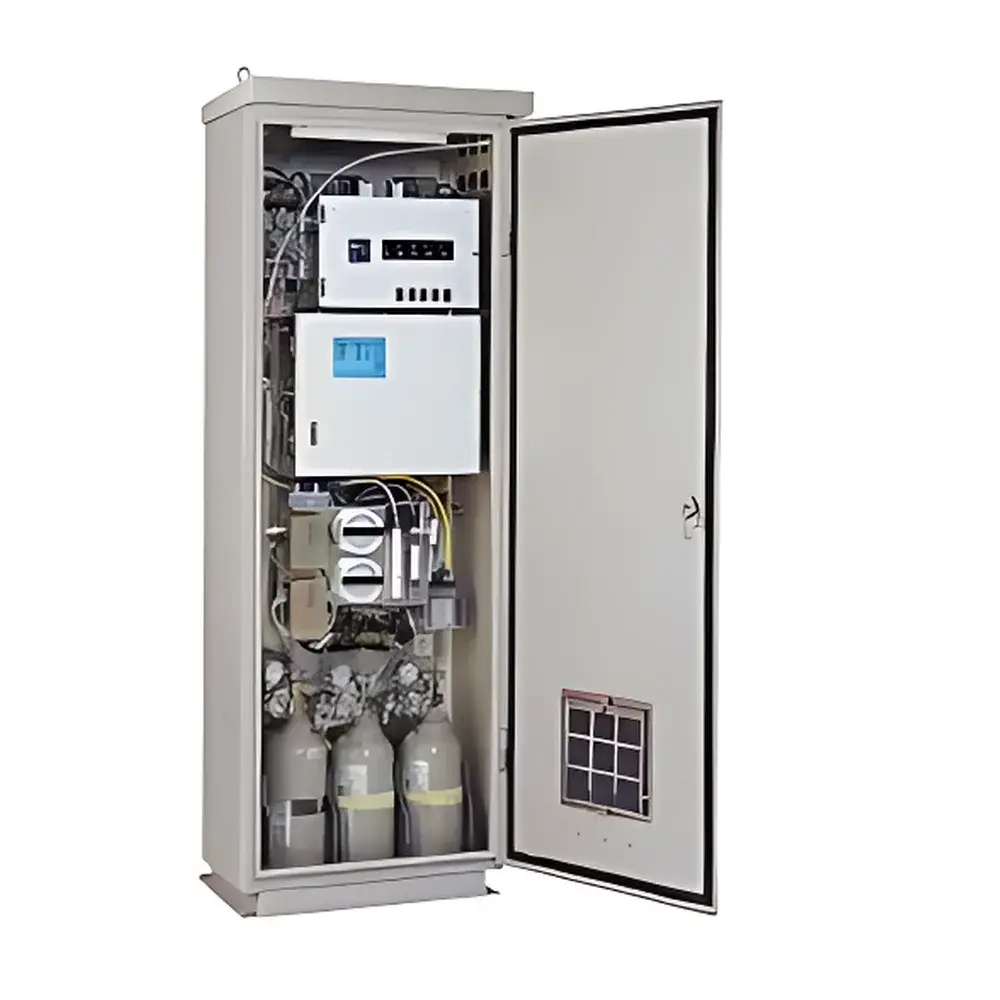
HORIBA ENDA-600ZG Online Multi-Component Flue Gas Analyzer
| Brand | HORIBA |
|---|---|
| Origin | Japan |
| Model | ENDA-600ZG Series |
| Instrument Type | In-situ Continuous Emission Monitoring System (CEMS) |
| Measured Gases | NOx, SO₂, CO, CO₂, O₂ |
| Minimum Range | 50 ppm |
| Repeatability | ±0.5% F.S. |
| Response Time (SO₂) | 60–240 s (T₉₀) |
| Zero Drift | ±1.0% F.S. |
| Span Drift | ±2.0% F.S./week |
| Linearity Error | ±1.0% F.S. |
Overview
The HORIBA ENDA-600ZG is a compact, high-stability online flue gas analyzer engineered for continuous, simultaneous measurement of up to five critical combustion-related gases—NOx, SO2, CO, CO2, and O2—in industrial stack emissions. Designed for compliance with global regulatory frameworks including EU Directive 2010/75/EU (IED), U.S. EPA Performance Specification 2 (PS-2), and China’s HJ 75–2017 and HJ 76–2017 standards, the ENDA-600ZG integrates dual physical detection principles: alternating-flow non-dispersive infrared (NDIR) spectroscopy for NOx, SO2, CO, and CO2, and magnetic pressure (paramagnetic) detection for O2. This hybrid architecture eliminates reliance on carrier gases for oxygen analysis and avoids optical alignment drift—key failure modes in conventional dual-beam NDIR systems. The analyzer operates on a 1-second alternating cycle between sample and reference gas streams, ensuring intrinsic zero-point stability and self-cleaning of the optical cell through periodic gas exchange. Its design reflects over three decades of HORIBA’s field-proven expertise in CEMS deployment, with more than 100,000 units installed worldwide across diverse thermal processes.
Key Features
- Single-analyzer, five-gas capability: Simultaneous real-time quantification of NOx, SO2, CO, CO2, and O2 without external gas switching manifolds or multi-analyzer integration.
- Drift-free NDIR architecture: Alternating-flow modulation eliminates need for mechanical optical recalibration; zero drift remains within ±1.0% F.S. over 24 hours.
- Paramagnetic O2 detection: No nitrogen or synthetic air supply required—ambient air serves as reference gas, reducing consumables and operational cost.
- Integrated interference compensation: Dedicated H2O and CO2 correction sensors mitigate cross-sensitivity in NOx and SO2 channels; proprietary interference filter optics suppress spectral overlap effects.
- Compact footprint: Overall analyzer volume reduced by 50% versus prior-generation ENDA platforms; dimensions optimized for retrofit installations where space is constrained.
- Accelerated dry calibration: SO2 span calibration completed in ≤3 minutes using certified dry standard gas—contrasted with 15-minute wet-gas procedures in legacy models.
- Front-access maintenance: All service operations—including filter replacement, calibration valve actuation, and sensor inspection—are performed from the instrument’s front panel.
Sample Compatibility & Compliance
The ENDA-600ZG is deployed with application-specific sampling systems validated for harsh flue gas matrices. For waste incineration, integrated Cl2 scrubbers and triple-stage thermoelectric coolers (primary + dual secondary) minimize SO2/NO2 loss due to aqueous absorption while achieving T90 ≤ 90 s (SO2-free) or ≤ 240 s (SO2-present). In coal-fired power plants, optional NH3 removal modules prevent sulfamic acid formation during SO2 analysis. High-dust environments (e.g., sintering plants, cement kilns) utilize wall-mounted auto-blowback controllers (350 × 550 × 180 mm), downsized by 23% versus previous designs. All sampling trains comply with ISO 12039, EN 15267-3, and ASTM D6522 for particulate-laden, humid, and corrosive gas streams. The system supports GLP/GMP audit trails when paired with optional data acquisition software compliant with FDA 21 CFR Part 11.
Software & Data Management
The ENDA-600ZG features an embedded 10.1-inch capacitive touchscreen interface with intuitive navigation for configuration, diagnostics, and historical review. Real-time display shows all five gas concentrations simultaneously, alongside O2-corrected values (e.g., NOx @ 6% O2), 1-hour rolling averages, and alarm status. Calibration logs, zero/span events, and maintenance timestamps are stored onboard for ≥12 months. Up to 12 analog outputs (4–20 mA) support transmission of instantaneous, corrected, or averaged signals to DCS/SCADA systems. Optional HORIBA CEMS Manager software enables remote monitoring, automated report generation (PDF/CSV), and secure user-role management aligned with IEC 62443-3-3 cybersecurity requirements.
Applications
The ENDA-600ZG is qualified for continuous emission monitoring in regulated thermal processes requiring Tier 1 or Tier 2 CEMS certification. Proven deployments include:
- Coal- and gas-fired power stations (NOx/SO2 compliance per MATS or LCPD)
- Municipal solid waste and hazardous waste incinerators (Cl2/HCl co-monitoring readiness)
- Steelmaking facilities (sinter plants, blast furnaces, coke ovens)
- Glass melting furnaces (high-temperature, alkali-rich gas streams)
- Sulfuric acid production plants (SO2 conversion efficiency tracking)
- Industrial steam boilers and cogeneration units (combustion optimization & carbon accounting)
Its modular sampling architecture allows customization for dew point control, acid gas removal, and particulate pre-filtration—ensuring representative, artifact-free gas conditioning per EN 14181 QA/QC protocols.
FAQ
What detection principles does the ENDA-600ZG use for each gas?
NOx, SO2, CO, and CO2 are measured via alternating-flow non-dispersive infrared (NDIR); O2 is determined using paramagnetic (magnetic pressure) detection.
Is carrier gas required for O2 measurement?
No—ambient air serves as the reference gas for the paramagnetic O2 sensor, eliminating the need for bottled N2 or synthetic air supplies.
How often does the system require calibration?
Automatic zero and span calibration is scheduled every 7 days; manual dry-gas calibration for SO2 takes ≤3 minutes and may be performed on-demand.
Can the ENDA-600ZG meet U.S. EPA PS-2 requirements?
Yes—the analyzer and its associated sampling system are designed to satisfy PS-2 accuracy, drift, and response time criteria when installed and maintained per manufacturer specifications.
What is the maximum allowable dust loading for the sampling probe?
With optional auto-blowback controller and heated probe, the system handles particulate concentrations up to 10 g/Nm³ in accordance with EN 15267-3 test protocols.
Related Products







