
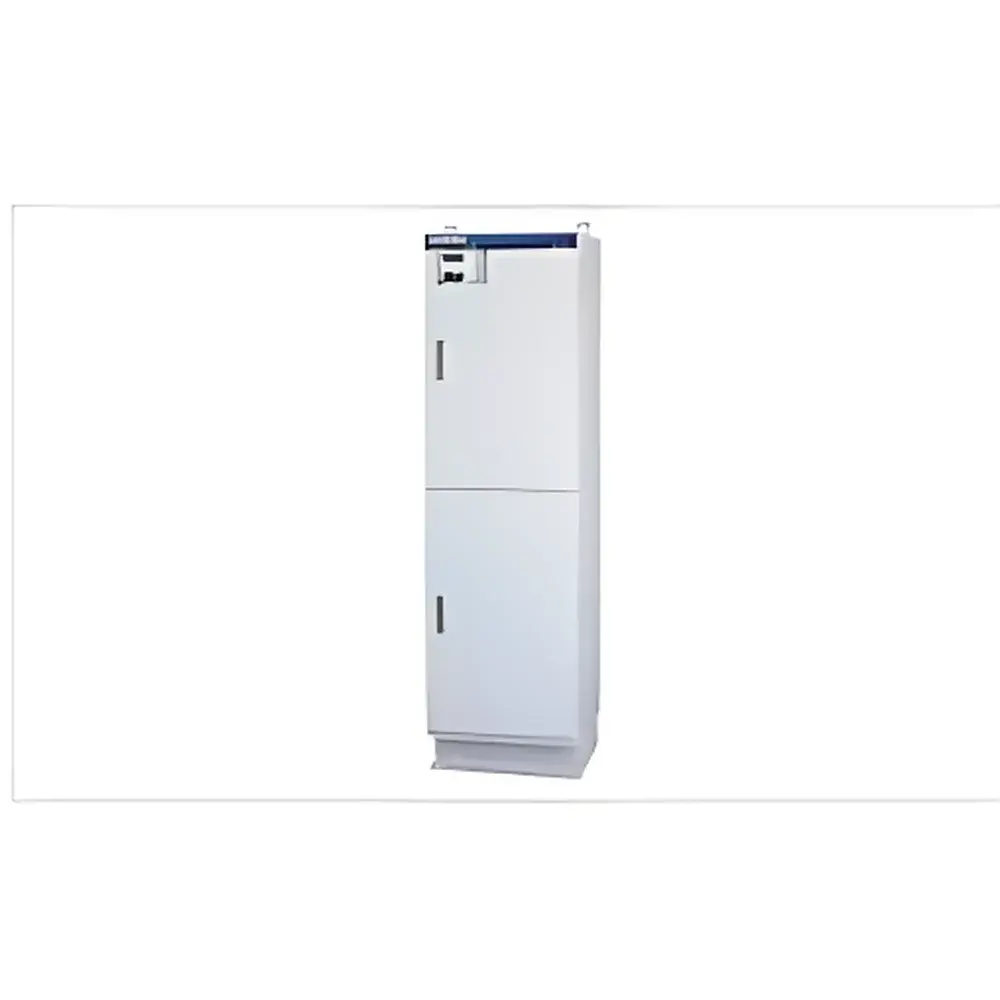
HORIBA TPNA-300 Automated Total Nitrogen and Total Phosphorus Analyzer
| Brand | HORIBA |
|---|---|
| Origin | Japan |
| Model | TPNA-300 |
| Measurement Principle | Alkaline persulfate/UV oxidation followed by UV spectrophotometry (TN) |
| Detection Range (Standard) | TN: 0–2 mgN/L, TP: 0–0.5 mgP/L |
| Detection Range (1-Stage Dilution) | TN: 0–5/10/20/50 mgN/L, TP: 0–1/2/5/10 mgP/L |
| Detection Range (2-Stage Dilution) | TN: 0–100/200/500/1000 mgN/L, TP: 0–20/50/100/250 mgP/L |
| Repeatability | ±3% FS (standard & 1-stage), ±5% FS (2-stage) |
| Sample Temp. | 2–40 °C |
| Flow Rate | 0.5–5 L/min |
| Analysis Time | 60 min per cycle |
| Analog Outputs | DC 4–20 mA or 0–16 mA (concentration & load), configurable per measurement point |
| Digital I/O | Relay inputs/outputs for flow status, calibration trigger, alarm conditions, and maintenance signals |
| Communication | RS-232C |
| Power Supply | AC 100 V ±10 V, 50/60 Hz, ≤400 VA |
| Dimensions | 460 × 380 × 1500 mm (W×D×H) |
| Weight | ~80 kg |
| Enclosure Color | Munsell 5PB8/1 |
| Ambient Operating Conditions | 2–40 °C, ≤85% RH (non-condensing), indoor installation with adequate ventilation, no direct sunlight |
Overview
The HORIBA TPNA-300 is a fully automated, on-line water quality analyzer engineered for simultaneous, sequential quantification of total nitrogen (TN) and total phosphorus (TP) in municipal wastewater effluents, surface waters, and industrial discharge streams. It implements two standardized oxidative digestion protocols—alkaline potassium persulfate coupled with ultraviolet (UV) irradiation for TN, and acidic potassium persulfate/UV oxidation for TP—followed by highly selective photometric detection. Unlike high-pressure autoclave-based systems, the TPNA-300 operates under ambient pressure and at temperatures below 100 °C, significantly reducing mechanical stress on reagent delivery components and minimizing routine maintenance intervals. Its design complies with core principles of continuous emission monitoring (CEM) and supports regulatory reporting under national water quality management frameworks requiring mass-based pollutant load estimation. The system maintains traceability to conventional manual laboratory methods (e.g., APHA Standard Methods 4500-N and 4500-P) through built-in conversion algorithms, ensuring longitudinal data consistency across manual and automated datasets.
Key Features
- Integrated TN/TP Dual-Channel Analysis: Single-instrument architecture performs both TN and TP measurements within one 60-minute analytical cycle, eliminating cross-contamination risks associated with shared digestion vessels in sequential analyzers.
- Seawater-Compatible Oxidation Chemistry: Patented seawater compensation algorithm (Patent No. 3093633) corrects for chloride interference during UV oxidation and colorimetric detection—enabling reliable operation in estuarine, coastal, or brackish influent applications without sample pretreatment.
- Real-Time Pollutant Load Calculation: Accepts analog flow signal input (4–20 mA) to compute instantaneous and cumulative mass loading (gN/h, gP/h), supporting compliance with total maximum daily load (TMDL) and discharge permit requirements.
- Autonomous Operational Integrity: Features include automatic zero-point correction before each analysis, programmable multi-interval calibration scheduling, onboard diagnostic logging with printed fault reports, and relay-triggered alerts for critical events (e.g., sample interruption, reagent depletion, blank water exhaustion).
- Flexible Range Configuration: Supports standard, one-stage, and two-stage dilution modes—allowing dynamic adaptation to variable concentration profiles across seasonal or process-driven fluctuations without hardware modification.
- Regulatory-Ready Data Handling: Internal memory retains up to two months of timestamped results (concentration, load, QC flags); all stored values are immutable and time-stamped to support audit trails required under GLP and ISO/IEC 17025 environments.
Sample Compatibility & Compliance
The TPNA-300 accepts raw or clarified liquid samples within a temperature range of 2–40 °C and flow rates of 0.5–5 L/min via gravity-fed overflow channels. It accommodates turbid, saline, and organically complex matrices—including seawater-influenced wastewater—when equipped with the optional seawater compensation module. The analyzer meets the functional requirements of JIS K 0102 (Japanese Industrial Standards for water analysis), aligns with methodology referenced in ISO 11908 (water quality — determination of total nitrogen), and supports validation against US EPA Method 351.2 (TN) and 365.4 (TP). Its analog and digital I/O architecture enables integration into SCADA systems compliant with IEC 61131-3 and Modbus RTU (via optional converter). All firmware operations retain full audit trail capability, satisfying documentation expectations under ISO 9001 and ISO 14001 environmental management systems.
Software & Data Management
No embedded GUI or proprietary software is required for basic operation—the TPNA-300 functions as a standalone instrument with front-panel controls and LED status indicators. All configuration parameters (calibration schedules, dilution factors, alarm thresholds, flow scaling coefficients) are set via DIP switches and menu-driven keypads. Raw and processed data—including measured absorbance, calculated concentrations, load outputs, and diagnostic codes—are transmitted via RS-232C serial interface using ASCII protocol (baud rate: 9600, 8N1). Output formats are compatible with third-party historian platforms (e.g., OSIsoft PI, Ignition SCADA) and Excel-compatible CSV ingestion. Internal non-volatile memory logs every analysis event with UTC timestamps, operator ID (if assigned), and QC pass/fail flags—ensuring full traceability for regulatory submissions and internal QA reviews. Data export does not require administrative privileges or proprietary drivers.
Applications
- Municipal wastewater treatment plant (WWTP) effluent monitoring for discharge compliance and nutrient removal efficiency assessment
- Industrial pretreatment facilities subject to NPDES or equivalent permits requiring TN/TP mass balance reporting
- Surface water quality surveillance networks tracking eutrophication drivers in lakes, rivers, and estuaries
- Research-grade long-term ecological monitoring where continuity with legacy manual datasets is essential
- Process control in advanced tertiary treatment systems employing denitrification and phosphorus precipitation
- Validation of membrane bioreactor (MBR) or moving bed biofilm reactor (MBBR) performance under variable hydraulic loads
FAQ
Does the TPNA-300 require high-pressure digestion vessels or steam generators?
No. It uses low-temperature (<100 °C), ambient-pressure UV/persulfate oxidation—eliminating autoclave components and associated safety certifications.
Can it operate unattended for extended periods?
Yes. With scheduled calibration, 50-L monthly blank water supply, and standard reagent kits, typical maintenance intervals exceed 30 days.
Is method validation data available for regulatory submission?
HORIBA provides application notes demonstrating correlation with APHA 4500-N and 4500-P, including precision (±3% RSD), spike recovery (92–105%), and inter-laboratory comparison reports.
What flow meter types are compatible with its analog input?
Any 4–20 mA output electromagnetic, ultrasonic, or magnetic flowmeter meeting NEMA 4X enclosure rating and calibrated per ISO 4064.
Is remote firmware update supported?
Firmware updates require physical access and use of HORIBA’s certified service tool; no over-the-air or web-based update capability is implemented for security and regulatory integrity.
Related Products







