
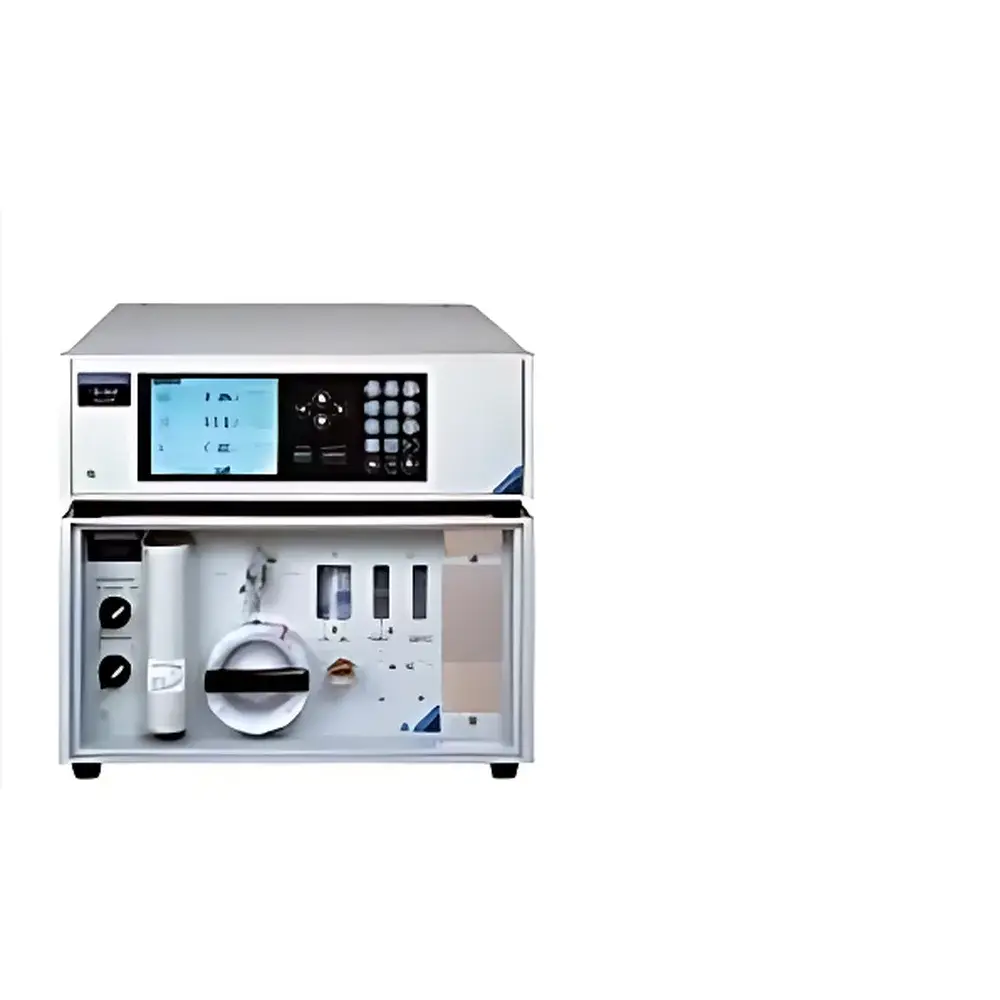
HORIBA VA-3000/VS-3000 Series NDIR & CLA Multi-Gas In-Situ Analyzer
| Brand | HORIBA |
|---|---|
| Origin | Japan |
| Model | VA-3000 / VS-3000 |
| Instrument Type | In-Line |
| Detection Principle | NDIR (CO, CO₂, CH₄, N₂O, SO₂), CLA (NOₓ), MPA / Electrochemical / Zirconia (O₂) |
| Minimum Detectable Range | 1–5 ppm (CH₄) |
| Repeatability | ±0.5% of Full Scale |
| Resolution | 0.01 ppm |
| Response Time | T90 ≤ 30 s |
| Zero Drift | ±2.0% of Full Scale per Week |
| Warm-up Time | 20–60 min (varies by sensor type) |
| Analog Output | DC 0–1 V / 4–20 mA (optional) |
| Communication Interface | RS-232C |
| Sample Flow Rate | ~0.5 L/min |
| Operating Environment | 0–40 °C, RH ≤ 90% non-condensing |
| Power Supply | AC 100–120 V or 200–240 V, 50/60 Hz |
| Dimensions (VA-3000) | 430 mm (W) × 132 mm (H) × 550 mm (D) |
| Weight (VA-3000) | ~20 kg |
| Compliance | Designed for ISO 14001-aligned monitoring, compatible with EPA Method 6C, EN 15267-certified configurations (per sensor module selection), supports GLP/GMP data integrity via timestamped analog output and serial logging |
Overview
The HORIBA VA-3000/VS-3000 Series is a modular, in-line multi-gas analyzer engineered for continuous, high-fidelity measurement of trace and percent-level gaseous species in environmental, industrial emission, and energy research applications. Utilizing non-dispersive infrared (NDIR) spectroscopy for CO, CO₂, CH₄, N₂O, and SO₂; chemiluminescence analysis (CLA) for NOₓ; and magnetic pressure (MPA), electrochemical, or zirconia-based detection for O₂, the system delivers analyte-specific selectivity and metrological stability under real-world process conditions. Its architecture centers on interchangeable sensor modules—up to three housed within a single 19-inch rack-mount VA-3000 analyzer unit—enabling flexible configuration without hardware duplication. The design addresses evolving regulatory and operational demands, including low-concentration methane leak detection (1–5 ppm), high-dynamic-range combustion gas profiling (up to 100 vol% CO₂), and simultaneous NOₓ/SO₂ compliance monitoring in flue gas streams. All optical and electrochemical sensing elements are factory-calibrated and thermally stabilized to ensure minimal thermal drift during extended unattended operation.
Key Features
- Modular sensor architecture: Supports up to three independent detection modules (NDIR, CLA, MPA, electrochemical, or zirconia) in one VA-3000 chassis for multi-component analysis without external multiplexing.
- Wide dynamic range capability: NDIR channels offer up to 20× span ratio (optional); CLA provides 100× span ratio across eight programmable ranges—enabling seamless transition from ambient air quality (ppm) to stack emission (vol%) monitoring.
- High metrological performance: Repeatability ±0.5% FS, linearity ±1.0% FS (≤10× span), zero drift ±2.0% FS/week (NDIR/CLA/MPA/zirconia), and ±1.0% FS/day (electrochemical O₂).
- Fast response and thermal stability: T90 ≤ 30 s for single-component measurement; warm-up time as low as 20 min for NDIR modules, optimized for rapid deployment in mobile or intermittent monitoring scenarios.
- Ruggedized sampling interface: VS-3000 series sample conditioning units (VS-3001 to VS-3004) provide heated, dry-sampling pathways with corrosion-resistant wetted materials (SUS, PTFE, PVDF, FKM) and precise flow control (0.5 L/min nominal).
- Standardized digital and analog I/O: RS-232C serial interface for bidirectional command/control and timestamped data export; optional isolated 4–20 mA or 0–1 V analog outputs compliant with SCADA and DCS integration requirements.
Sample Compatibility & Compliance
The VA-3000/VS-3000 system operates under defined sample gas constraints to maintain sensor longevity and measurement fidelity. Acceptable sample conditions include: temperature at ambient, moisture content below 5 °C dew point (VS-3000 dry-sampling ensures this), particulate loading 50 ppm SO₃, > 6 ppm NO₂), explosive, or strongly reducing gases (CO + H₂ + THC 10 ppm coexists. The platform aligns with international reference methods: NDIR modules conform to EPA Method 6C for CO/CO₂, EN 14181 for QAL2/QAL3 verification, and ISO 12039 for stationary source CO monitoring. Optional audit trails and electronic log files support 21 CFR Part 11 readiness when paired with validated third-party data acquisition software.
Software & Data Management
While the VA-3000 operates autonomously via front-panel LCD (320 × 240 pixels) and hardware controls, its RS-232C interface enables full remote configuration, real-time data streaming, and event-triggered logging using HORIBA’s proprietary PC-based software or user-developed applications. The protocol supports ASCII command sets for zero/span calibration initiation, range switching, alarm threshold setting, and diagnostic status polling. Analog outputs allow direct connection to PLCs or chart recorders without protocol translation. All measurements are timestamped at the firmware level; raw voltage/current signals retain traceability to NIST-traceable calibration certificates provided with each sensor module. Data export formats include CSV and fixed-width text, facilitating import into LIMS, environmental reporting platforms (e.g., EEA’s E-PRTR), or statistical process control tools. No cloud connectivity or proprietary drivers are required—interoperability is achieved through industry-standard serial communication and passive analog signaling.
Applications
- Continuous emissions monitoring (CEMS) for thermal power plants, cement kilns, and waste incinerators—simultaneous quantification of CO, CO₂, NOₓ, SO₂, and O₂ for combustion efficiency and regulatory reporting (e.g., EU IED, US Clean Air Act).
- Landfill and biogas upgrading facilities—low-ppm CH₄ and N₂O tracking for GHG inventory (IPCC Tier 2), along with CO₂ and O₂ for anaerobic digester health assessment.
- R&D laboratories studying catalytic converters, fuel cells, or carbon capture solvents—high-resolution, multi-point gas composition mapping under variable temperature and pressure.
- Ambient air quality networks—urban background monitoring of CO, NOₓ, and CO₂ at regulatory-grade accuracy (EN 14625, EN 14626).
- Industrial hygiene and confined space safety—real-time O₂ deficiency/enrichment detection using electrochemical or zirconia modules with fail-safe alarm outputs.
FAQ
What gas species can be measured simultaneously?
Up to three components may be measured concurrently—e.g., CO (NDIR), NOₓ (CLA), and O₂ (zirconia)—by installing corresponding modules in the VA-3000 chassis.
Is calibration gas required for routine operation?
Yes. Zero gas (N₂ or synthetic air) and span gas (certified mixture at mid-range concentration) are required for periodic verification per EN 14181 QAL2 and manufacturer-recommended intervals (typically weekly for critical applications).
Can the system measure NH₃ or C₂H₄?
NH₃ and C₂H₄ are not supported by standard NDIR, CLA, or MPA modules; custom optical filter sets or alternative detection principles (e.g., tunable diode laser) would require engineering consultation with HORIBA.
How is cross-interference managed in multi-gas environments?
NDIR modules employ narrow-band optical filters and reference detectors to suppress spectral overlap; CLA uses ozone-based reaction specificity; O₂ sensors include built-in compensation algorithms for CO/H₂ interference where applicable.
What maintenance is required beyond calibration?
Annual inspection of sample line integrity, VS-3000 particulate filter replacement, and verification of pump performance and desiccant saturation (in dry-sampling path) are recommended. No optical alignment or detector replacement is needed under normal operating conditions.
Related Products







