
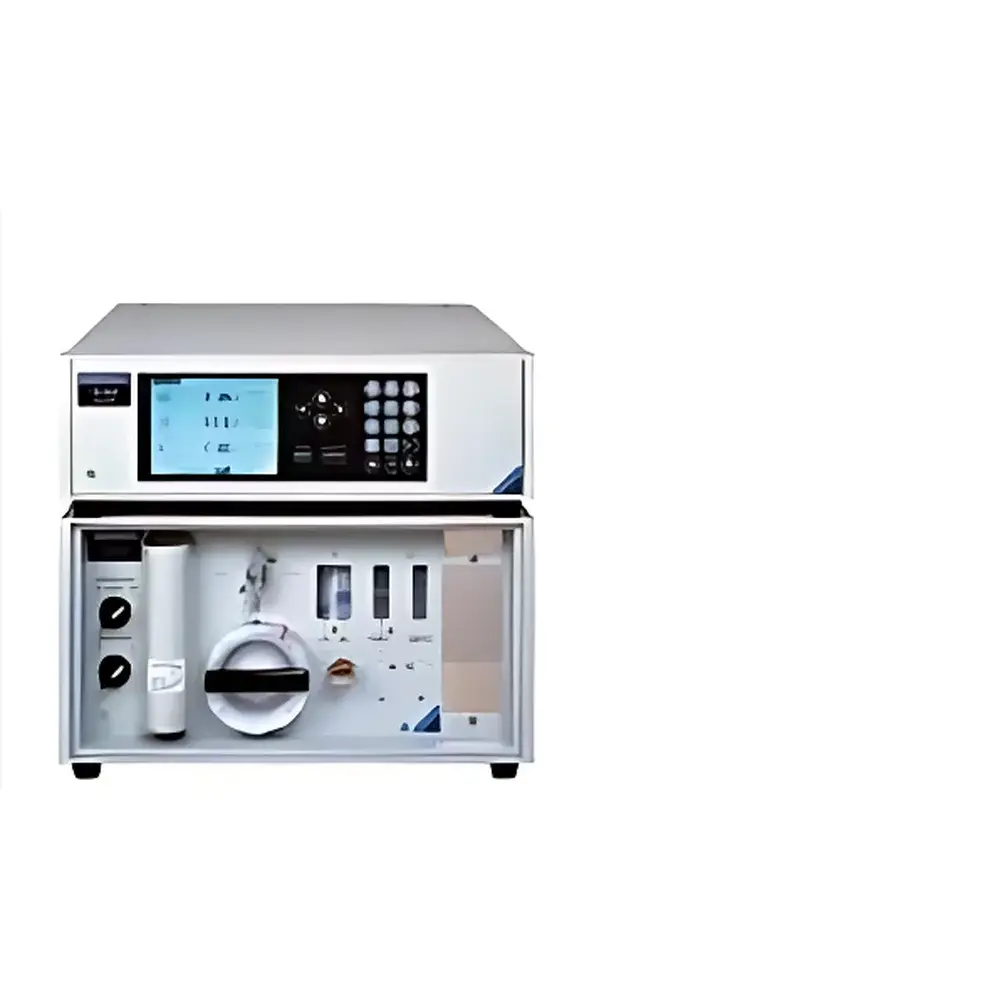
HORIBA VA-3000/VS-3000 Series Multi-Gas Analyzer
| Brand | HORIBA |
|---|---|
| Origin | Japan |
| Model | VA-3000 (Analyzer Unit) / VS-3000 (Sampling System) |
| Instrument Type | Online Continuous Gas Analyzer |
| Target Gases | CO, CO₂, NOₓ, SO₂, CH₄, N₂O, C₂H₄, O₂ |
| Detection Principle | NDIR (CO, CO₂, CH₄, N₂O, SO₂), CLA (NOₓ), MPA (O₂), Electrochemical (O₂), Zirconia (O₂) |
| Minimum Detectable Range | 1–5 ppm |
| Full-Scale Repeatability | ±0.5% FS |
| Linearity | ±1.0% FS (≤10× range), ±1.5% FS (>10× range) |
| Zero Drift | ±2.0% FS/week (NDIR/CLA/MPA/ZrO₂), ±1.0% FS/day (Electrochemical O₂) |
| Response Time | T₉₀ ≤ 30 s (single-component mode) |
| Resolution | 0.1 ppm (ppm-range gases) |
| Analog Outputs | DC 0–1 V / 4–20 mA (isolated optional) |
| Digital Interface | RS-232C |
| Sample Flow Rate | 0.5 L/min |
| Operating Temperature | 0–40 °C |
| Power Supply | AC 100–120 V or 200–240 V, 50/60 Hz |
| Dimensions (VA-3000) | 430 × 132 × 550 mm (W×H×D) |
| Weight (VA-3000) | ~20 kg |
| Compliance | Designed for ISO/IEC 17025-aligned operation |
Overview
The HORIBA VA-3000/VS-3000 Series is a modular, online multi-gas analyzer engineered for high-precision, continuous measurement of trace and percent-level concentrations across diverse industrial, environmental, and research applications. Built upon HORIBA’s decades of expertise in optical and electrochemical gas sensing, the system integrates multiple detection technologies—including Non-Dispersive Infrared (NDIR), Chemiluminescence Analysis (CLA), Magnetic Pressure Analysis (MPA), electrochemical cells, and zirconia-based oxygen sensors—within a single 19-inch rack-mountable platform. Its core architecture enables simultaneous or sequential analysis of up to three gas components using interchangeable sensor modules, eliminating the need for parallel analyzers and reducing footprint, calibration overhead, and operational complexity. The VA-3000 analyzer unit interfaces with the VS-3000 series sampling systems (VS-3001 to VS-3004), which provide conditioned sample introduction via heated, corrosion-resistant flow paths constructed from PTFE, PVDF, SUS, and FKM—ensuring stability for aggressive or humid stack gases. With warm-up times as low as 20 minutes (NDIR/zirconia) and response times meeting T₉₀ ≤ 30 s, the system meets stringent real-time monitoring demands in emission compliance, combustion optimization, biogas upgrading, and laboratory-scale reaction studies.
Key Features
- Modular sensor architecture supporting up to three independently configurable gas measurement channels in one chassis
- Multi-principle detection: NDIR for CO, CO₂, CH₄, N₂O, and SO₂; CLA for NOₓ (NO/NO₂); MPA, electrochemical, and zirconia for O₂—each optimized for selectivity and long-term stability
- Wide dynamic range capability: Up to 10× (standard) or 20× (optional NDIR) full-scale ratio per channel; CLA offers up to 100× range flexibility with programmable span switching
- High metrological performance: ±0.5% FS repeatability, ±1.0% FS linearity (≤10× range), and zero drift controlled to ±2.0% FS/week (±1.0% FS/day for electrochemical O₂)
- Ruggedized sampling interface: VS-3000 series includes temperature-stabilized dry sampling (5 °C dew point), particulate filtration (<0.1 mg/m³), and corrosion-resistant wetted materials (PTFE, PVDF, glass)
- Standard digital and analog I/O: RS-232C serial interface for remote configuration and data export; isolated 4–20 mA and 0–1 V analog outputs compliant with PLC/DCS integration standards
- Comprehensive diagnostics: Real-time status monitoring of sensor health, flow rate, temperature, pressure, and calibration validity
Sample Compatibility & Compliance
The VA-3000/VS-3000 system is designed for use with clean, non-explosive, non-corrosive sample streams meeting defined physical and chemical constraints. Acceptable sample conditions include: temperature within ambient range (0–40 °C), moisture content ≤5 °C dew point (VS-3000 dry sampling), particulate loading 10 ppm; zirconia O₂ sensing mandates coexistence of H₂O and O₂ when reducing gases (e.g., CO, H₂, THC) are present, per the stoichiometric condition [THC + CO + H₂] < [H₂O + O₂]. The system complies with international installation and safety expectations for continuous emissions monitoring systems (CEMS), including structural alignment with ISO 14064-3 verification protocols and functional readiness for EPA Method 10/18, EN 15267, and JIS B 7982 validation frameworks. While not certified intrinsically safe, its architecture supports integration into hazardous area systems via external purging or remote sampling configurations.
Software & Data Management
Data acquisition and instrument control are facilitated via HORIBA’s proprietary PC-based software suite, compatible with Windows OS and supporting both local and networked deployment. The software provides full parameter configuration—including zero/span calibration scheduling, range selection, alarm thresholds (high/low, rate-of-change), and sensor module assignment—without hardware reconfiguration. All measurement events, calibration actions, and system diagnostics are timestamped and logged with user ID attribution, fulfilling foundational requirements for 21 CFR Part 11-compliant environments when deployed with appropriate IT controls (e.g., electronic signatures, audit trail enablement, and role-based access). Raw analog outputs and serial data streams support third-party SCADA, LIMS, and historian platforms via Modbus RTU (via RS-232C converter) or direct ASCII protocol parsing. Export formats include CSV and Excel-compatible .xls, enabling traceability across QA/QC workflows, regulatory reporting (e.g., EU ETS, US EPA e-CFR), and long-term trend analysis.
Applications
- Regulatory stack emission monitoring (SO₂, NOₓ, CO, CO₂) per national CEMS requirements
- Combustion efficiency optimization in boilers, incinerators, and gas turbines via O₂ + combustibles feedback
- Biogas and landfill gas quality control (CH₄, CO₂, H₂S*–via optional add-on, O₂, H₂O)
- Automotive exhaust R&D: transient NOₓ and CO dynamics during WLTC/NEDC cycles
- Controlled atmosphere fermentation and cell culture incubation (O₂, CO₂, N₂O)
- Environmental chamber validation and indoor air quality (IAQ) assessment
- Chemical process safety: continuous hydrocarbon (CH₄, C₂H₄) leak detection in petrochemical facilities
FAQ
What gas detection principles are supported by the VA-3000 platform?
NDIR (for CO, CO₂, CH₄, N₂O, SO₂), Chemiluminescence (NOₓ), Magnetic Pressure (O₂), Electrochemical (O₂), and Zirconia (O₂). Sensor modules are physically and electrically decoupled to allow flexible combinations.
Can the same analyzer measure both ppm-level NO and %-level O₂ simultaneously?
Yes—by installing a CLA module for NOₓ and an MPA or zirconia module for O₂ in separate slots, the VA-3000 delivers concurrent, independent measurements across six orders of magnitude.
Is automatic zero/span calibration supported?
Manual zero/span is standard; automated calibration sequences require external solenoid valves and certified gas standards—integrated via the VS-3000’s auxiliary port and software-triggered timing.
How does the system handle cross-interference, e.g., water vapor on NDIR CO₂ readings?
All NDIR modules incorporate integrated temperature/pressure compensation and factory-applied interference correction matrices; optional chilled mirror or permeation dryers in the VS-3000 further minimize H₂O spectral overlap.
What maintenance intervals are recommended for long-term unattended operation?
Sensor modules require annual verification; optical windows should be inspected quarterly; sampling filters and desiccant (if used) must be replaced per site-specific particulate/moisture load—typically every 3–6 months.
Related Products







