
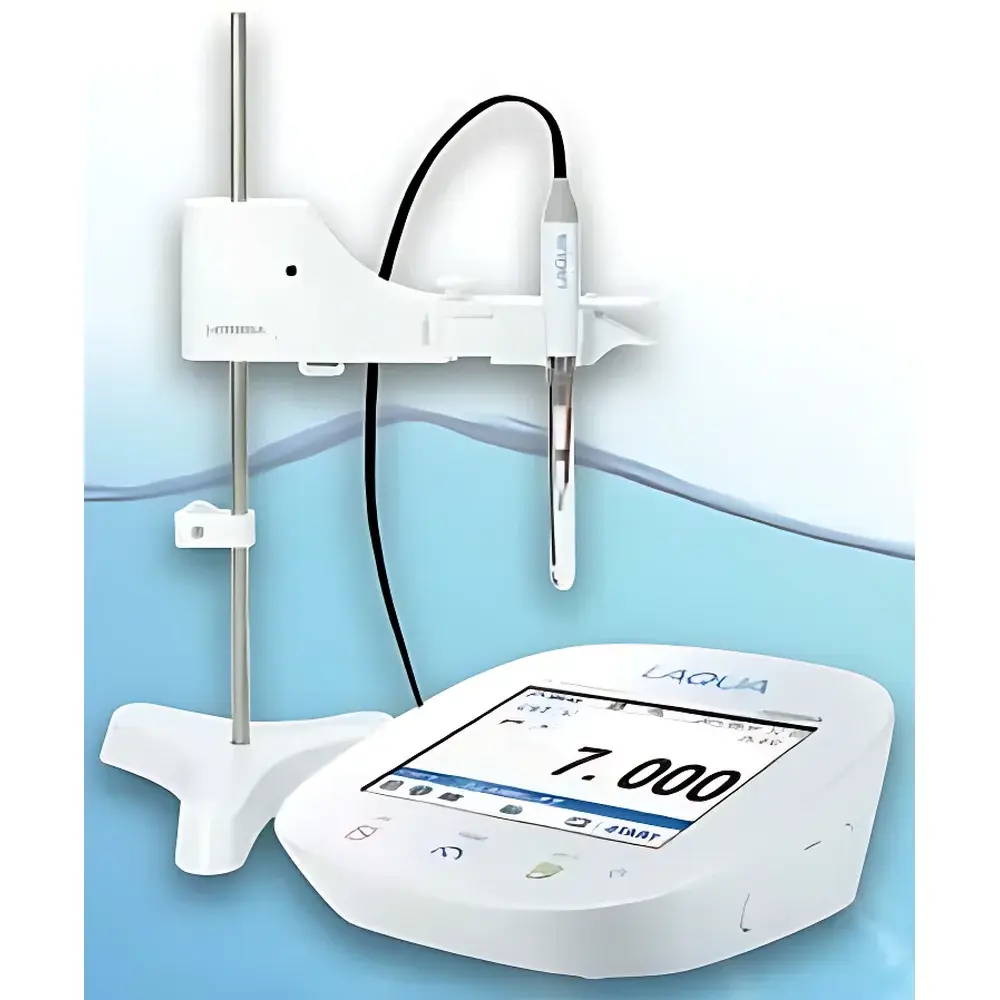
HORIBA F-70 Laboratory Multi-Parameter Water Quality Analyzer
| Brand | HORIBA |
|---|---|
| Origin | Japan |
| Model | F-70 |
| Type | Benchtop Laboratory Water Quality Analyzer |
| Measured Parameters | pH, Temperature, ORP, Ion Concentration, Conductivity, Resistivity, Salinity, TDS |
| Compliance | JIS, USP <645>, EP 2.2.38, JP/CP Pharmacopoeial Standards |
| Data Storage | Up to 999 measurements |
| Interface | USB (host & device), GLP/GMP-compatible printer support |
| Display | Monochrome LCD with intuitive navigation |
| Languages | English, Japanese, Chinese, Korean |
| Power | AC adapter (100–240 V, 50/60 Hz) |
| Weight | ~500 g |
Overview
The HORIBA F-70 is a precision-engineered benchtop multi-parameter water quality analyzer designed for regulated laboratory environments requiring traceable, reproducible measurements across pharmaceutical, environmental, and industrial R&D applications. Built upon electrochemical sensing principles—including glass electrode potentiometry for pH and ORP, ion-selective electrode (ISE) methodology for monovalent/multivalent ion quantification, and dual-electrode AC conductivity measurement—the F-70 delivers metrologically sound data aligned with international pharmacopoeial standards. Its architecture supports full traceability through embedded calibration history, sensor diagnostics, and timestamped measurement logs—critical for laboratories operating under Good Laboratory Practice (GLP) or Good Manufacturing Practice (GMP) frameworks. Unlike portable or field-deployed units, the F-70 prioritizes analytical rigor over mobility: its stable thermal mass, low-drift analog front-end, and optimized electrode interface minimize measurement uncertainty in controlled lab settings.
Key Features
- Simultaneous real-time measurement of pH, temperature, oxidation-reduction potential (ORP), ion concentration (via ISE), conductivity, resistivity, salinity, and total dissolved solids (TDS)
- High-resolution pH measurement (0.000–14.000 range, ±0.005 pH repeatability) using low-drift glass electrodes with integrated temperature compensation
- Dual-electrode AC conductivity cell with selectable cell constants (0.01, 0.1, 1.0 cm⁻¹) enabling accurate measurement across 0.000 mS/m to 199.9 S/m
- Automated calculation of derived parameters: resistivity (Ω·m), salinity (ppt or %), and TDS (mg/L to g/L) based on standardized conversion algorithms per ASTM D1125 and ISO 7888
- Smart diagnostic navigation system guiding users through calibration validation, electrode condition checks, and error resolution—reducing operator dependency and training burden
- Compliance-ready data management: timestamped records with operator ID entry, automatic calibration log retention, and audit-trail-capable USB export
- Pharmaceutical mode supporting USP , EP 2.2.38, and JP/CP purified water specifications—including conductivity limit checks at defined temperatures and automatic temperature correction
Sample Compatibility & Compliance
The F-70 is validated for aqueous samples within 0.0 °C to 100.0 °C (extended range: −30.0 °C to 130.0 °C with appropriate probes). It accommodates standard combination pH/ORP electrodes, solid-state ISEs (e.g., Na⁺, K⁺, Cl⁻, F⁻), and interchangeable conductivity cells. All measurement protocols adhere to JIS Z 8401 (accuracy evaluation), ISO/IEC 17025–2017 (competence of testing labs), and FDA 21 CFR Part 11 requirements when paired with compliant software and electronic signature workflows. The instrument’s periodic verification mode enables automated compliance checks against pharmacopoeial conductivity limits (e.g., USP Stage 1–3 tests), generating pass/fail reports with deviation annotations. Electrode cleaning protocols are documented per manufacturer guidelines to ensure long-term stability and inter-laboratory comparability.
Software & Data Management
Data acquisition and reporting are managed via the built-in memory (999 measurement records) and USB 2.0 interface. Raw datasets—including measured values, calibration coefficients, electrode IDs, ambient temperature, and user-entered metadata—are exportable in CSV format for integration into LIMS or statistical analysis platforms (e.g., JMP, Minitab). When connected to a GLP/GMP-compliant thermal printer, the F-70 generates hard-copy reports containing instrument ID, date/time stamp, operator code, calibration status, and measurement uncertainty estimates. Firmware supports multilingual UI (English, Japanese, Chinese, Korean) without requiring reinstallation—facilitating global deployment in multinational facilities. No proprietary cloud service or vendor-hosted platform is required; all data remains under user control.
Applications
- Pharmaceutical water system validation: Purified Water (PW), Water for Injection (WFI), and Clean Steam condensate monitoring per USP and EU Annex 1
- Environmental lab QA/QC: Surface water, groundwater, and wastewater characterization per EPA Method 120.1 (pH), 120.2 (conductivity), and 150.1 (TDS)
- Chemical manufacturing: Process water purity verification, rinse bath monitoring, and electrolyte concentration control in plating baths
- Academic research: Fundamental studies of ion transport kinetics, membrane fouling assessment, and solution thermodynamics
- Food & beverage labs: Conductivity-based sugar concentration estimation, brine strength validation, and pH stability profiling during fermentation
FAQ
Does the F-70 support automatic temperature compensation (ATC) for all parameters?
Yes—ATC is applied in real time to pH, ORP, conductivity, resistivity, salinity, and TDS calculations using either built-in or external Pt1000 temperature sensors.
Can the F-70 be used for USP purified water testing?
Yes—its pharmaceutical mode implements the three-stage conductivity acceptance criteria, automatic temperature correction to 25 °C, and alarm thresholds per USP Chapter .
Is electrode calibration traceable to NIST standards?
While the F-70 itself does not generate NIST-traceable certificates, it records calibration buffer IDs, dates, slopes, and offsets—enabling users to maintain full traceability when using NIST-certified buffers (e.g., NIST SRM 186, 187).
What is the maximum data export capacity via USB?
All stored measurements (up to 999 entries) can be exported as a single CSV file; no file size limitation is imposed by the instrument firmware.
Does the F-70 require annual recalibration by HORIBA service?
No—users perform routine calibration and performance verification per internal SOPs; however, HORIBA recommends biannual verification using certified reference materials for GxP-regulated environments.







