
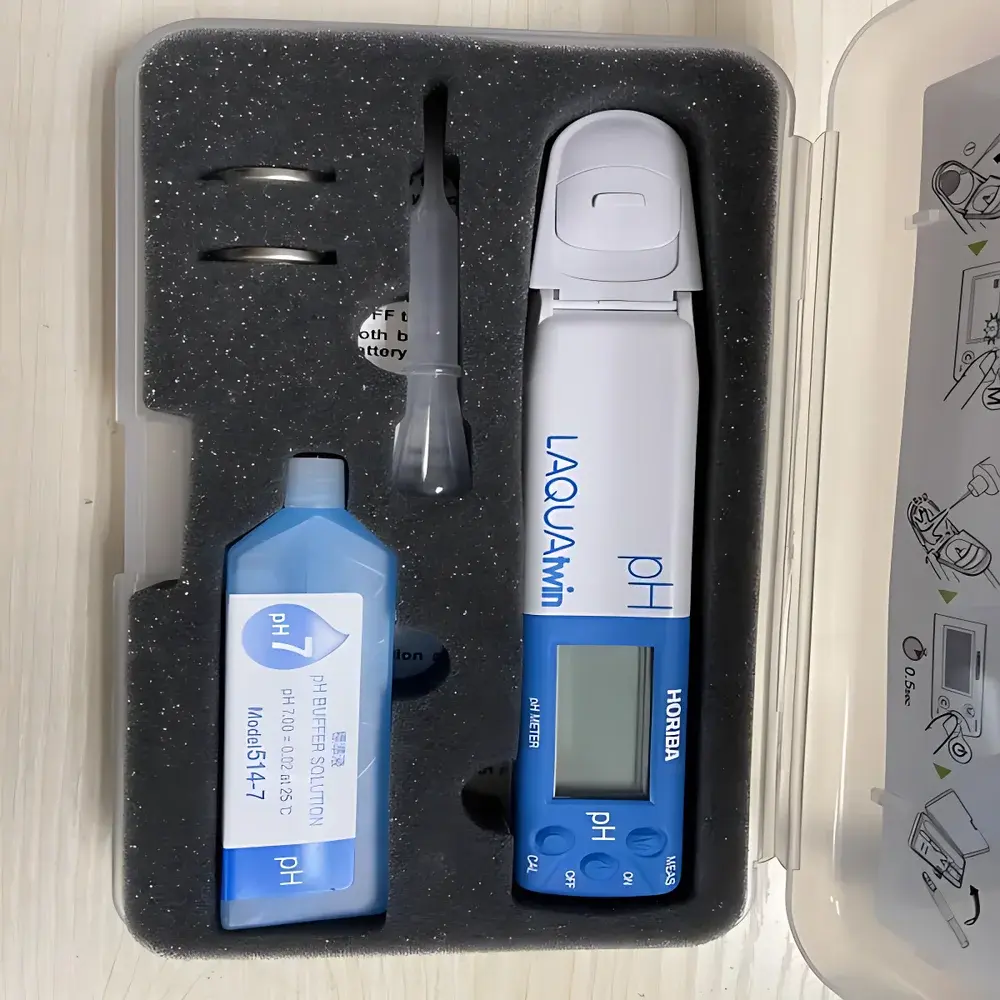
HORIBA S010 Portable Pen-Type pH Meter
| Brand | HORIBA |
|---|---|
| Origin | Japan |
| Instrument Type | Pen-Style pH Meter |
| Parameter Type | Single-Parameter (pH) |
| Measurement Range | 0–14 pH |
| Resolution | ±0.01 pH |
| Accuracy | ±0.01 pH |
| Calibration Solutions | pH 4.01 and pH 7.00 standard buffers |
| Temperature Compensation | Automatic (ATC) |
| Electrode Type | Flat-Surface pH Sensor |
| Minimum Sample Volume | 100 µL |
| Compliance | Designed for routine QC, field testing, and educational use in accordance with ISO 7888 and ASTM D1293 guidelines |
Overview
The HORIBA S010 is a compact, rugged pen-type pH meter engineered for rapid, reliable field and benchtop pH measurements in resource-constrained or mobile environments. Based on potentiometric measurement principles, it employs a flat-surface glass pH electrode integrated into a sealed, ergonomic pen-shaped housing—eliminating the need for bulky probe assemblies or external reference junctions. The device operates via the Nernst equation, detecting the potential difference between the sensing glass membrane and an internal Ag/AgCl reference system to deliver quantitative pH values across the full aqueous scale (0–14 pH). Its design prioritizes operational simplicity without compromising metrological integrity: automatic temperature compensation (ATC) ensures traceable readings across 0–50 °C, while the low-volume sampling capability (≥100 µL) supports analysis of limited or viscous samples such as soil extracts, food slurries, or small-volume aquaculture water aliquots.
Key Features
- Integrated flat-surface pH sensor with stable glass membrane and built-in temperature sensor for real-time ATC
- High-precision analog-to-digital conversion yielding ±0.01 pH resolution and accuracy under standard calibration conditions
- Two-point calibration protocol using certified pH 4.01 and pH 7.00 buffer solutions—fully compliant with ISO 7888 calibration procedures
- Auto-power-off function (after 10 minutes of inactivity) and low-battery indicator for extended field usability
- IP67-rated housing resistant to dust ingress and temporary immersion—suitable for outdoor, agricultural, or industrial site deployment
- No external cables, connectors, or PC interface required; fully self-contained operation with replaceable CR2032 battery
Sample Compatibility & Compliance
The S010 is validated for direct measurement of aqueous and semi-aqueous matrices including drinking water, wastewater effluents, aquarium and pond water, diluted soil leachates, fruit juice extracts, dairy product rinsates, and pharmaceutical rinse solutions. It is not intended for non-aqueous solvents, highly viscous oils, or strongly oxidizing media (e.g., >10% bleach). All factory calibration and verification data are traceable to NIST-certified reference materials. The instrument meets the functional requirements of ISO 7888 (water quality — determination of pH), ASTM D1293 (standard test method for pH of water), and supports GLP-compliant documentation when used with manual logbook entry. While not FDA 21 CFR Part 11–enabled (due to lack of electronic audit trail), its calibration records and measurement outputs satisfy basic GMP/QC record-keeping expectations for non-regulated environments.
Software & Data Management
The HORIBA S010 operates as a standalone instrument with no embedded memory, Bluetooth, or USB connectivity. All measurements are displayed in real time on a high-contrast LCD screen and must be manually recorded. This architecture eliminates software validation overhead and aligns with laboratories operating under simplified quality systems (e.g., ISO/IEC 17025 Clause 7.7 for equipment management). Users are advised to maintain calibration logs—including date, buffer lot numbers, slope (%), and offset (mV)—in accordance with internal SOPs. For organizations requiring digital data capture, third-party logging via smartphone photography or external handheld data loggers is compatible given the device’s consistent display format and stable reading hold.
Applications
- Aquaculture and hydroponics: Monitoring pH stability in recirculating systems where rapid response prevents stress-induced mortality in sensitive species
- Food safety screening: Spot-checking acidity in fresh produce wash water, fermented dairy products, and canned goods prior to thermal processing
- Environmental field surveys: On-site assessment of surface water pH during EPA Region-specific watershed evaluations or soil pH mapping projects
- Educational labs: Introducing electrochemical fundamentals and calibration methodology in undergraduate chemistry and environmental science curricula
- Manufacturing QA checkpoints: Verifying rinse water neutrality post-cleaning of medical device components or semiconductor wafers
FAQ
What calibration standards are required for daily use?
The S010 requires two-point calibration using certified pH 4.01 and pH 7.00 buffer solutions at ambient temperature. Calibration should be performed before each measurement session or after exposure to extreme pH samples.
Can the electrode be cleaned or regenerated if performance degrades?
Yes—the flat-surface glass electrode may be gently rinsed with deionized water after each use and soaked in 0.1 M HCl for 30 seconds if clogged with organic residue. Avoid abrasive cleaning or prolonged storage in dry conditions.
Is temperature compensation adjustable or fixed?
Automatic temperature compensation is built-in and non-adjustable; the integrated thermistor provides continuous correction across 0–50 °C based on the Nernst equation’s theoretical slope.
How often should the instrument be verified against a reference meter?
Verification against a calibrated laboratory-grade pH meter is recommended weekly for critical applications or after any physical impact to the sensor tip.
Does the S010 meet regulatory requirements for pharmaceutical water testing?
While suitable for preliminary checks, USP and EP 2.2.3 mandate multi-parameter systems with documented uncertainty budgets and automated calibration reporting—making the S010 appropriate only for non-GMP support tasks in pharma settings.





