
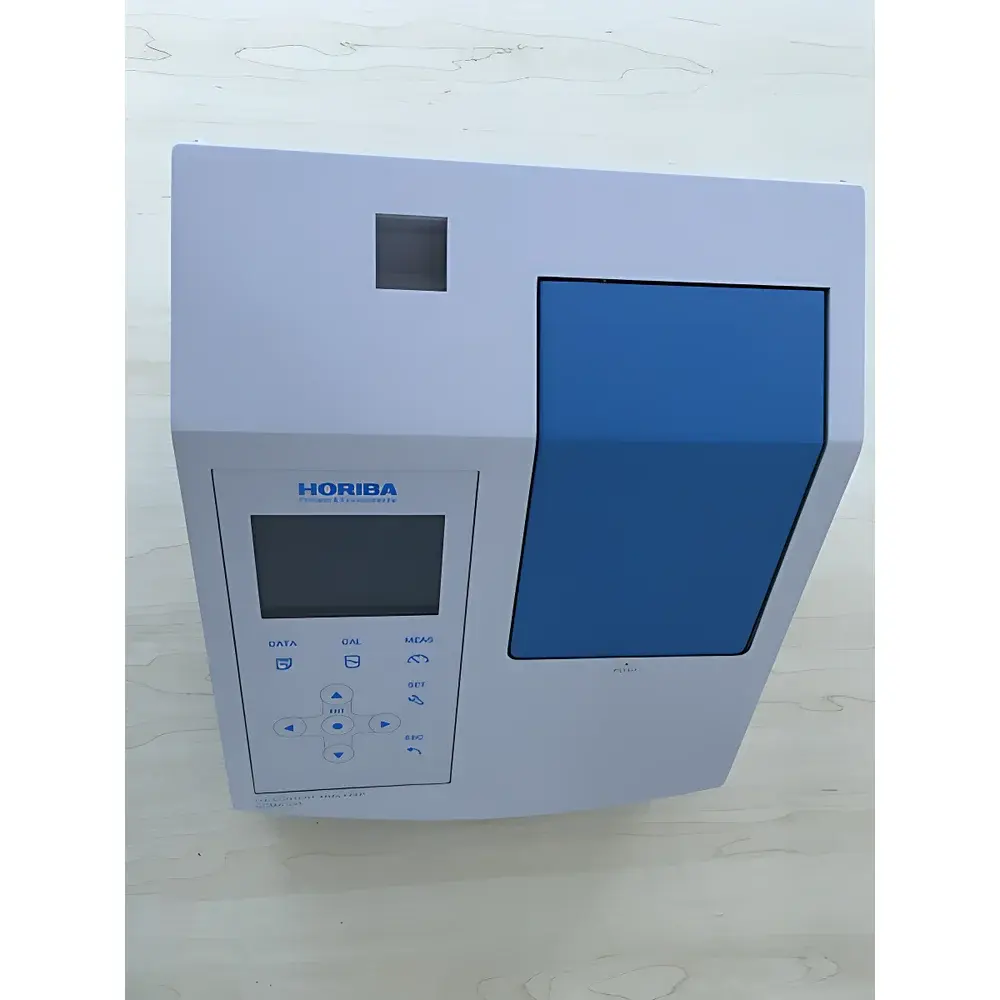
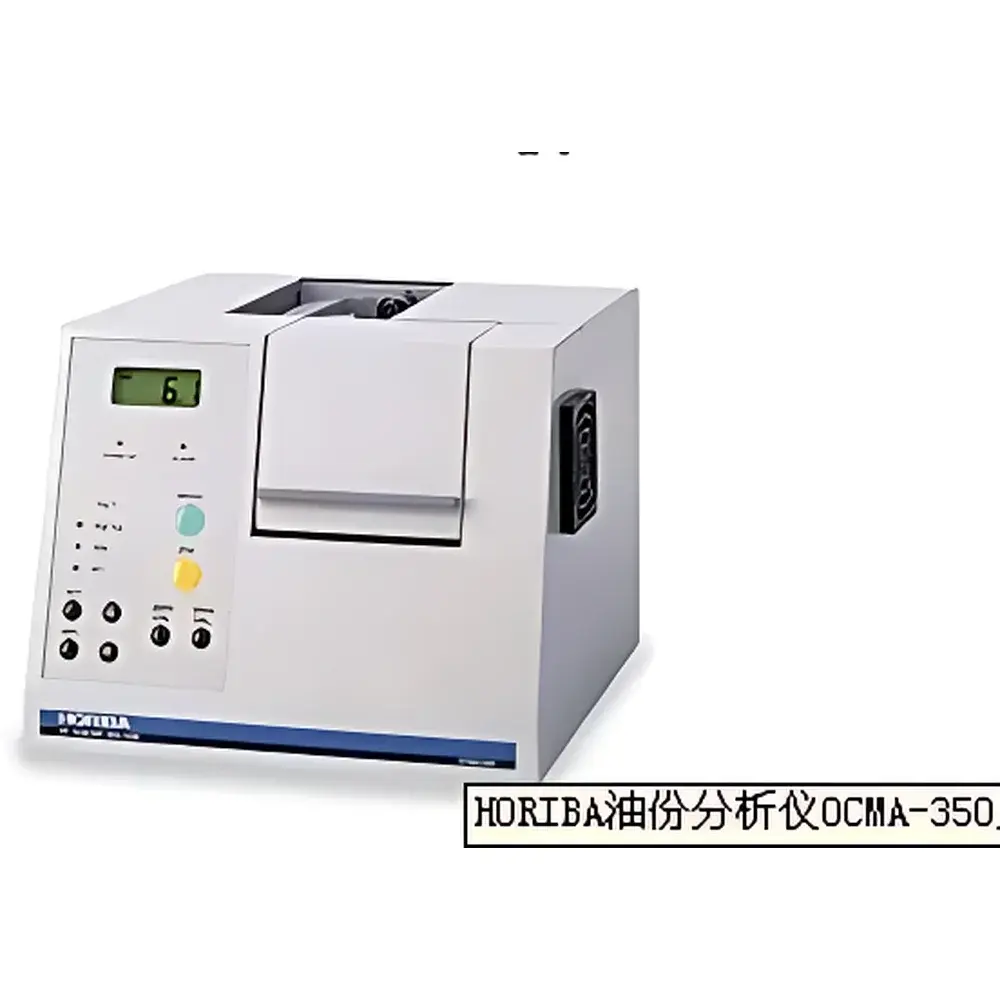
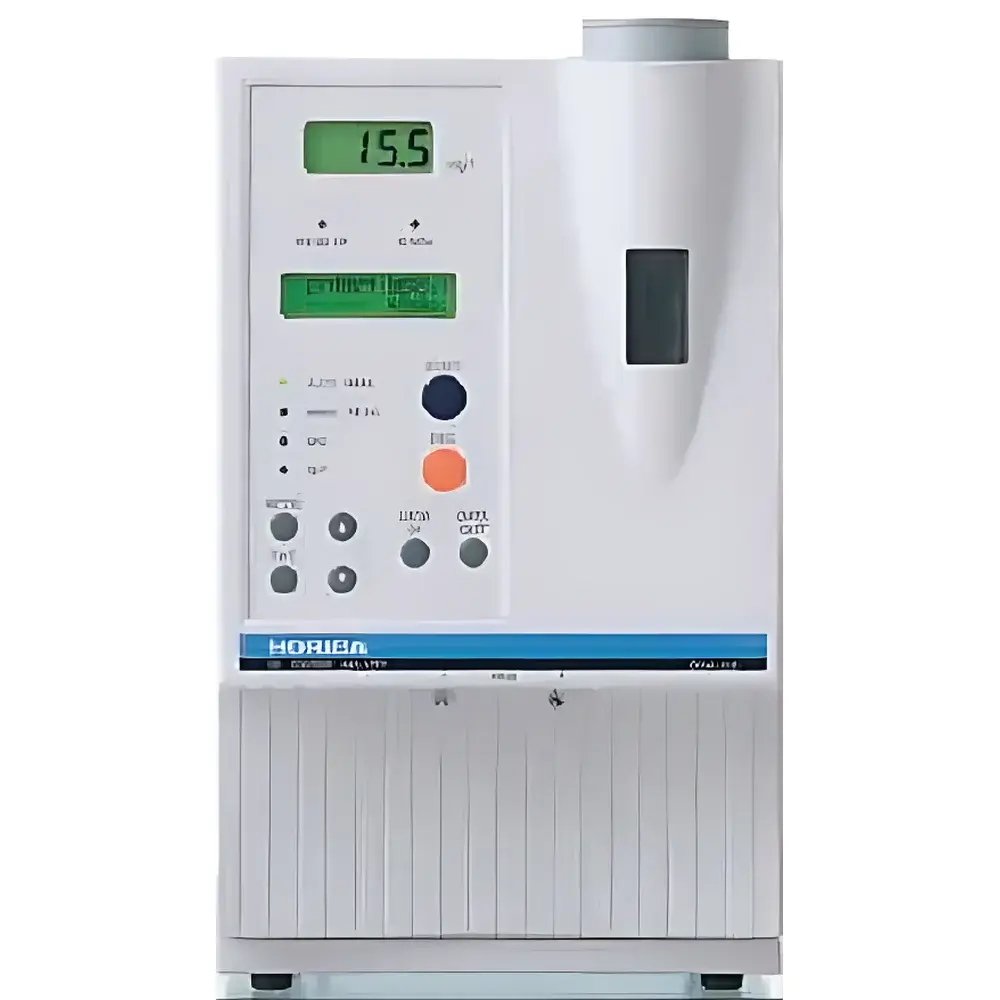
HORIBA OCMA-555 Oil Content Analyzer
| Brand | HORIBA |
|---|---|
| Origin | Japan |
| Model | OCMA-555 |
| Instrument Type | Portable |
| Measurement Principle | Non-Dispersive Infrared (NDIR) Absorption with H-997 Extraction Solvent |
| Measurement Range | 0–200 mg/L (water), 0–1000 mg/kg (soil), 0–1 Abs |
| Repeatability | ±0.4 mg/L ±1 digit (0–9.9 mg/L), ±2.0 mg/L ±1 digit (10.0–99.9 mg/L), ±4 mg/L ±1 digit (100–200 mg/L), ±1% F.S. (0–1 Abs) |
| Optical Path | 200 mm Quartz Cuvette |
| Detector | Thermoelectric Sensor |
| Display | Backlit LCD with Timestamp |
| Interface | RS-232C, Parallel Printer Port |
| Power Supply | 230 V AC, 50 Hz |
| Dimensions | 250 × 200 × 285 mm (W × H × D) |
Overview
The HORIBA OCMA-555 Oil Content Analyzer is a field-deployable, precision instrument engineered for quantitative determination of hydrocarbon-based oil residues in aqueous and solid-phase environmental samples. It operates on the principle of non-dispersive infrared (NDIR) absorption spectroscopy, specifically targeting the characteristic C–H stretching vibration band near 3.4 µm — a spectral region where hydrocarbons exhibit strong, selective absorbance while common extraction solvents such as H-997 remain optically transparent. Unlike fluorescence-based alternatives, the OCMA-555 delivers chemically specific, matrix-resistant quantification by measuring absorbance directly attributable to aliphatic and aromatic hydrocarbon functional groups. Its design adheres to core analytical rigor required for regulatory compliance in wastewater discharge monitoring, contaminated site assessment, and industrial effluent verification per ISO 9377-2 (petroleum hydrocarbons in water) and ASTM D7066 (oil and grease by infrared spectrophotometry). The analyzer is optimized for post-extraction analysis — i.e., it measures oil pre-extracted from water or soil using standardized solvent protocols — ensuring minimal interference from suspended solids (SS), turbidity, or emulsified organics.
Key Features
- Triple-unit measurement capability: seamlessly switch between concentration units — mg/L (for water extracts), mg/kg (for soil/sediment extracts), and absorbance (Abs) — without recalibration.
- Integrated thermoelectric detector with stable thermal compensation, enabling high reproducibility across ambient temperature fluctuations (15–35 °C operational range).
- 200 mm optical path quartz cuvette ensures enhanced sensitivity for low-concentration detection down to sub-mg/L levels, with documented repeatability meeting ISO 5725-2 precision criteria.
- Onboard timestamping and automatic zero calibration upon power-up or user-initiated reset, supporting GLP-compliant data integrity and audit readiness.
- RS-232C serial interface and parallel printer port enable direct data export to LIMS, laboratory notebooks, or regulatory reporting systems — fully compatible with FDA 21 CFR Part 11–enabled software environments when paired with validated host applications.
- Compact, ruggedized chassis (250 × 200 × 285 mm) with IP20-rated enclosure, designed for transport between field sites, mobile labs, and QC/QA workbenches without performance degradation.
Sample Compatibility & Compliance
The OCMA-555 is validated for use with solvent-extracted samples prepared according to EPA Method 1664B (n-hexane extractable material, or HEM), ISO 9377-2 (infrared determination of mineral oil hydrocarbons), and JIS K 0102 (Japanese Industrial Standard for oil content in water). It accepts extracts obtained using H-997 — a chlorinated hydrocarbon solvent selected for its low IR background at 3.4 µm and compatibility with standard EPA-approved extraction workflows. The system accommodates both liquid-phase extracts (e.g., from water or leachate) and solvent-eluted solid-phase matrices (e.g., soil, sludge, or metal parts rinsates). While not intended for direct-injection analysis of raw wastewater, its post-extraction architecture eliminates interferences from surfactants, humic substances, and particulate matter that commonly compromise UV/fluorescence methods. All measurement protocols align with QA/QC requirements under ISO/IEC 17025-accredited laboratories.
Software & Data Management
The OCMA-555 operates autonomously without embedded firmware-based software; instead, it functions as a dedicated hardware sensor node delivering calibrated analog/digital output via RS-232C. This architecture supports seamless integration into enterprise-grade laboratory informatics platforms including LabWare LIMS, Thermo Fisher SampleManager, and custom Python- or LabVIEW-based acquisition systems. Raw absorbance values and unit-normalized concentrations are transmitted with embedded timestamps and instrument ID, enabling full traceability. When deployed in regulated environments (e.g., pharmaceutical manufacturing wastewater control or semiconductor fab effluent monitoring), the device satisfies data integrity prerequisites when paired with validated serial communication drivers that enforce audit trails, electronic signatures, and change-control logging per 21 CFR Part 11 Annex 11 guidelines.
Applications
- Regulatory compliance testing of industrial effluents prior to municipal sewer discharge or environmental release.
- Field screening of groundwater plumes and soil cores during Phase II environmental site assessments (ESA).
- Validation of cleaning efficacy in precision engineering — e.g., residual oil quantification on machined metal components, silicon wafers, or optical substrates.
- Monitoring of oil-water separator performance and activated carbon filter breakthrough in refinery or petrochemical facilities.
- Quality assurance of solvent recovery systems, including compatibility verification with HORIBA SR-305 solvent regeneration units.
- Research applications in hydrocarbon biodegradation kinetics, where time-series oil depletion in microcosms requires repeatable, low-drift endpoint measurements.
FAQ
What extraction solvent is required for the OCMA-555, and why is H-997 specified instead of S-316?
H-997 is the designated extraction solvent for the OCMA-555 model. It exhibits negligible absorbance at 3.4 µm, enabling selective detection of hydrocarbon analytes without baseline drift. S-316 is used exclusively with the OCMA-550 variant and is incompatible with the OCMA-555’s optical calibration.
Can the OCMA-555 measure total petroleum hydrocarbons (TPH) directly in untreated wastewater?
No. The instrument requires solvent extraction prior to analysis. Direct measurement of raw wastewater is not supported due to spectral interference from suspended solids, dissolved organic carbon, and emulsifiers.
Is the 200 mm quartz cuvette included with the base configuration?
Yes. A sealed, matched-pair quartz cuvette with integrated cap is supplied as standard equipment, certified for NDIR transmission stability and thermal expansion tolerance.
Does the OCMA-555 support multi-point calibration curves?
No. It employs a single-point, factory-established absorbance-to-concentration algorithm traceable to NIST-traceable mineral oil standards. Linearity across 0–200 mg/L is verified per ISO 8466-1.
How is data integrity ensured during extended field deployments?
Timestamped measurements, automatic zero tracking, and non-volatile memory retention of last-calibration parameters provide continuity between powered sessions. No internal battery-backed clock is present; external time synchronization is recommended for long-term monitoring campaigns.
Related Products







