
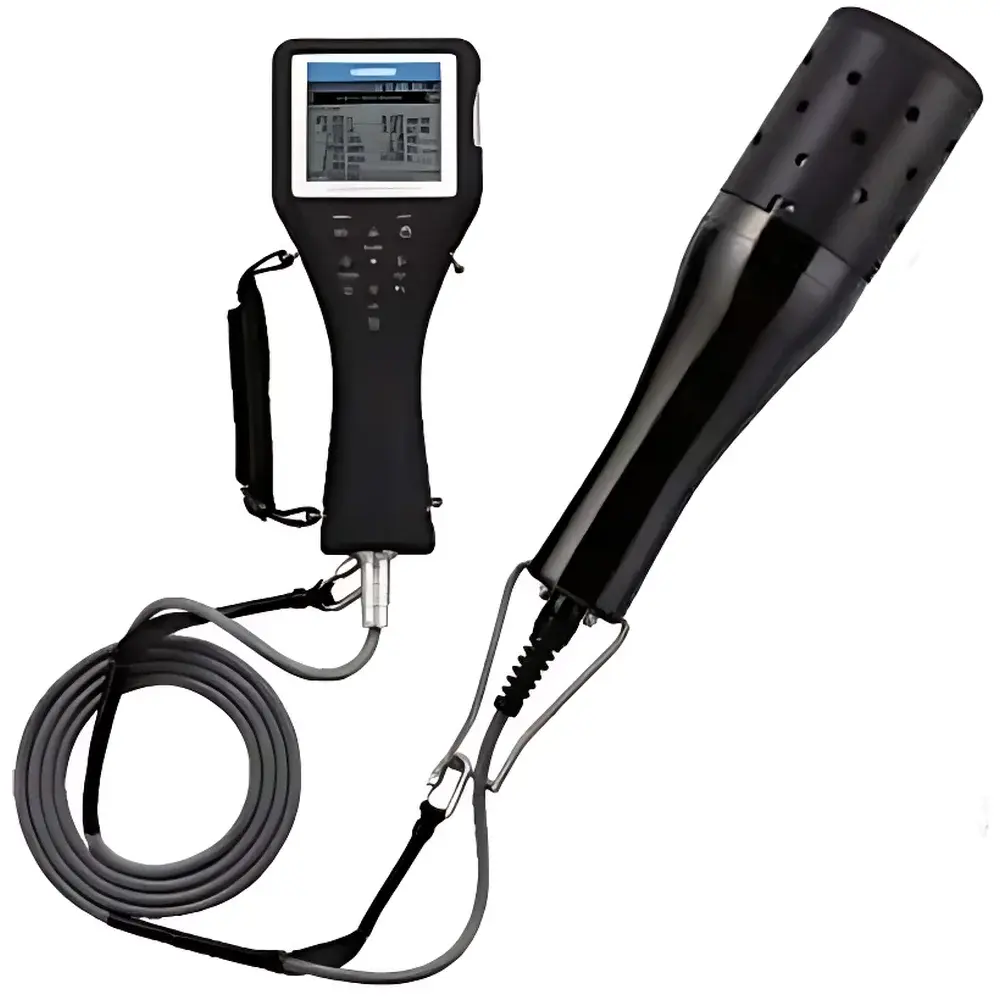
HORIBA U-50 Series Portable Multiparameter Water Quality Analyzer
| Brand | HORIBA |
|---|---|
| Origin | Japan |
| Model | U-50 Series |
| Instrument Type | Portable/Handheld Water Quality Analyzer |
| Measured Parameters | pH, ORP, Conductivity, Dissolved Oxygen (DO), Temperature, Turbidity, Salinity, TDS, Specific Gravity (Seawater), Depth, GPS Positioning |
| Turbidity Standards | U-53 — US EPA Method 180.1 (LED forward scatter) |
| Turbidity Resolution | 0.01 NTU (0–10 NTU range) |
| DO Sensor Response Time | Improved polarographic response (<60 s to 90% step change) |
| Operating Temperature | −10 °C to +55 °C |
| Depth Measurement Range | Up to 30 m (pressure-based, optional on U-52G/U-53G/U-54G) |
| IP Rating | IP67 (instrument body), IP68 (probe assembly) |
| Data Storage | 10,000 measurement sets |
| Power | Four AA alkaline batteries (≈70 h operation, backlight off) |
| Communication | USB 2.0 |
| Display | 320 × 240 monochrome LCD with backlight |
| Weight | Probe ≈1.8 kg |
Overview
The HORIBA U-50 Series is a field-deployable, multi-parameter water quality analyzer engineered for high-reliability environmental monitoring in diverse aquatic systems—including rivers, lakes, groundwater wells, estuaries, wastewater outfalls, and coastal zones. Built upon HORIBA’s legacy of electrochemical and optical sensor design, the U-50 platform integrates seven core measurement principles into a single ruggedized handheld system: glass electrode potentiometry (pH), platinum redox electrode (ORP), Clark-type polarographic dissolved oxygen sensing, four-electrode AC conductivity, LED- or tungsten-based turbidimetry (per US EPA 180.1 or EN ISO 7027), pressure transduction (depth), and RTD-based temperature compensation (Pt1000 per JIS B Class). All parameters are simultaneously acquired, temperature-compensated in real time, and displayed on a high-contrast monochrome LCD. The instrument supports traceable calibration workflows compliant with ISO/IEC 17025–recommended practices and enables data integrity through timestamped, GPS-georeferenced logging—critical for regulatory reporting under EPA, EU WFD, or national water quality directives.
Key Features
- Ruggedized modular architecture: Probe housing constructed from PPS, PEEK, SUS316L stainless steel, titanium, and FEP membrane—resistant to biofouling, abrasion, and chemical corrosion in freshwater, brackish, and seawater matrices.
- Dual turbidity sensor options: U-53 probe implements US EPA-compliant forward-scatter LED detection (0–800 NTU); U-54 probe conforms to EN ISO 7027 via 90° LED scatter geometry (0–1000 NTU), both delivering 0.01 NTU resolution in low-range mode and integrated automatic cleaning brushes (U-53G/U-54G models).
- Enhanced DO performance: Optimized polarographic membrane and cathode geometry reduce response time by >30% versus prior-generation sensors while simplifying membrane replacement and electrolyte refilling—minimizing field maintenance downtime.
- Multi-language interface: On-device display supports English, Japanese, Russian, Spanish, and Portuguese—facilitating cross-border deployment and multilingual operator training without software localization overhead.
- Integrated GNSS module (U-52G/U-53G/U-54G): 12-channel GPS receiver provides sub-5 m horizontal accuracy (CEP), enabling spatially referenced sampling logs compatible with GIS platforms and regulatory mapping requirements.
- Auto-ranging conductivity with dual-temperature compensation: Supports automatic switching between µS/cm, mS/cm, and S/m scales; applies both linear (25 °C reference) and non-linear (natural water algorithms) compensation per ASTM D1125 and ISO 7888.
Sample Compatibility & Compliance
The U-50 Series is validated for use across natural and anthropogenic water matrices—freshwater (pH 4–10, conductivity <2 mS/cm), estuarine (salinity 0–35 ppt), seawater (up to 70 ppt), and municipal/industrial effluents (turbidity ≤1000 NTU, DO ≤50 mg/L). Sensor materials meet FDA 21 CFR §177.2420 (food-contact polymers) and RoHS 2011/65/EU. Calibration traceability aligns with NIST-traceable standards: pH (NIST SRM 186, 4.01, 7.00, 10.01), conductivity (KCl solutions per ISO 7888), DO (air-saturation and Winkler titration validation), and turbidity (AMCO AEPA primary standards). The system supports GLP-compliant audit trails when paired with HORIBA’s optional LabSolutions QA software (21 CFR Part 11–enabled user authentication and electronic signature).
Software & Data Management
Data acquisition and export are managed via HORIBA’s proprietary U-50 PC Utility (Windows-compatible), which supports USB mass-storage mode for direct file access. Each measurement record contains: date/time stamp, GPS coordinates (latitude/longitude/altitude), all 11 measured parameters with units and uncertainty flags, probe serial numbers, calibration history (date, standard used, slope/offset), and operator ID. Export formats include CSV (for Excel/Python analysis), XML (for LIMS integration), and PDF reports with embedded calibration certificates. Firmware updates preserve configuration profiles and historical datasets; version-controlled firmware complies with IEC 62304 Class B software safety requirements.
Applications
- Regulatory compliance monitoring: Routine sampling per EPA Method 150.1 (pH/ORP), 152.1 (conductivity/salinity), 360.1 (DO), and 180.1 (turbidity) at NPDES discharge points or watershed assessment sites.
- Groundwater vulnerability studies: Simultaneous pH, EC, DO, and redox profiling in borehole profiling campaigns to identify aerobic/anaerobic transition zones.
- Wastewater treatment plant optimization: Real-time tracking of influent/effluent DO, conductivity, and turbidity to support aeration control, coagulant dosing, and clarifier performance evaluation.
- Marine ecological surveys: Seawater-specific parameters (specific gravity δt, salinity, DO saturation %) coupled with GPS-tagged transects for habitat mapping and hypoxia zone delineation.
- Educational field laboratories: Modular probe selection (e.g., U-51 for basic pH/EC/Temp; U-54G for full marine parameter set) enables scalable curriculum integration aligned with AP Environmental Science and university hydrology labs.
FAQ
What calibration standards are required for full regulatory compliance?
NIST-traceable pH buffers (4.01, 7.00, 10.01), KCl conductivity standards (e.g., 0.01 mol/kg, 0.1 mol/kg per ISO 7888), DO air-saturation verification at local barometric pressure, and AMCO AEPA turbidity standards (0.1, 10, 100, 800 NTU) are recommended. Two-point pH and DO calibrations are mandatory before each sampling day.
Can the U-50 Series be used for drinking water analysis per USP <643> or ISO 9001?
Yes—when operated with documented calibration, preventive maintenance logs, and raw data archiving per 21 CFR Part 11 (using LabSolutions QA), the U-50 meets metrological requirements for potable water QC testing, including turbidity ≤0.3 NTU verification.
How does the depth sensor compensate for temperature and pressure drift?
The piezoresistive pressure transducer incorporates onboard Pt1000 temperature sensing; firmware applies a second-order polynomial correction per IEC 61298-2, ensuring ±0.3 m accuracy across −10 °C to +45 °C ambient ranges.
Is firmware validation documentation available for GMP environments?
HORIBA provides IQ/OQ protocols, firmware release notes with change logs, and a Design Qualification Summary (DQS) package upon request—supporting computerized system validation per Annex 11 and FDA Guidance for Industry.
What is the maximum cable length supported for deep-water profiling?
Standard probe cable is 2 m; optional 10 m and 30 m versions are available with reinforced polyurethane jacketing (IP68-rated) and strain-relief connectors—validated for continuous immersion at 30 m depth (3 bar static pressure).
Related Products







