
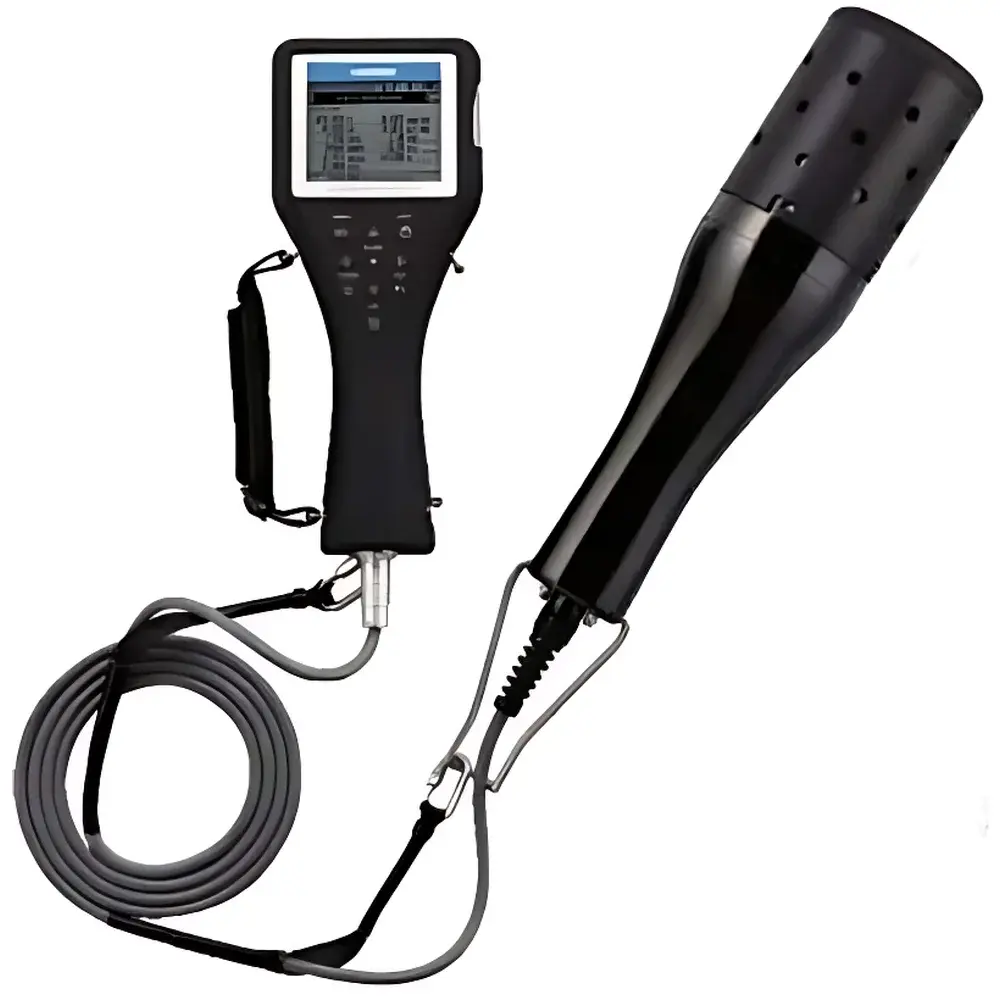
HORIBA U-50 Series Portable Multiparameter Water Quality Analyzer
| Brand | HORIBA |
|---|---|
| Origin | Japan |
| Model | U-50 Portable |
| Instrument Type | Multiparameter |
| Parameter Count | 11 |
| pH Range | 0–14 |
| pH Resolution & Accuracy | 0.01 pH |
| ORP Range | −2000 to +2000 mV |
| DO Range | 0–50.0 mg/L |
| DO Resolution | 0.01 mg/L |
| Conductivity Range | 0–10 S/m |
| Turbidity Methods | LED forward scatter (U-53), tungsten lamp 90° scatter (U-53G), LED 90° scatter (U-54) |
| Turbidity Resolution | 0.01 NTU (0–10 NTU range) |
| Depth Measurement | up to 30 m (pressure-based, optional on U-52G/U-53G/U-54G) |
| Temperature Range | −10 to 55 °C |
| IP Rating | IP67 (host), IP68 (probe) |
| Battery Life | up to 70 h (alkaline AA ×4, backlight off) |
| Data Storage | 10,000 sets |
| Communication | USB |
| Calibration | 2-point pH (pH 4.01/7.00/9.18 buffers), multi-point turbidity/conductivity |
Overview
The HORIBA U-50 Series Portable Multiparameter Water Quality Analyzer is an engineered field-deployable instrument designed for high-reliability in situ monitoring of natural and engineered water systems. Based on electrochemical, optical, and pressure transduction principles, the U-50 platform integrates calibrated glass electrode pH sensing, platinum-based ORP measurement, Clark-type polarographic dissolved oxygen detection, four-electrode AC conductivity analysis, and ISO/US EPA-compliant turbidity quantification. Its modular probe architecture supports configuration-specific sensor suites—ranging from basic 10-parameter (U-51) to full 11-parameter deployments with GPS geotagging (U-52G/U-53G/U-54G). The system operates across diverse hydrological matrices including rivers, groundwater wells, wastewater effluents, estuaries, and coastal zones, delivering traceable, laboratory-grade data under ambient environmental conditions (−5 to 45 °C operating temperature; IP67/IP68 ingress protection).
Key Features
- Simultaneous real-time measurement of 11 critical water quality parameters: pH, mV (ORP), dissolved oxygen (DO), conductivity, salinity, TDS, seawater specific gravity (δt), temperature, turbidity (NTU), depth (m), and GPS coordinates (on G-models)
- Dual turbidity sensor options: U-53 employs EPA Method 180.1–compliant LED forward-scatter optics (0–800 NTU); U-54 implements EN ISO 7027–certified LED 90° scatter detection (0–1000 NTU) with integrated auto-cleaning brush for fouling resistance
- Enhanced polarographic DO sensor with accelerated response time (<60 s to 90% step change) and simplified membrane/electrolyte maintenance protocol
- Ruggedized probe construction using PPS, PEEK, SUS316L, titanium, and FEP membranes—validated for continuous immersion at depths up to 30 m
- Multi-language interface (English, Japanese, Russian, Spanish, Portuguese) with monochrome 320 × 240 LCD and adjustable backlight
- USB data export and onboard storage of 10,000 measurement records with timestamp, GPS metadata, and sensor status flags
Sample Compatibility & Compliance
The U-50 Series is validated for use with freshwater, brackish water, seawater (up to 70 ppt salinity), and municipal/industrial wastewater. All electrochemical sensors comply with JIS Z 8401 (accuracy classification) and IEC 60746-2 for pH/ORP instrumentation. Conductivity measurements adhere to ASTM D1125 and ISO 7888 standards; turbidity modules meet US EPA 180.1 (U-53) and EN ISO 7027:2016 (U-54) requirements. Depth transducers conform to IEC 61000-6-2/6-3 for electromagnetic compatibility in field environments. The system supports GLP-compliant workflows via user-defined calibration logs, audit trails, and buffer verification reports—fully traceable to NIST-traceable pH 4.01, 7.00, and 9.18 reference standards.
Software & Data Management
Data acquisition and post-processing are supported through HORIBA’s proprietary U-50 PC Software (Windows-compatible), enabling batch calibration validation, statistical trend analysis (min/max/mean/stdev per parameter), spatial mapping via embedded GPS coordinates, and automated report generation in PDF/CSV formats. Raw data files include full metadata headers (instrument ID, probe serial number, calibration dates, operator ID, environmental conditions). The software enforces 21 CFR Part 11–aligned security controls—including electronic signatures, role-based access, and immutable audit logs—for regulated applications in environmental monitoring programs subject to EPA, EU WFD, or national regulatory authority oversight.
Applications
- Regulatory compliance monitoring: EPA NPDES permit reporting, EU Water Framework Directive (WFD) status assessment, and ISO 5667–based sampling programs
- Source water vulnerability studies: rapid profiling of aquifer recharge zones, riverine mixing dynamics, and sediment–water interface chemistry
- Wastewater treatment optimization: real-time DO/pH/conductivity feedback for aeration basin control and denitrification process tuning
- Marine and estuarine research: salinity–temperature–turbidity co-variation analysis, hypoxia event detection, and ballast water compliance screening
- Emergency response: rapid deployment for post-spill or flood-event water safety triage (e.g., pH excursions, DO depletion, turbidity spikes)
FAQ
What calibration standards are required for routine operation?
Standard two-point pH calibration uses NIST-traceable buffers at pH 4.01 and 7.00 (or 9.18 for alkaline samples); ORP requires Zobell’s solution or quinhydrone standard; DO calibration follows Winkler titration–verified air-saturation or zero-oxygen sodium sulfite methods.
How does the U-50 handle temperature compensation across parameters?
All sensors feature integrated Pt1000 thermistors (JIS B-class accuracy) with automatic temperature compensation applied per parameter-specific algorithms—e.g., nonlinear pH vs. temperature correction per NBS equations, linear DO solubility adjustment per APHA Standard Methods 4500-O G.
Is the system suitable for long-term unattended deployment?
While optimized for handheld survey use, select models (U-52G/U-53G with optional 10 m or 30 m cable) support moored deployment with external power adapters and telemetry modules—subject to site-specific biofouling mitigation planning.
Can turbidity data be correlated with suspended solids concentration?
Yes—calibration curves linking NTU to gravimetric TSS (mg/L) can be imported into U-50 PC Software for direct conversion, provided site-specific correlation coefficients are established per ISO 7027 Annex C protocols.
What documentation is provided for regulatory audits?
Each unit ships with a Certificate of Conformance, factory calibration report, and traceable NIST certificate for included pH buffers—supporting full chain-of-custody documentation under ISO/IEC 17025 and EPA QA/G-5 guidelines.
Related Products






