
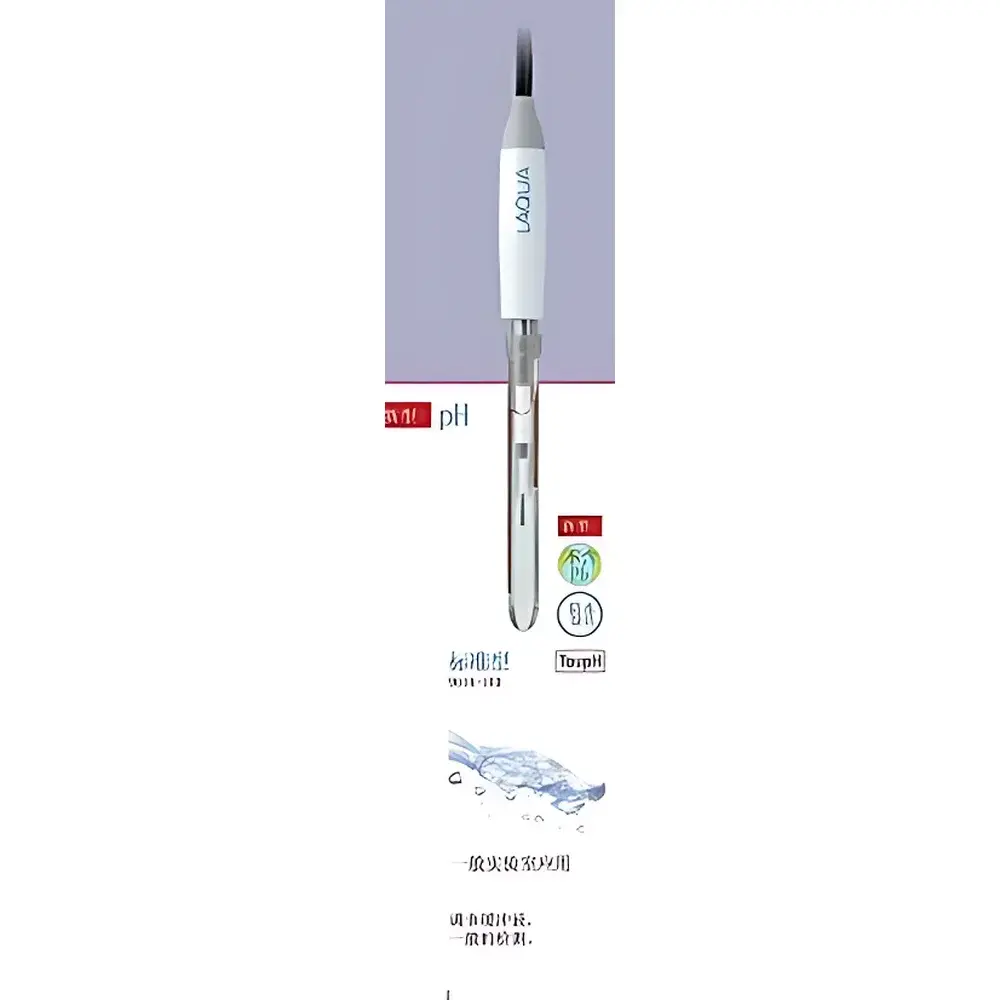
HORIBA 9615-10D ToupH™ Tri-Function pH Electrode (pH/Temp/ORP)
| Brand | HORIBA |
|---|---|
| Origin | Japan |
| Model | 9615-10D |
| Temperature Range | 0–100 °C |
| pH Range | 0–14 |
| Compliance | ISO 3696 (Grade 2 water), ASTM D1293, USP <791>, JIS Z 8802 |
| Electrode Type | Integrated Glass pH Sensor + Ag/AgCl Reference + Pt ORP Element + NTC Thermistor |
| Body Material | Chemically Resistant PPS Plastic |
| Tip Geometry | Flat-Surface Ceramic Junction with Sub-100 µm Guard Gap |
| Response Time (t₉₀) | ≤15 s (pH 4 → 7 → 10 buffer transition, 25 °C) |
| Drift | <0.01 pH/h (24 h, stable electrolyte fill) |
| Mechanical Strength | >10× JIS R 3201 (Glass Electrode Impact Resistance Standard) |
Overview
The HORIBA 9615-10D ToupH™ Tri-Function pH Electrode is an integrated electrochemical sensor engineered for high-reproducibility pH, redox potential (ORP), and temperature measurements in demanding laboratory, quality control, and process environments. Unlike conventional combination electrodes, the 9615-10D implements a unified tri-sensing architecture—simultaneously delivering calibrated pH (via patented rare-earth-doped glass membrane), ORP (via embedded platinum element), and temperature compensation (via precision NTC thermistor)—all within a single, robust PPS housing. Its measurement principle adheres to the Nernst equation for pH (E = E⁰ − (RT/F) ln(10)·pH) and the mixed-potential theory for ORP, ensuring traceable compliance with ISO 3696 (for purified water testing), ASTM D1293 (for surface water), and USP (for pharmaceutical aqueous solutions). Designed for continuous immersion or intermittent contact, it eliminates inter-sensor calibration drift and positional error associated with multi-electrode setups.
Key Features
- Patented Rare-Earth-Doped pH Glass Membrane: Incorporates HORIBA-developed lanthanide oxide compounds to reduce response time by 50% versus conventional glass membranes (t₉₀ ≤15 s), while increasing mechanical durability beyond JIS R 3201 requirements by a factor of ten.
- Stabilized Double-Junction Reference System: Features a hollow-fiber cation-selective membrane surrounding the Ag/AgCl reference element, suppressing silver ion migration and complex formation by >99.9%—minimizing junction potential drift and maintaining stable liquid junction potential over extended operation.
- Flat-Surface Ceramic Junction with Sub-100 µm Guard Gap: Enables direct surface pH mapping of solid samples, gel matrices, and microdroplets (≥5 µL); prevents air bubble entrapment at the sensing interface and ensures consistent electrolyte outflow under low-flow or static conditions.
- Integrated ORP Sensing Element: Platinum working electrode co-located with pH and temperature sensors enables simultaneous redox potential measurement without cross-contamination or spatial offset—critical for disinfection monitoring (e.g., chlorine residual in potable water) and fermentation redox profiling.
- ESD-Resistant Semiconductor Architecture: Combines proprietary gate oxide passivation and active charge-dissipation circuitry to eliminate electrostatic discharge (ESD) susceptibility—a known failure mode in ISFET-based and high-impedance glass electrodes—ensuring operational reliability in dry-lab and cleanroom settings.
Sample Compatibility & Compliance
The 9615-10D is validated for use across diverse sample matrices including aqueous buffers, biological suspensions (cell cultures, fermentation broths), low-conductivity ultrapure water (≥1 MΩ·cm), and semi-solid formulations (creams, gels, hydrogels). It meets GLP/GMP documentation requirements via full traceability to NIST-traceable pH standards (NIST SRM 186, 4699) and supports audit-ready data integrity through compatible HORIBA LAQUA Smart software (21 CFR Part 11 compliant when deployed with electronic signature modules). The electrode complies with ISO 17025-accredited calibration protocols and is routinely employed in environmental labs (EPA Method 150.1), pharmaceutical QC (ICH Q5C stability studies), and food safety testing (AOAC 984.27).
Software & Data Management
When paired with HORIBA LAQUA Smart v4.2+ or LAQUA Twin series meters, the 9615-10D enables automatic sensor recognition, real-time temperature-compensated pH/ORP calculation, and auto-ranging calibration (1–3 point). Raw analog outputs (mV, Ω, °C) are logged at 1 Hz resolution with timestamped metadata (operator ID, calibration history, electrode serial number). Data export supports CSV, PDF, and XML formats compatible with LIMS integration (e.g., LabWare, Thermo Fisher SampleManager). Firmware updates preserve calibration coefficients and support future regulatory enhancements—including enhanced audit trail logging per FDA 21 CFR Part 11 Annex 11 requirements.
Applications
- Pharmaceutical manufacturing: In-process pH and redox monitoring during lyophilization cycle development and buffer preparation.
- Biotechnology: Real-time pH/ORP profiling in single-use bioreactors and downstream purification skids.
- Environmental testing: Simultaneous field measurement of pH, ORP, and temperature in wastewater influent/effluent streams per EPA guidance.
- Academic research: Surface pH mapping of polymer films, hydrogel drug delivery systems, and biofilm interfaces using flat-tip geometry.
- Food & beverage QA: Rapid verification of acidification endpoints in dairy fermentation and shelf-life stability testing.
FAQ
Is the 9615-10D compatible with non-HORIBA meters?
Yes, it operates as a standard BNC + mini-DIN (or 6-pin) analog sensor and is interoperable with most pH/ORP/temperature-capable benchtop or portable meters supporting separate mV, RTD, and ORP inputs.
What is the recommended storage condition?
Store upright in 3 M KCl solution or HORIBA Storage Solution (Cat. No. 9300-0000); avoid prolonged dry storage unless using the optional ISFET-compatible variant.
Can it be used for low-ionic-strength samples like deionized water?
Yes—the double-junction design and low-resistance ceramic frit minimize liquid junction error; however, use of a dedicated low-conductivity sleeve electrode (e.g., 6367-10D) is advised for sub-10 µS/cm applications.
Does it require recalibration after each use?
No—drift remains below 0.01 pH/h under stable thermal conditions; daily two-point calibration (pH 4.01 and 7.00) is sufficient for GLP-compliant operations.
How is electrostatic discharge protection implemented?
Through a dual-layer approach: (1) silicon nitride passivation of internal gate structures and (2) transient voltage suppression circuitry integrated into the electrode cable’s signal conditioning module.





