
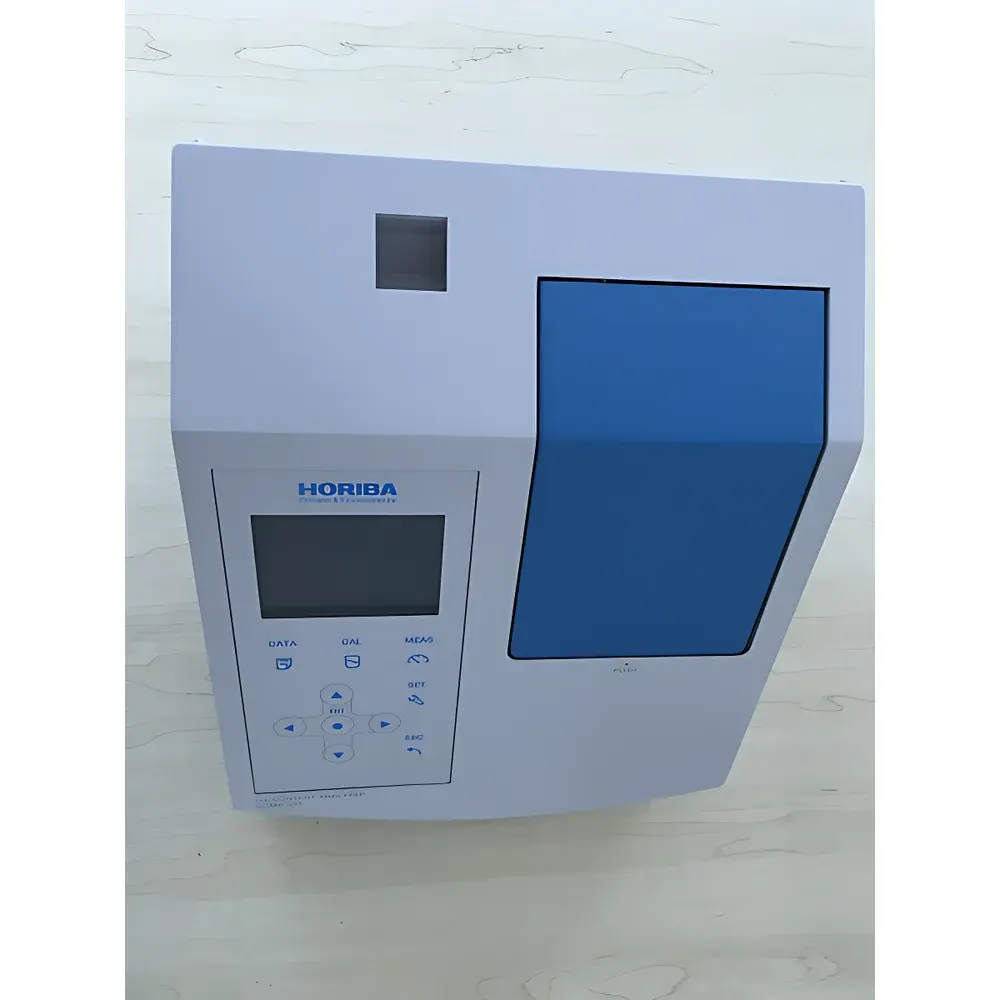
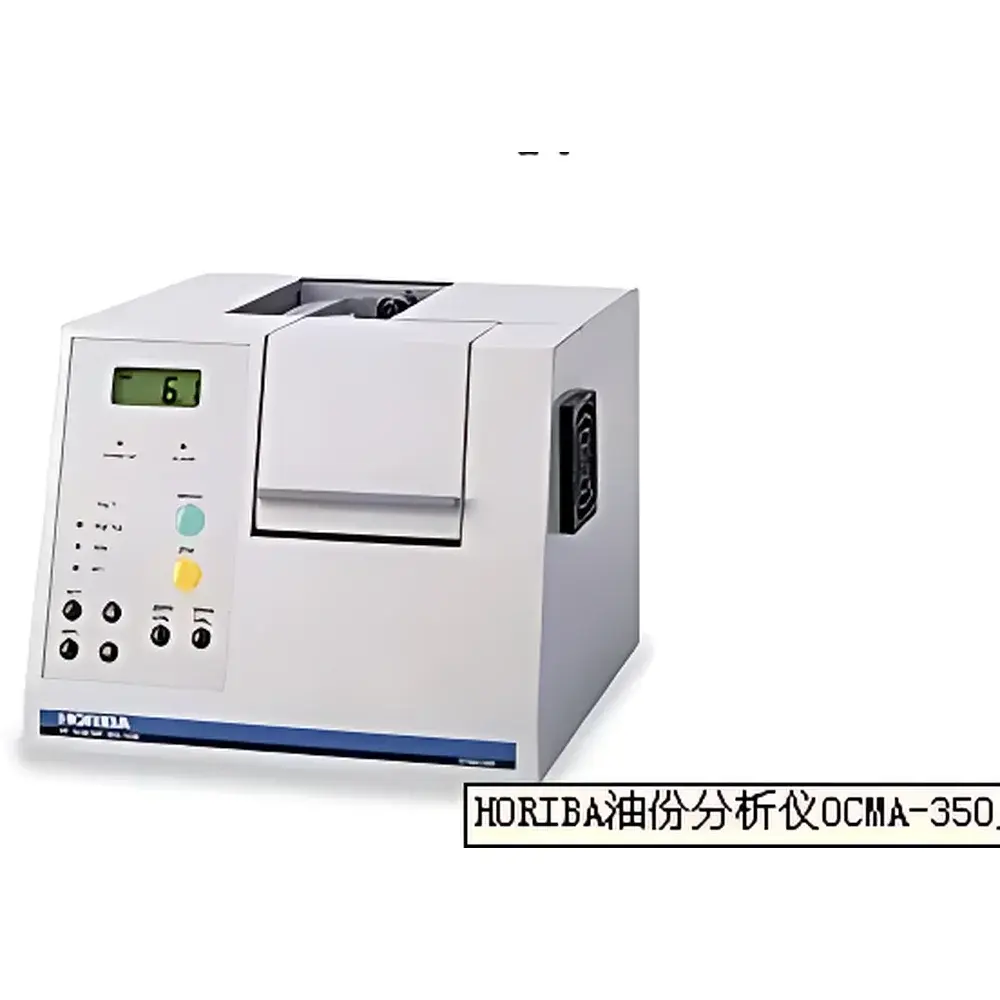
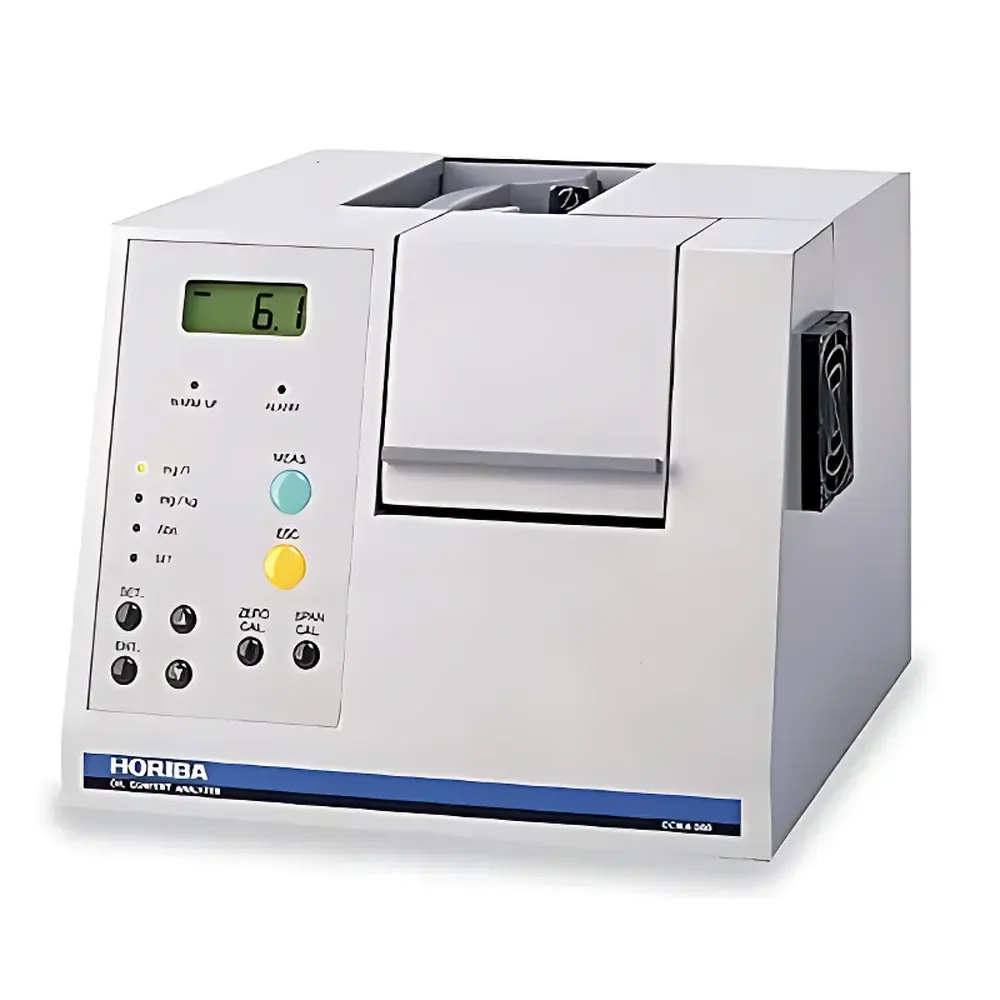
HORIBA OCMA-555 Portable Oil Content Analyzer
| Brand | HORIBA |
|---|---|
| Origin | Japan |
| Model | OCMA-555 |
| Instrument Type | Portable |
| Measurement Principle | Non-Dispersive Infrared (NDIR) Absorption Spectrophotometry |
| Extraction Solvent | H-997 |
| Measurement Range | 0–200 mg/L (water), 0–1000 mg/kg (soil), 0–1 Abs |
| Repeatability | ±0.4 mg/L (0–9.9 mg/L), ±2.0 mg/L (10.0–99.9 mg/L), ±4 mg/L (100–200 mg/L), ±1% F.S. (0–1 Abs) |
| Detection Limit | 0.1 ppm |
| Optical Path | Quartz Cuvette (200 mm path length) |
| Display | Backlit LCD with timestamping |
| Interface | RS-232C, Parallel Printer Port |
| Power Supply | 230 V AC, 50 Hz |
| Dimensions | 250 × 200 × 285 mm (W × H × D) |
| Standard Accessories | Covered quartz cuvette, power cord, heavy oil standard (B-grade), 2 A fuse, 10 mL and 25 µL syringes |
Overview
The HORIBA OCMA-555 is a portable, field-deployable oil content analyzer engineered for precise quantification of hydrocarbon contaminants in aqueous and solid-phase environmental samples. It operates on the principle of non-dispersive infrared (NDIR) absorption spectrophotometry at the characteristic C–H stretching vibration band near 3.4 µm — a spectral region where hydrocarbons exhibit strong, selective absorbance while common extraction solvents (e.g., H-997) remain optically transparent. This spectral selectivity ensures measurement specificity to aliphatic and aromatic hydrocarbons without interference from water, particulates, or solvent residuals. Unlike gravimetric or fluorescence-based methods, the OCMA-555 delivers trace-level sensitivity (detection limit: 0.1 ppm) with high reproducibility across diverse matrices — including wastewater effluents, leachates from contaminated soils, industrial cooling fluids, and surface residues on machined metal or semiconductor wafers. Its design adheres to core principles of regulatory-compliant environmental analysis: minimal solvent consumption, operator-independent measurement execution, and built-in calibration traceability.
Key Features
- Triple-unit display capability: seamlessly switch between concentration units — mg/L (for water extracts), mg/kg (for soil extracts), and absorbance (Abs) — enabling direct compliance reporting per ASTM D7066, ISO 9377-2, and EPA Method 1664B.
- Integrated thermal-electric detector with temperature-stabilized optical path, ensuring stable baseline performance under variable ambient conditions (10–40 °C operating range).
- Backlit LCD interface with automatic timestamping for each measurement; supports GLP-compliant recordkeeping without external software dependency.
- Dedicated H-997 solvent compatibility — a chlorinated hydrocarbon-free alternative to S-316 — reducing hazardous waste generation and aligning with EU REACH and OSHA solvent exposure guidelines.
- Compact benchtop/portable form factor (250 × 200 × 285 mm) with integrated power supply (230 V AC, 50 Hz), eliminating need for battery packs or inverters in field deployments.
- One-button measurement workflow: after solvent extraction, sample introduction into the 200-mm-path-length quartz cuvette initiates automated zeroing, reference acquisition, and quantitative analysis within <15 seconds.
Sample Compatibility & Compliance
The OCMA-555 is validated for use with liquid-phase samples (e.g., wastewater, coolant emulsions, rinse waters) and solid-phase matrices (e.g., soil, sediment, swabbed surfaces) following standardized solvent extraction protocols. For aqueous samples, H-997 extraction yields recoveries >95% for C10–C40 aliphatics and monoaromatics (per ISO 9377-2 Annex B). Soil extractions employ Soxhlet or ultrasonic-assisted protocols compliant with ISO 16703 and ASTM D5172. The instrument’s optical architecture meets IEC 61000-4 electromagnetic immunity requirements for industrial environments. All firmware operations support audit-trail functionality, satisfying FDA 21 CFR Part 11 data integrity expectations when paired with validated LIMS integration via RS-232C.
Software & Data Management
While the OCMA-555 operates as a standalone analyzer, its RS-232C serial interface enables bidirectional communication with laboratory information management systems (LIMS) or custom data acquisition platforms. Raw absorbance values, calculated concentrations, timestamps, and unit selections are transmitted in ASCII format with configurable delimiters. No proprietary drivers are required; standard terminal emulation (e.g., Tera Term, PuTTY) suffices for real-time logging. Internal memory retains up to 1000 measurement records with date/time stamps, accessible directly on the LCD or exportable via printer port (Centronics-compatible). Optional solvent regeneration module SR-305 (sold separately) extends H-997 usability by >85% through dual-stage activated carbon/activated alumina purification — reducing solvent disposal frequency and lifecycle cost per analysis.
Applications
- Regulatory wastewater monitoring: verification of discharge compliance against local limits (e.g., ≤10 mg/L total petroleum hydrocarbons in municipal pretreatment ordinances).
- Hazardous site characterization: rapid on-site screening of soil cores for diesel-range organics (DRO) and gasoline-range organics (GRO) prior to lab confirmation.
- Industrial process control: validation of cleaning efficacy in semiconductor wafer rinsing baths, precision machining coolant recirculation loops, and textile desizing effluents.
- Environmental forensics: differentiation of petroleum vs. biogenic hydrocarbons using spectral shape analysis (absorbance profile evaluation at 3.4 µm).
- Research applications: kinetic studies of oil biodegradation in microcosms, sorption isotherm determination on activated carbon filters, and emulsion stability assessment in produced water treatment.
FAQ
What extraction solvent is required for the OCMA-555?
The OCMA-555 is optimized for H-997 solvent — a non-chlorinated, low-toxicity alternative to legacy S-316. H-997 provides equivalent extraction efficiency for C10–C40 hydrocarbons while complying with modern occupational safety and environmental regulations.
Can the OCMA-555 measure dissolved vs. dispersed oil separately?
No — it quantifies total extractable petroleum hydrocarbons (TEPH) as defined in EPA Method 1664B. Phase separation (e.g., centrifugation or membrane filtration) must be performed upstream if fractionated analysis is required.
Is calibration verification traceable to NIST standards?
Yes — factory calibration uses certified heavy oil standard (B-grade) with documented uncertainty. Users may perform in-house verification using secondary standards traceable to NIST SRM 2721 or equivalent.
Does the instrument support multi-point calibration?
The OCMA-555 performs single-point auto-calibration upon startup using the internal reference. Multi-point calibration is not implemented; linearity across 0–200 mg/L is verified per ISO/IEC 17025 during type testing and remains stable for ≥6 months under routine use.
How is solvent carryover mitigated between measurements?
The quartz cuvette is manually rinsed with fresh H-997 between samples, and the optical chamber includes passive purge airflow to minimize vapor condensation — a procedure validated in HORIBA Application Note AN-OCMA-021.







