
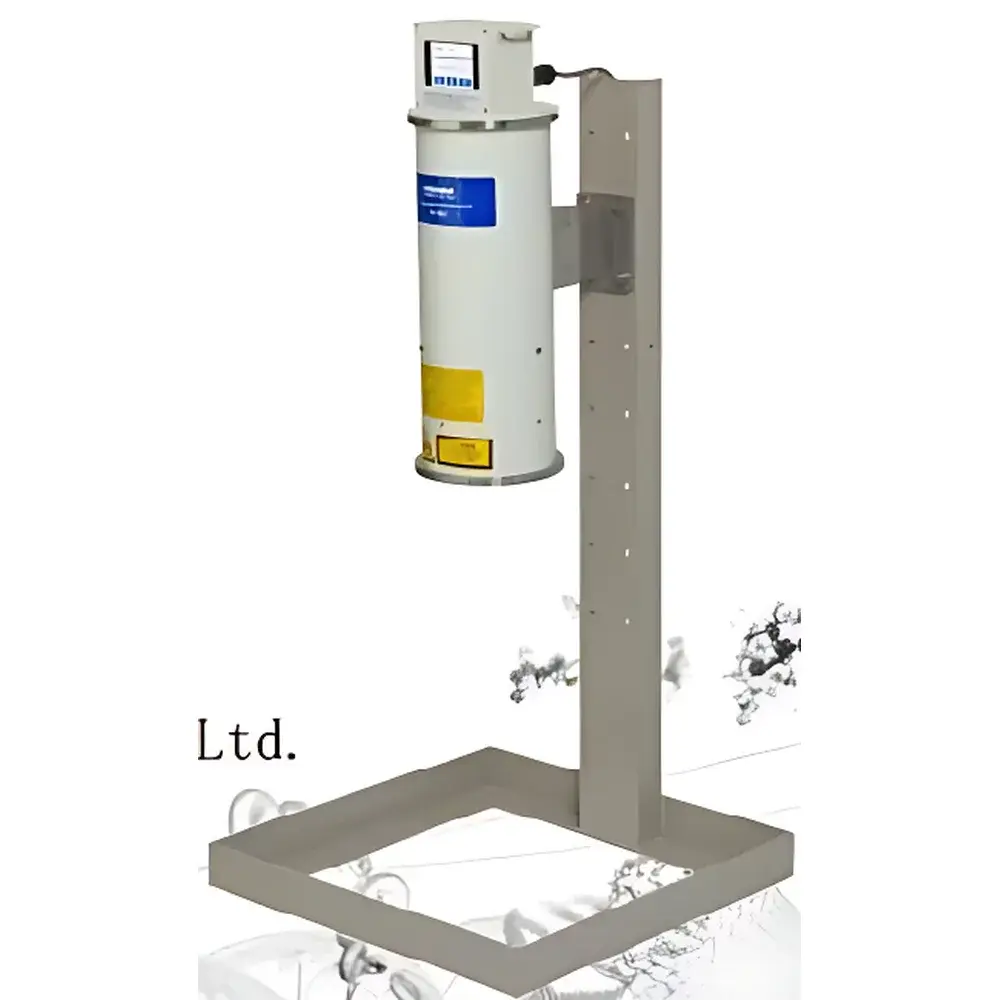
HORIBA LO-300 Online Oil Film Monitor
| Brand | HORIBA |
|---|---|
| Origin | Japan |
| Model | LO-300 |
| Instrument Type | Online |
| Measurement Principle | Laser Circular Area Scanning Reflectometry |
| Accuracy | ≤2.0% FS |
| Detection Range | 0–10 ppm (as oil film coverage equivalent) |
| Flow Rate Compatibility | Up to 100 L/min |
| Detection Distance | 0.3–4.0 m (up to 6.0 m on still water) |
| IP Rating | IP66 |
| Operating Temperature | −10 to +50 °C |
| Power Supply | AC 100 V ±10%, 50/60 Hz, ≤100 VA |
| Dimensions | Ø185 × 547 mm (H) |
| Weight | ~11 kg |
Overview
The HORIBA LO-300 Online Oil Film Monitor is an industrial-grade, non-contact optical instrument engineered for continuous, real-time detection of floating hydrocarbon films on water surfaces in environmental monitoring, wastewater treatment, and industrial effluent discharge applications. Unlike conventional extractive or fluorescence-based oil-in-water analyzers, the LO-300 employs a Class 2 semiconductor laser (≤1 mW output) configured in a circular area scanning geometry. This method measures spatially resolved reflectance variations across a defined scan zone—enabling quantitative assessment of oil film presence, surface coverage ratio (0–100%), and temporal persistence without physical sampling or reagent consumption. Its operational principle relies on differential reflectivity between clean water and hydrophobic oil layers under controlled incident laser illumination, delivering high reproducibility in dynamic outdoor environments including open channels, retention basins, and stormwater outfalls.
Key Features
- Non-invasive, maintenance-free operation: No immersion probes, no consumables, no calibration fluids required—designed for extended unattended deployment.
- Automatic vertical alignment system: Integrated motorized adjustment ensures optimal emitter–receiver collimation during installation, minimizing setup time and angular misalignment errors.
- Extended detection range: Configurable over 0.3–4.0 m; up to 6.0 m on still water surfaces—ideal for elevated mounting above wide channels or containment berms.
- Laser circular scanning optics: Eliminates wave-induced false positives by averaging reflectance over a stable 360° azimuthal profile, significantly improving robustness in turbulent or wind-affected conditions.
- Intelligent alarm logic: User-definable thresholds based on oil film area percentage, minimum duration (e.g., sustained >30 s), and intensity level—reducing nuisance alarms from transient debris or foam.
- IP66-rated stainless-steel housing: Certified for permanent outdoor installation in harsh industrial or municipal settings, resistant to rain, dust, and temperature extremes (−10 to +50 °C).
- Integrated color touchscreen interface: Full-featured local HMI with real-time visualization of reflected signal strength (4–20 mA), oil coverage %, setpoints, and status indicators.
Sample Compatibility & Compliance
The LO-300 detects free-phase hydrocarbons forming visible surface films—including gasoline, kerosene, diesel, heavy fuel oil, insulating oils, and lubricants. It does not respond to water-soluble oils or emulsified hydrocarbons below the detection threshold of monolayer formation. The instrument complies with IEC 60825-1 for Class 2 laser safety and meets EN 61326-1 (EMC) and EN 61000-6-2/6-4 for industrial electromagnetic compatibility. While not a certified regulatory analyzer per EPA Method 1664 or ISO 9377-2, its performance characteristics support pre-compliance screening, leak detection, and operational readiness verification in facilities subject to ISO 14001, ISO 50001, or local discharge permit requirements. Optional video recording functionality enables audit-ready documentation aligned with GLP-aligned incident investigation protocols.
Software & Data Management
Standard analog outputs include one isolated 4–20 mA channel (proportional to normalized reflectance signal) and two dry-contact relay outputs (oil alarm and system fault). For networked integration, optional LAN connectivity supports remote monitoring via standard TCP/IP protocols—enabling data logging into SCADA, DCS, or cloud-based environmental management platforms. When equipped with the optional surveillance camera module, the system records MP4-formatted video clips (6 MB per event at 3 fps) capturing 30 seconds pre- and post-alarm trigger. Timestamped color footage includes on-screen overlay of date/time, oil coverage %, and alarm status—facilitating forensic review and regulatory reporting. Video archives are stored onboard and retrievable via Ethernet or USB export.
Applications
- Real-time monitoring of industrial cooling water return lines for hydrocarbon contamination.
- Early warning detection at wastewater treatment plant influent channels prior to primary clarification.
- Compliance surveillance at stormwater outfalls in petrochemical, automotive, and aerospace manufacturing zones.
- Leak detection in aboveground storage tank (AST) secondary containment areas and bunded yards.
- Environmental protection monitoring at port facilities, marinas, and fuel transfer terminals.
- Supporting ISO 14001 environmental aspect identification and operational control documentation.
FAQ
Does the LO-300 measure dissolved or emulsified oil?
No. It detects only free-floating, surface-adherent hydrocarbon films. Emulsified or solubilized oil phases are not within its detection scope.
Can it operate under direct sunlight?
Direct solar exposure on the optical path must be avoided. Use of the optional sunshade hood is strongly recommended for installations in unsheltered locations.
Is the laser safe for personnel and wildlife?
Yes. The device uses a Class 2 visible laser (≤1 mW), compliant with IEC 60825-1. No special protective equipment is required during normal operation.
What maintenance intervals are recommended?
Optical windows require periodic cleaning (quarterly or as site conditions dictate); no internal calibration or sensor replacement is needed within the first five years of service.
Can the alarm thresholds be customized remotely?
Yes—via the web-based configuration interface when connected to a LAN. Thresholds for coverage %, dwell time, and hysteresis can be adjusted without physical access.







