
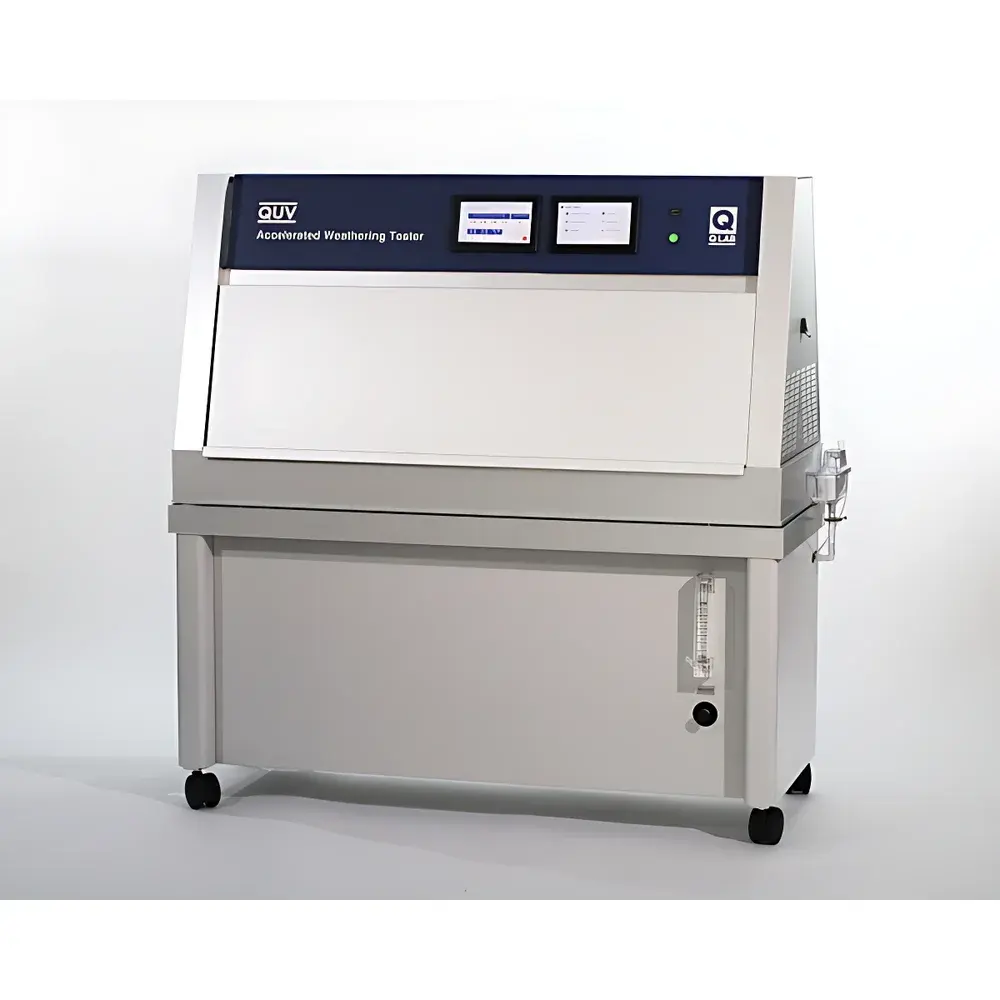
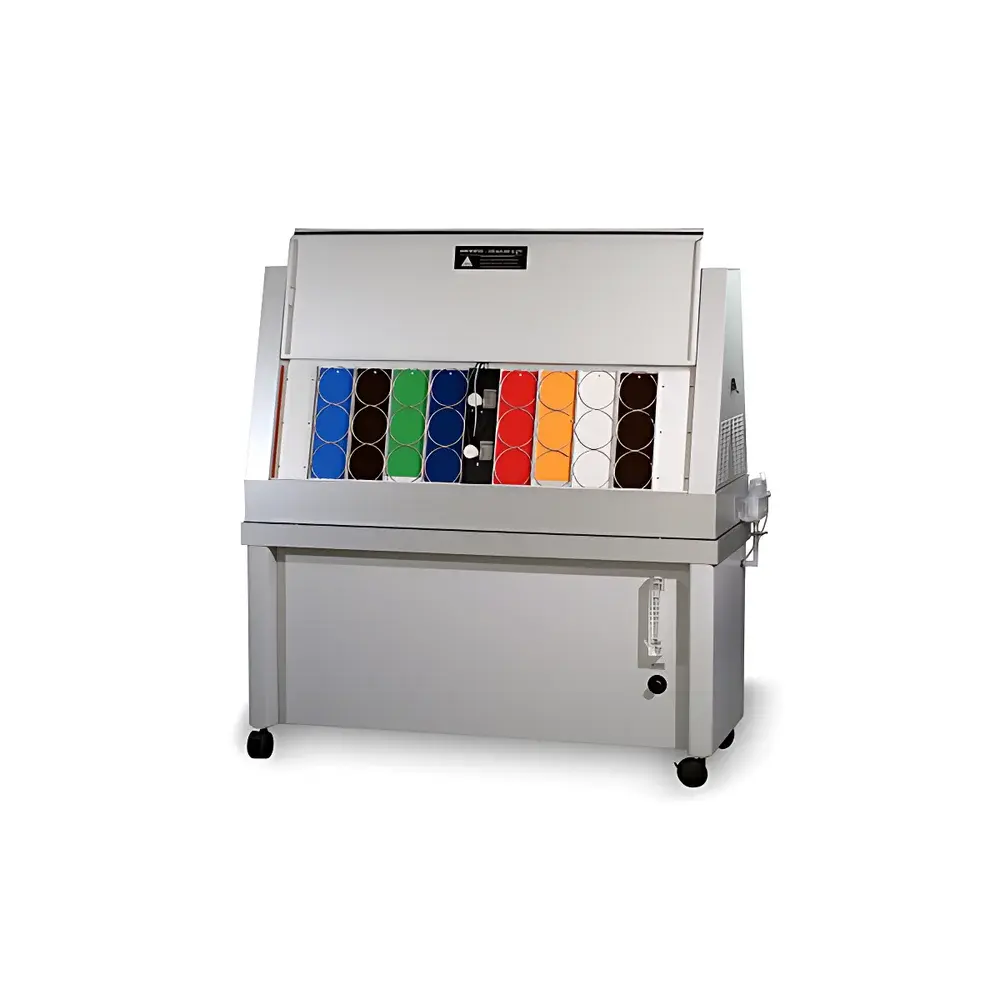
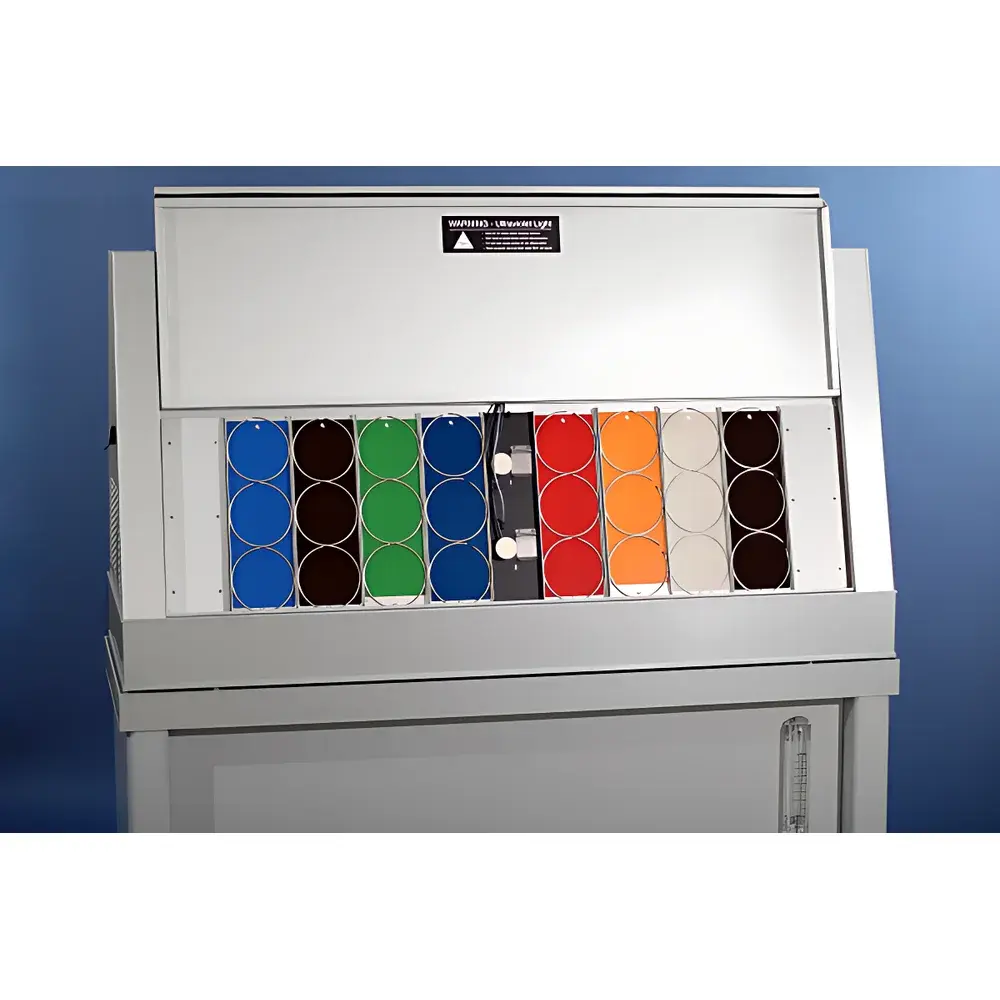
Q-LAB QUV Advanced UV Accelerated Weathering Tester
| Brand | Q-LAB |
|---|---|
| Origin | USA |
| Manufacturer Type | Original Equipment Manufacturer (OEM) |
| Import Status | Imported |
| Model | QUV |
| Humidity Range | 10–95% RH |
| Lamp Power | 40 W |
| Irradiance Range | 0.25–1.3 W/m² |
| Test Duration | User-Defined |
| Light Exposure Temperature Range | 40–80 °C |
| Black Panel Temperature Range | 35–80 °C |
| UV Wavelength Range | 250–400 nm |
Overview
The Q-LAB QUV Advanced UV Accelerated Weathering Tester is an industry-standard benchtop instrument engineered for precision simulation of outdoor weathering stressors—primarily short-wave ultraviolet (UV) radiation, thermal cycling, and condensation moisture—on polymeric materials, coatings, adhesives, textiles, and composites. Unlike broad-spectrum xenon arc or carbon arc testers, the QUV system employs fluorescent UV lamps to replicate the most photochemically aggressive portion of terrestrial solar irradiance (250–400 nm), where photon energy exceeds bond dissociation thresholds for C–C, C–H, and C–O linkages. This targeted spectral output enables accelerated degradation mechanisms—including chain scission, crosslinking, chromophore bleaching, and surface oxidation—to manifest in days or weeks rather than years, while maintaining mechanistic fidelity to real-world field exposure. The integrated condensation cycle replicates dew formation—the dominant moisture exposure mechanism in natural outdoor environments—not rainfall—by thermally driving water vapor onto cooled specimen surfaces, thereby inducing hygrothermal stress without mechanical erosion.
Key Features
- Fluorescent UV lamp arrays with selectable spectral outputs (UVA-340, UVB-313, UVC, or cool white) compliant with ISO 4892-3, ASTM G154, and SAE J2020
- Precise black panel temperature control (35–80 °C) and chamber air temperature regulation (40–80 °C) via PID-controlled heaters and forced-air circulation
- Condensation humidity generation through heated water reservoir and controlled surface cooling—no external humidifier required
- SOLAR EYE irradiance feedback control (standard on QUV/se, QUV/spray, QUV/uvc, and QUV/cw models) ensures traceable, stable UV intensity within ±5% of setpoint across lamp lifetime
- AUTOCAL calibration system enables rapid, operator-independent radiometric verification using built-in reference sensors and NIST-traceable calibration routines
- 17-language touchscreen interface with intuitive test programming, real-time parameter monitoring, and password-protected user levels (Operator, Technician, Administrator)
- Ethernet connectivity supporting MODBUS TCP and HTTP protocols for integration into LIMS or centralized data acquisition systems
- Comprehensive self-diagnostic engine with predictive service alerts, error logging, and maintenance history tracking aligned with GLP/GMP documentation requirements
Sample Compatibility & Compliance
The QUV accommodates up to 48 standard specimens (75 mm × 150 mm) on its rotating sample wheel, with optional fixtures for irregular geometries, 3D parts, or multi-layer laminates. All configurations comply with international testing standards including ISO 4892-3 (Plastics — Methods of exposure to laboratory light sources — Part 3: Fluorescent UV lamps), ASTM G154 (Standard Practice for Operating Fluorescent Ultraviolet (UV) Lamp Apparatus for Exposure of Non-Metallic Materials), and IEC 61215 (for PV module qualification). The system supports full audit trails, electronic signatures, and 21 CFR Part 11–compliant data integrity features when operated with validated software packages. Calibration certificates are issued per ISO/IEC 17025 requirements, with uncertainty budgets documented for irradiance, temperature, and humidity parameters.
Software & Data Management
Q-LAB’s QUVMaster™ software (optional) provides advanced test method library management, automated report generation (PDF/CSV), trend analysis, and comparative degradation modeling across multiple material batches. Raw sensor data—including irradiance (W/m²), black panel temperature (°C), chamber humidity (%RH), and elapsed time—is timestamped at 1-second intervals and stored locally on internal flash memory (16 GB) with automatic rollover. Export formats include .csv, .xlsx, and XML for third-party statistical analysis (e.g., JMP, Minitab). Firmware updates are delivered via secure HTTPS and validated cryptographically prior to installation. All data records include immutable metadata: operator ID, instrument serial number, calibration date, and environmental chamber log entries.
Applications
- Automotive OEMs validating exterior trim durability against ISO 20671 and GMW14124
- Architectural coating manufacturers qualifying weather resistance per AAMA 2605 and ASTM D4587
- Photovoltaic encapsulant R&D assessing yellowing and delamination under IEC 61215-2 MQT10
- Medical device polymer suppliers verifying ISO 10993-12 extractables stability under simulated shelf-life conditions
- Aerospace composites testing per Boeing BMS 8-130 and Airbus AITM 1-0002
- Consumer electronics housing validation for UV-induced gloss loss and microcracking per IPC-CC-830B
FAQ
What UV spectral bands does the QUV support?
The base QUV system operates with UVA-340 lamps (peak 340 nm, simulating sunlight down to 295 nm). Optional lamp types include UVB-313 (enhanced short-wave output), UVC (254 nm germicidal), and cool white (visible spectrum only). All lamps are interchangeable without hardware modification.
How is condensation moisture generated—and why not use spray?
Condensation is formed by heating deionized or tap water in a stainless-steel reservoir and allowing saturated vapor to contact cooler specimen surfaces—mimicking nocturnal dew formation. Spray cycles (available on QUV/spray) simulate rain but introduce mechanical stress not representative of typical outdoor moisture exposure; condensation remains the preferred method for photodegradation-focused studies.
Is calibration traceable to national standards?
Yes. The SOLAR EYE irradiance sensor is calibrated against NIST-traceable reference detectors. AUTOCAL performs in situ verification using factory-calibrated reference cells, and full recalibration services are available through Q-LAB’s ISO/IEC 17025-accredited laboratories.
Can the QUV operate unattended for extended durations?
Yes. The system is designed for continuous 24/7 operation with redundant safety interlocks, thermal cutoffs, and automatic lamp replacement alerts. Internal data logging persists through power interruption, and Ethernet-based remote monitoring enables off-site oversight.
Does the QUV meet FDA or pharmaceutical regulatory requirements?
While not a GxP-certified instrument out-of-the-box, the QUV supports 21 CFR Part 11 compliance when configured with QUVMaster™ software, electronic audit trails, role-based access control, and validated backup procedures—enabling use in stability-indicating method development per ICH Q1A(R2).



