
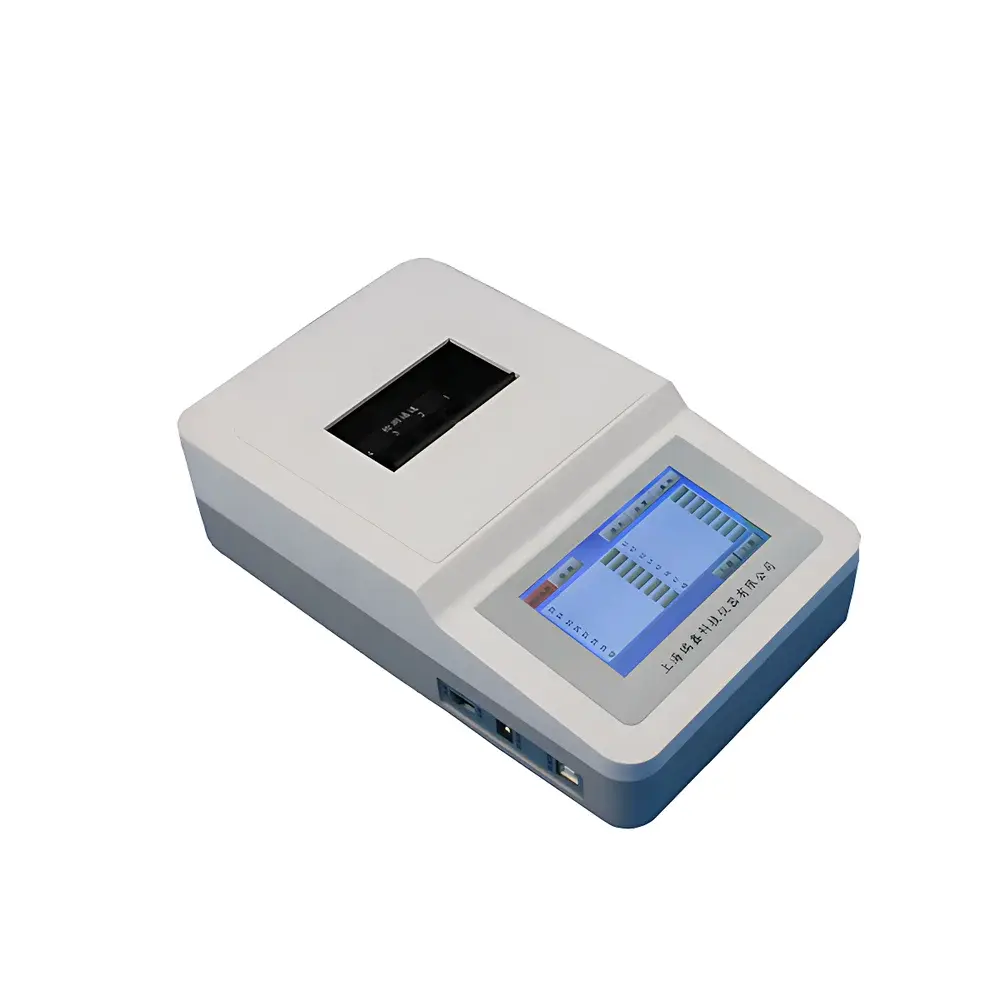
Ruixin SPb-JPb2 Portable Lead (Pb) Heavy Metal Analyzer
| Brand | Ruixin |
|---|---|
| Origin | Shanghai, China |
| Manufacturer Type | Authorized Distributor |
| Country of Origin | China |
| Model | SPb-JPb2 |
| Functionality | Single-Analyte Detection (Lead Only) |
| Sample Format | Single-Sample Dedicated Use |
| Wavelength | 540 nm |
| Detection Time | ≤3 min |
| Repeatability | ≤0.2% |
| Detection Channels | 1 |
| Absorbance Range | 0.000–4.000 |
| Transmittance Range | 0.00–100.00% |
| Transmittance Resolution | 0.01% |
| Absorbance Resolution | 0.001 |
| Photometric Accuracy (Transmittance) | ±2.0% |
| Stability (3 min) | ≤0.3% |
| LOD for Pb | 0.5 mg/kg |
| Quantification Range for Pb | 0–15 mg/kg |
| Communication Interfaces | RS-232, USB |
| Power Supply | Integrated Li-ion Battery, AC 220 V, DC 5 V |
Overview
The Ruixin SPb-JPb2 Portable Lead (Pb) Heavy Metal Analyzer is a dedicated spectrophotometric instrument engineered for rapid, on-site quantification of lead (Pb) in food matrices. It operates on the principle of visible-light absorbance measurement at a fixed wavelength of 540 nm, where lead ions—pre-concentrated and complexed with a chromogenic reagent—generate a stable colored complex proportional to concentration. This method aligns with standardized colorimetric protocols referenced in GB 5009.12–2023 (National Food Safety Standard for Determination of Lead in Foods) and supports compliance with ISO/IEC 17025 requirements for field-deployable testing. Designed for regulatory enforcement and routine screening, the SPb-JPb2 delivers quantitative results within three minutes without requiring laboratory infrastructure, making it suitable for mobile inspection units, market surveillance, and decentralized quality assurance workflows.
Key Features
- Integrated lithium-ion battery enabling ≥8 hours of continuous operation in field environments—no external power source required during transit or roadside inspections.
- 4.3-inch high-resolution color TFT touchscreen with full Chinese GUI, supporting direct input of sample names, operator IDs, and institutional metadata via on-screen keyboard or stylus.
- Self-calibrating optical path system: automatic zero and 100% transmittance calibration upon startup eliminates manual photometric alignment and reduces operator dependency.
- Dual-mode display: simultaneous real-time readout of both absorbance (0.000–4.000, resolution 0.001) and transmittance (0.00–100.00%, resolution 0.01%), facilitating method validation and cross-platform data comparison.
- Embedded thermal printer generating compliant test reports containing analyte concentration (mg/kg), Chinese-labeled sample ID, date/time stamp, analyst name, and issuing unit—fully traceable per GLP documentation standards.
- On-device data management: automatic storage of ≥1,000 test records with timestamped retrieval, searchable by sample ID or date range.
Sample Compatibility & Compliance
The SPb-JPb2 is validated for use with homogenized solid and liquid food samples—including grains, vegetables, dairy products, beverages, and processed snacks—following standardized extraction and derivatization procedures outlined in GB/T 5009.12. Its single-channel architecture ensures dedicated optimization for Pb-specific chemistry, minimizing cross-reactivity with other heavy metals (e.g., Cd, As, Hg). The instrument meets photometric performance criteria specified in JJG 178–2015 (Chinese Verification Regulation for Visible Spectrophotometers), including transmittance repeatability ≤0.2% and stability ≤0.3% over 3 minutes. While not FDA 21 CFR Part 11–compliant out-of-the-box, audit-ready data export (via USB/RS-232) enables integration into validated LIMS environments supporting GMP/GLP-aligned workflows.
Software & Data Management
Data acquisition and reporting are handled natively through the embedded firmware; no PC installation is required for basic operation. Test results are stored locally with ISO 8601 timestamps and can be exported in CSV format for offline analysis. The RS-232 and USB interfaces support bidirectional communication with central monitoring platforms—enabling real-time transmission to municipal food safety surveillance networks or enterprise-level dashboards. Firmware updates are delivered via USB flash drive, ensuring version control and traceability across device fleets deployed across regional inspection agencies.
Applications
- Routine surveillance by municipal market supervision bureaus conducting unannounced inspections at wholesale markets, supermarkets, and school canteens.
- Field verification during food recall investigations, where rapid Pb screening informs containment decisions before lab confirmation.
- Pre-shipment screening for export-oriented food processors subject to EU Commission Regulation (EC) No 1881/2006 maximum levels for Pb in foodstuffs.
- Capacity-building in rural laboratories with limited infrastructure, serving as a primary screening tool prior to confirmatory ICP-MS analysis.
- Training and proficiency testing for QA/QC personnel under national food safety certification programs.
FAQ
What sample preparation is required prior to analysis?
Standardized acid digestion or chelation-based extraction must be performed off-instrument per GB 5009.12–2023; the SPb-JPb2 accepts only pre-processed clear supernatants or filtrates.
Can the instrument be used for metals other than lead?
No—it is a single-analyte platform optimized exclusively for Pb detection at 540 nm; no wavelength tuning or multi-element capability is supported.
Is calibration verification traceable to national standards?
Yes—factory calibration uses NIST-traceable neutral density filters; users may perform intermediate verification using certified reference materials (CRMs) such as GBW(E)100018 (Pb in rice flour).
Does the device support network authentication or user role management?
No—user access is unrestricted; however, all printed and exported reports include immutable operator and timestamp fields for accountability.
What is the expected service life of the optical components?
The LED light source and silicon photodiode detector are rated for ≥10,000 hours of operation under typical field conditions; no consumable optical parts require periodic replacement.






