
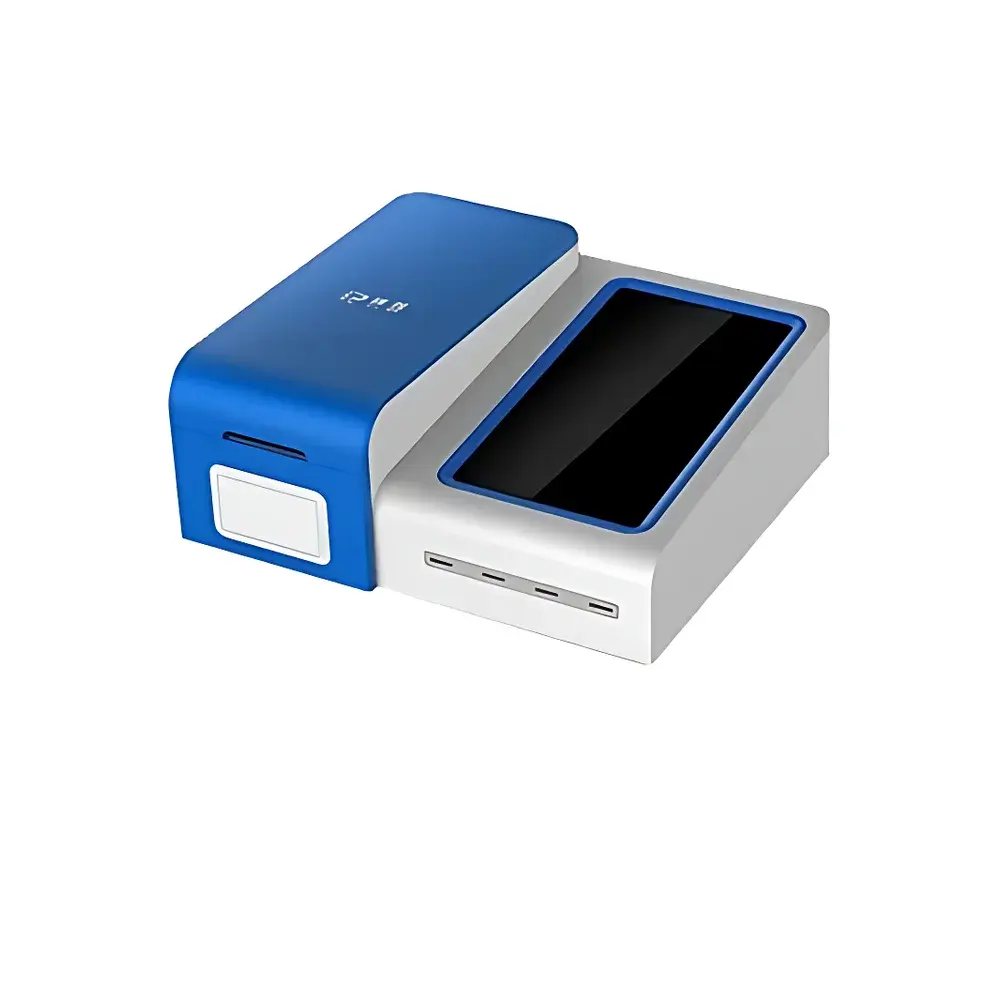
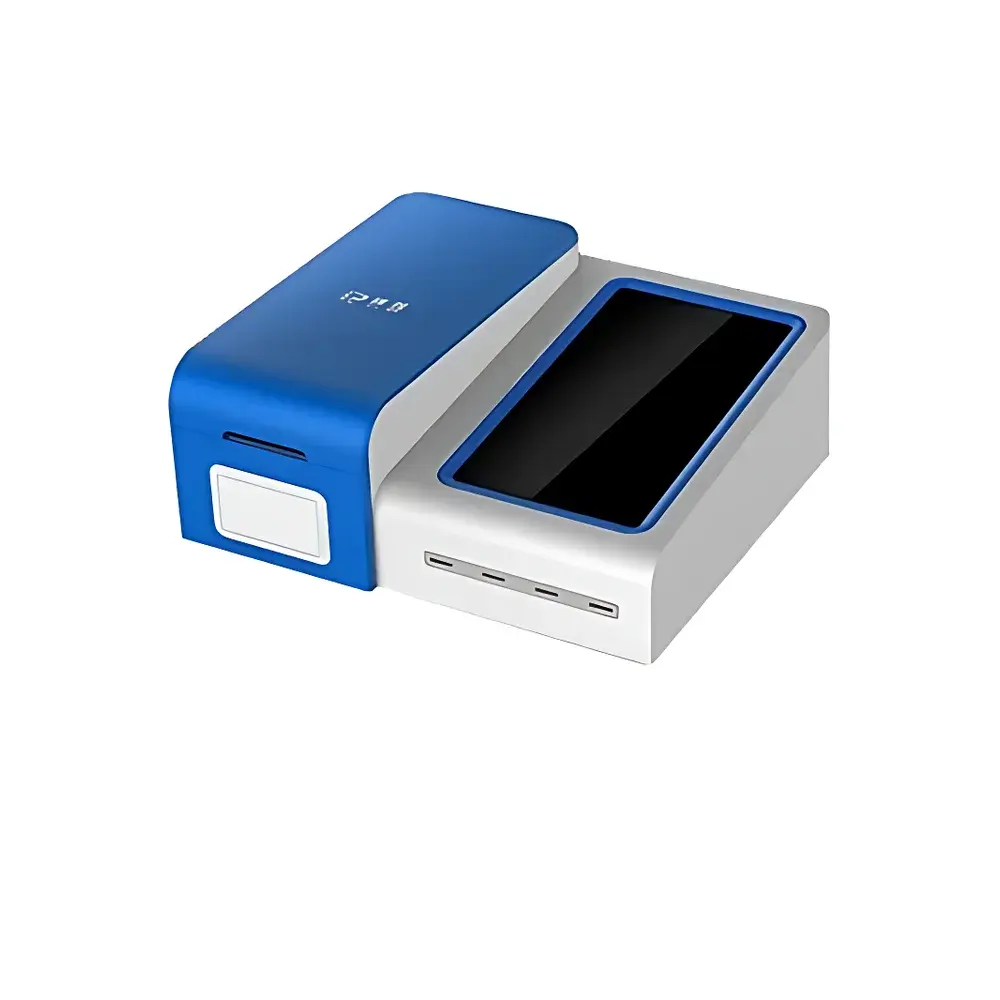
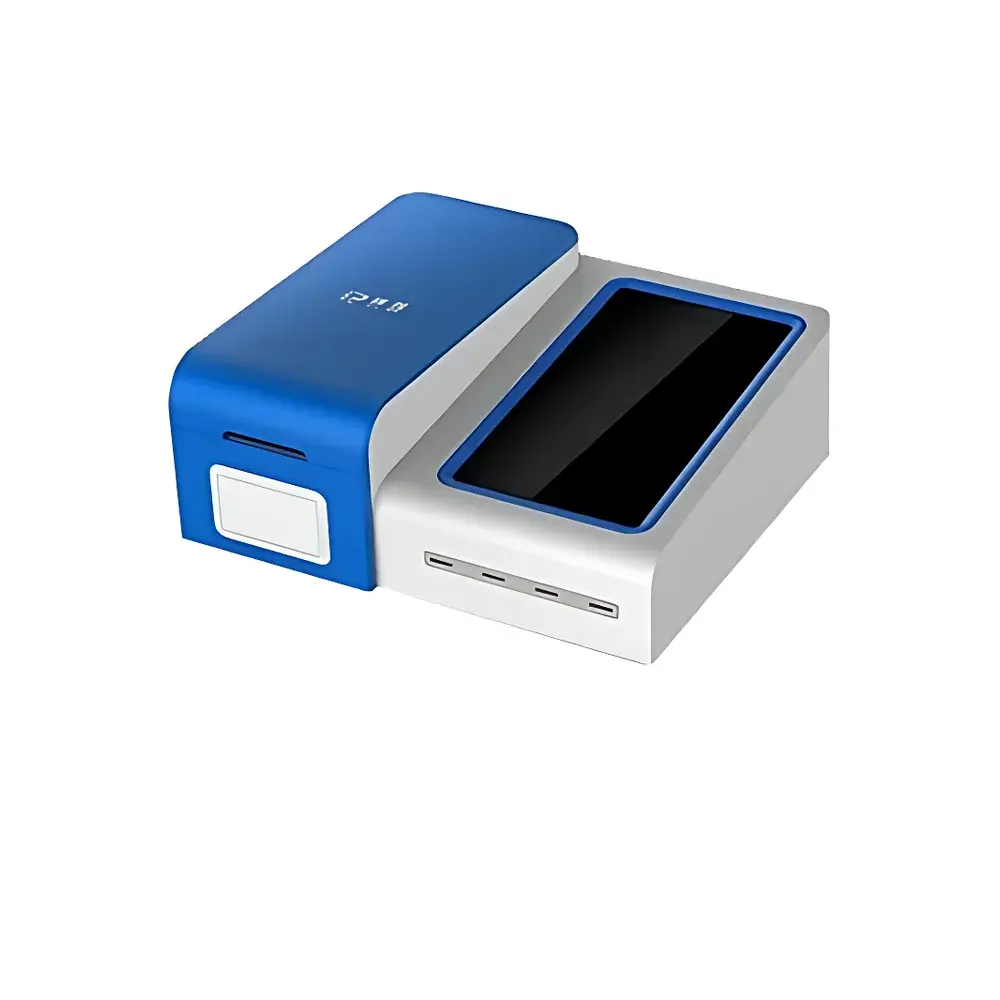
Ruixin SP-1218D Multi-Parameter Food Safety Analyzer
| Brand | Ruixin |
|---|---|
| Origin | Shanghai, China |
| Model | SP-1218D |
| Function Type | Multi-parameter rapid detection (spectrophotometric + dry immunochromatographic gold nanoparticle assay) |
| Wavelength Range | 380–680 nm |
| Detection Time | ≤3 min per sample |
| Repeatability | ≤0.3% (photometric), CV <1% (colloidal gold) |
| Detection Channels | 12 independent optical channels |
| Absorbance Range | 0.000–4.000 A |
| Transmittance Range | 0.00–100.00% T |
| Transmittance Resolution | 0.01% T |
| Absorbance Resolution | 0.001 A |
| Photometric Accuracy | ±0.5% T |
| Photocurrent Drift | ≤0.2% (3 min) |
| Overall Measurement Accuracy | ±5% (vs. reference standards) |
| Colloidal Gold Module | 3 dedicated readers with CT-ratio, colorimetric, and T/C line quantification |
| Connectivity | USB ×3, Wi-Fi, Bluetooth 4.2, 4G LTE |
| Power Supply | AC 220 V ±10% |
Overview
The Ruixin SP-1218D Multi-Parameter Food Safety Analyzer is an integrated, field-deployable analytical platform engineered for regulatory compliance and operational efficiency in food safety monitoring. It combines dual-mode detection architecture—UV-Vis spectrophotometry (380–680 nm) and quantitative dry-reagent immunochromatographic assay (colloidal gold lateral flow)—within a single ruggedized instrument. This hybrid design enables simultaneous quantification of low-molecular-weight contaminants (e.g., sulfites, formaldehyde, nitrites), pesticide metabolites (organophosphates, carbamates), veterinary drug residues (β-agonists, fluoroquinolones, sulfonamides), mycotoxins (aflatoxin B1, zearalenone), heavy metals (Pb, Cd, Hg), and adulterants (melamine, Sudan dyes) across diverse matrices. The system operates on Beer-Lambert law-based photometric calibration for colorimetric assays and employs pixel-intensity normalization algorithms for colloidal gold strip analysis, delivering trace-level sensitivity without laboratory-grade infrastructure. Designed for GLP-aligned workflows, it supports audit-ready data capture and meets foundational performance criteria referenced in ISO/IEC 17025:2017 Annex A.3 for rapid screening instrumentation.
Key Features
- 12-channel independent optical detection system enabling parallel analysis of up to 12 samples or analytes per run, significantly reducing throughput time in high-volume screening environments.
- 10.1-inch capacitive touchscreen interface with full Chinese/English bilingual GUI, supporting intuitive navigation, method selection, and real-time result visualization without external computing hardware.
- Dual detection engine: integrated spectrophotometer for quantitative colorimetric assays and three dedicated colloidal gold readers with automatic T-line/C-line recognition, CT-ratio calculation, and batch-calibrated response curves.
- Embedded thermal printer (80 mm width) generating compliant test reports per channel—including channel ID, analyte name, concentration, operator ID, timestamp, and detection unit—with optional A4 laser or inkjet output via USB host.
- Multi-modal connectivity: triple USB 3.0 ports, IEEE 802.11n Wi-Fi, Bluetooth 4.2, and embedded 4G LTE module enabling secure TLS-encrypted transmission to cloud-based LIMS or national food safety surveillance platforms (e.g., China’s NIFDC e-Surveillance System).
- Ruggedized portable enclosure meeting IP54 environmental rating; optimized for use in mobile inspection vehicles, on-site market audits, and decentralized lab settings with ambient temperature operation (10–35°C) and humidity tolerance (30–80% RH non-condensing).
Sample Compatibility & Compliance
The SP-1218D accommodates liquid extracts, homogenized suspensions, and lateral flow test strips derived from raw agricultural commodities (fruits, vegetables, grains), processed foods (oils, sauces, dairy), animal-derived products (meat, eggs, aquaculture samples), and environmental swabs. Sample preparation follows standardized extraction protocols aligned with GB/T 5009.x, SN/T series, and AOAC Official Methods® where applicable. Instrument validation adheres to internal performance verification against certified reference materials (CRMs) traceable to NIM (National Institute of Metrology, China). While not FDA 21 CFR Part 11–certified out-of-box, its audit trail functionality—including user login logs, method versioning, and immutable timestamped result export—supports GMP/GLP documentation requirements when deployed within validated organizational SOPs.
Software & Data Management
Firmware v3.2.1 includes embedded database storage for ≥50,000 test records with searchable metadata (sample ID, matrix type, analyst, location tag). Data export formats include CSV, PDF, and XML compliant with HL7 ADT and ASTM E1384 standards. Cloud synchronization utilizes AES-256 encryption and OAuth 2.0 authentication; integration with third-party LIMS is supported via RESTful API endpoints. All measurements retain raw absorbance spectra (380–680 nm at 1 nm intervals) and colloidal gold image metadata for retrospective reanalysis. Firmware updates are delivered over-the-air (OTA) with SHA-256 signature verification to ensure integrity.
Applications
- Regulatory field screening: Real-time verification of pesticide residues in fresh produce markets per GB 2763–2021 maximum residue limits (MRLs).
- Supply chain quality assurance: Rapid quantification of aflatoxin B1 in corn and peanut batches prior to milling or export.
- Food fraud detection: Identification of melamine adulteration in dairy powders and hydrolyzed vegetable protein.
- Veterinary drug monitoring: Screening for clenbuterol and ractopamine in pork liver samples using ELISA-compatible lateral flow strips.
- Environmental hygiene validation: Detection of residual chlorine dioxide or hydrogen peroxide in food contact surface swabs.
- Research & method development: Platform for validating novel immunoassay formats or optimizing extraction protocols under controlled field conditions.
FAQ
Does the SP-1218D require daily calibration with standard solutions?
No routine daily calibration is required; however, photometric verification using neutral density filters (NIST-traceable) is recommended before each shift. Colloidal gold modules auto-calibrate using internal reference strips during power-up.
Can detection methods be customized or imported from external laboratories?
Yes—users may import validated curve-fitting parameters (4PL, linear, log-log) via USB and assign them to specific analytes; all method configurations are stored with version control and change history.
Is the instrument compatible with international food safety standards such as Codex Alimentarius or EU Regulation (EC) No 396/2005?
While the hardware meets general performance benchmarks cited in Codex CAC/GL 55–2005 for rapid screening devices, method-specific validation against EU MRLs must be performed by the end-user laboratory per EN ISO/IEC 17025:2017 clause 7.2.2.
What is the expected service life of the LED light source and photodiode array?
The 380–680 nm broadband LED has a rated lifetime of ≥50,000 hours; photodiode responsivity drift is compensated algorithmically and verified annually during preventive maintenance.
How does the system handle interference from highly pigmented or turbid samples?
The software applies baseline correction using dual-wavelength subtraction (e.g., 630 nm reference) for colorimetric assays and employs adaptive thresholding for colloidal gold line detection to mitigate matrix-induced false negatives.




