
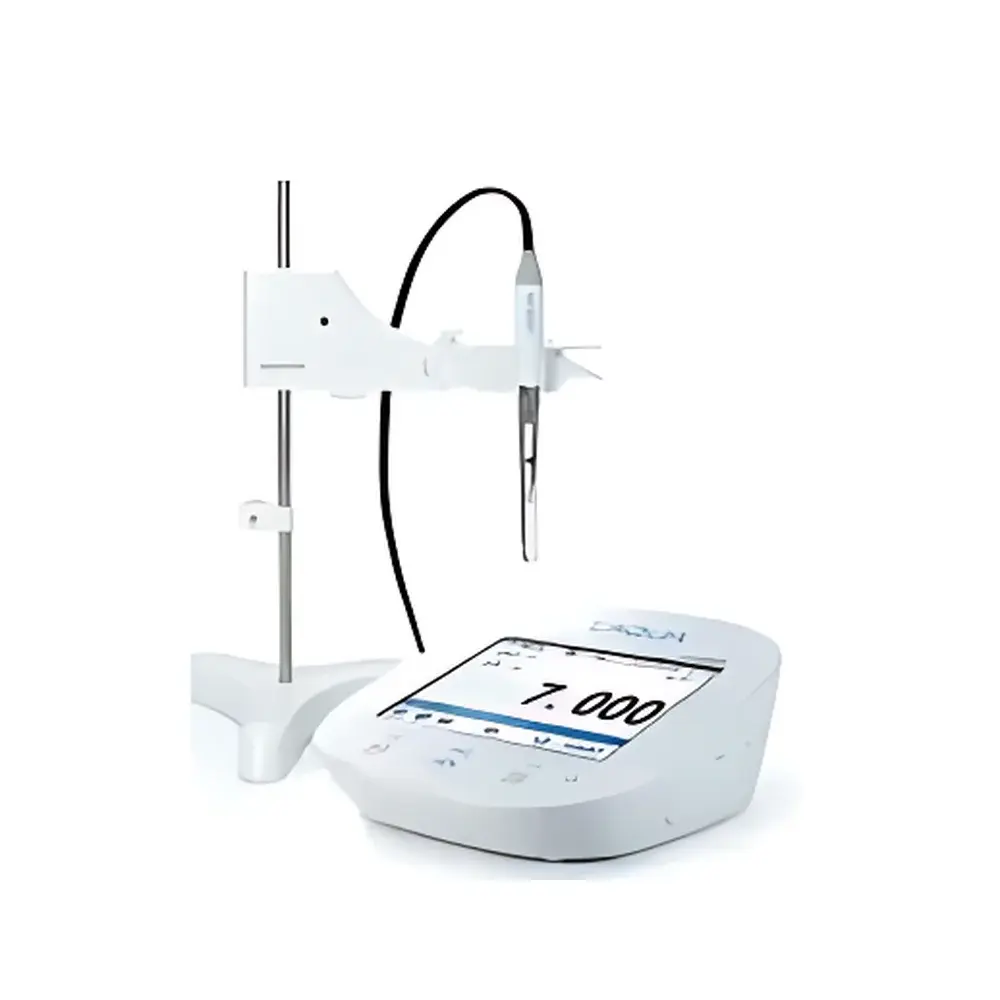
HORIBA F-70 Series Benchtop Multiparameter Water Quality Analyzer
| Brand | HORIBA |
|---|---|
| Origin | Japan |
| Model | F-70 Series |
| Instrument Type | Laboratory Water Quality Analyzer |
| Measurable Parameters | pH, ORP, Ion Concentration, Conductivity, Resistivity, Salinity, TDS, Temperature |
| Compliance | JIS, USP <645>, EP 2.2.38, JP/CP Pharmacopoeial Standards |
| Data Storage | Up to 2000 measurements |
| Connectivity | USB interface for PC communication and optional USB mass storage |
| Display | Capacitive touchscreen (F-74BW), multi-language support (English, Japanese, Chinese, Korean) |
| GLP/GMP Support | Audit-trail-capable data logging, calibration history, electrode diagnostics |
Overview
The HORIBA F-70 Series is a high-precision benchtop multiparameter water quality analyzer engineered for rigorous laboratory applications in pharmaceutical, biotechnology, environmental, and industrial R&D settings. It employs standardized electrochemical measurement principles: pH and redox potential (ORP) are determined using glass and noble-metal reference electrodes; ion concentration is measured via selective ion electrodes (ISE); conductivity is acquired using a dual-electrode AC excitation method with selectable cell constants (10, 100, or 1000 m⁻¹); resistivity, salinity, and total dissolved solids (TDS) are derived algorithmically from conductivity readings using NIST-traceable temperature compensation and configurable conversion factors. The system supports full compliance with pharmacopoeial water specifications—including USP , European Pharmacopoeia EP 2.2.38, Japanese Pharmacopoeia (JP), and Chinese Pharmacopoeia (CP)—through dedicated test modes, automated pass/fail evaluation, and documented calibration traceability.
Key Features
- Modular channel architecture: Configurable single- or dual-channel models (e.g., F-71: pH/ORP only; F-74BW: dual-channel with capacitive wide-screen touchscreen)
- Intelligent on-screen navigation: Context-aware guidance for calibration, troubleshooting, electrode maintenance, and system diagnostics—reducing operator dependency and minimizing procedural errors
- GLP/GMP-ready functionality: Time-stamped measurement records with user ID, electrode serial number, calibration history, and environmental conditions; exportable via USB to CSV or proprietary format for audit readiness
- Electrode health monitoring: Real-time impedance diagnostics for pH and conductivity sensors, with visual alerts for cleaning, replacement, or recalibration
- Pharmaceutical-grade validation support: Built-in periodic verification mode aligned with JIS Z 8401 and USP analytical instrument qualification (AIQ) requirements
- Wide dynamic range: pH 0.000–14.000 (±0.001 resolution); ORP ±1999.9 mV (0.1 mV resolution); conductivity up to 199.9 S/m (0.05% FS accuracy); TDS from 0.01 mg/L to 1000 g/L
Sample Compatibility & Compliance
The F-70 Series is validated for aqueous samples across purified water (PW), water for injection (WFI), clean steam condensate, process rinse solutions, and environmental surface waters. Its sensor architecture accommodates low-conductivity ultrapure water (resistivity up to 19.99 MΩ·cm) and high-salinity brines (up to 8.000% w/w). All models meet ISO/IEC 17025 documentation requirements for measurement uncertainty estimation and are compatible with FDA 21 CFR Part 11-compliant data management systems when paired with HORIBA’s optional software suite. Electrical safety complies with IEC 61010-1; EMC performance conforms to IEC 61326-1. Calibration protocols follow ASTM D1125 (conductivity), ASTM E70 (pH), and ISO 7888 (electrical conductivity of water).
Software & Data Management
Data acquisition and reporting are managed through a USB-host interface supporting direct connection to Windows-based PCs. Measurement logs—including raw sensor outputs, temperature-compensated values, calibration coefficients, and operator annotations—are stored internally (999–2000 entries depending on model) with automatic timestamping and cyclic overwrite protection. Optional USB flash drive logging enables offline archiving without PC dependency. Exported datasets include metadata required for regulatory submissions: instrument ID, firmware version, sensor lot numbers, calibration dates, and environmental ambient conditions. The embedded firmware supports firmware updates via USB and provides configurable audit trails with immutable event logging for GLP/GMP environments.
Applications
- Pharmaceutical QC labs performing USP conductivity and TOC-coupled resistivity testing on PW and WFI
- Biomanufacturing facilities monitoring buffer preparation conductivity and pH stability during formulation
- Environmental testing laboratories conducting EPA Method 120.1 (pH), 120.2 (conductivity), and ISO 7888-compliant salinity assessments
- Academic research groups studying ion transport kinetics, membrane fouling behavior, or electrochemical sensor response dynamics
- Industrial process control labs verifying rinse water purity in semiconductor wafer cleaning lines
FAQ
Does the F-70 Series support 21 CFR Part 11 compliance?
Yes—when used with HORIBA’s certified data management software and configured with electronic signatures, role-based access control, and audit-trail-enabled logging.
Can the same electrode be used for both pH and ORP measurements?
No—pH and ORP require separate, function-specific electrodes; however, the F-70’s dual-channel models allow simultaneous use of both sensor types on independent channels.
What is the recommended calibration frequency for pharmacopoeial applications?
Per USP , initial qualification requires 3-point pH and conductivity calibration; routine use mandates daily system suitability checks and full recalibration at least once per shift or after 24 hours of continuous operation.
Is temperature compensation automatic and configurable?
Yes—NTC thermistor-based temperature measurement is integrated into every parameter reading, with linear, nonlinear (e.g., Steinhart-Hart), or user-defined compensation curves available per parameter.
How is electrode drift monitored between calibrations?
The instrument continuously logs electrode slope (%), asymmetry potential (mV), and impedance (kΩ) during measurement; deviations beyond user-defined thresholds trigger maintenance alerts.
Related Products







