
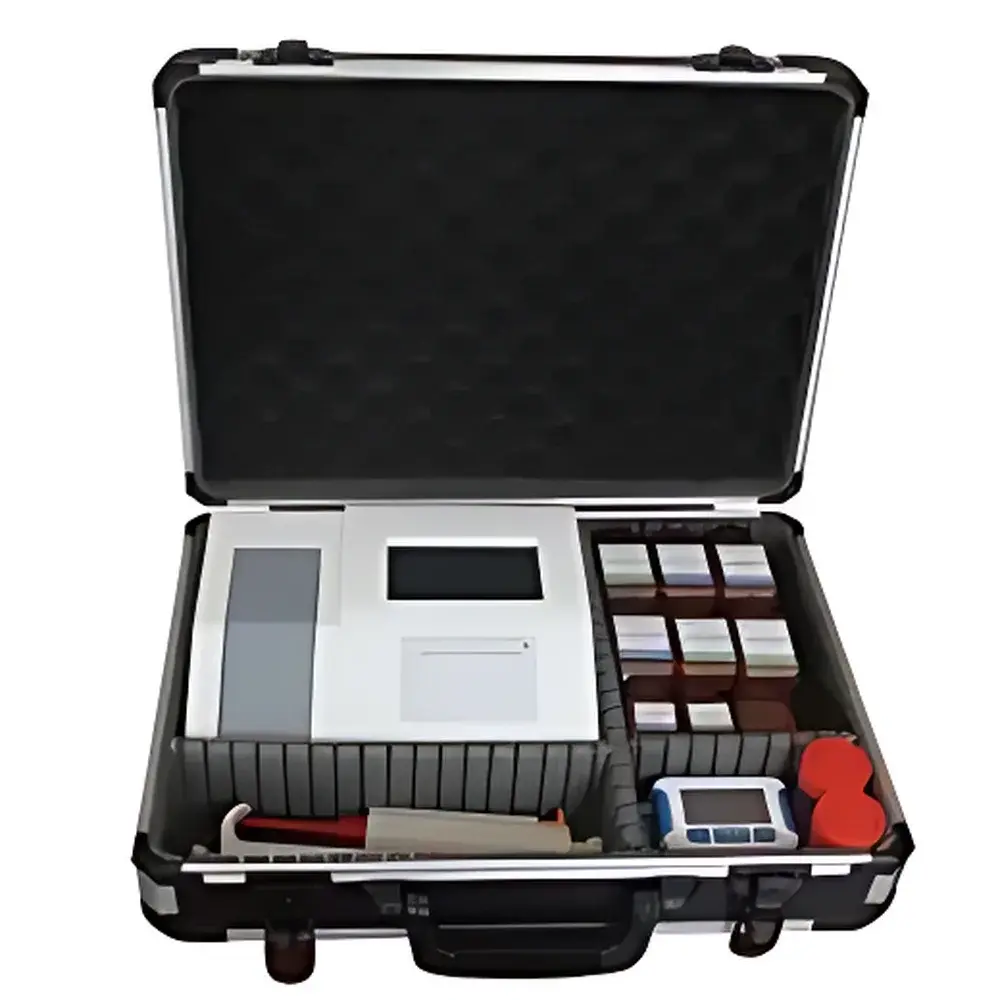
Ruixin CNY-8S Portable Pesticide Residue Rapid Tester
| Brand | Ruixin |
|---|---|
| Origin | Shanghai, China |
| Manufacturer Type | Authorized Distributor |
| Product Origin | Domestic (China) |
| Model | CNY-8S |
| Detection Method | Enzyme Inhibition Assay |
| Measurement Range | 0–100% Inhibition Rate |
| Number of Channels | 8 |
| Measurement Error | ≤10% |
| Limit of Detection (LOD) | 0.3 ppm |
| Display | 7-inch Color TFT Touchscreen |
| Wavelength | 410 nm (±2 nm) |
| Absorbance Range | 0.000–4.000 A |
| Transmittance Range | 0.00–100.00% T |
| Transmittance Resolution | 0.01% T |
| Absorbance Resolution | 0.001 A |
| Photometric Accuracy (Transmittance) | ±2.0% |
| Photometric Repeatability (Transmittance) | ≤0.2% |
| Photocurrent Drift | ≤0.2% (within 3 min) |
| Inhibition Rate Repeatability | ≤5% |
| Power Supply | AC 220 V ±10% / Built-in Rechargeable Lithium Battery |
| Communication Interfaces | RS-232, USB |
| Compliance | GB 5009.199–2003, NY/T 448–2001 |
Overview
The Ruixin CNY-8S Portable Pesticide Residue Rapid Tester is a field-deployable, eight-channel photometric analyzer engineered for the quantitative determination of organophosphorus and carbamate pesticide residues in fresh fruits and vegetables. It operates on the principle of acetylcholinesterase (AChE) or butyrylcholinesterase (BChE) inhibition assay — a well-established biochemical method standardized under GB 5009.199–2003 (National Food Safety Standard – Determination of Organophosphorus and Carbamate Pesticide Residues in Vegetables and Fruits) and NY/T 448–2001 (Agricultural Industry Standard – Rapid Detection Method for Pesticide Residues in Vegetables). The instrument measures the degree of enzymatic inhibition caused by residual pesticides, expressed as inhibition rate (%), with a detection limit of 0.3 ppm and a linear response range from 0 to 100% inhibition. Its optical architecture features a fixed-wavelength LED source at 410 nm (±2 nm), optimized for the yellow-colored chromogenic product (5-thio-2-nitrobenzoic acid, TNB) generated in the Ellman reaction. Designed for robustness in non-laboratory environments, the CNY-8S integrates hardware-level optical self-calibration, real-time channel diagnostics, and battery-powered operation — enabling reliable on-site screening without dependency on mains power or centralized infrastructure.
Key Features
- Eight independent optical detection channels with automatic sample presence recognition — inactive channels remain idle to conserve reagent and reduce background drift.
- 7-inch high-resolution color TFT touchscreen with full Chinese GUI; intuitive navigation supports rapid method setup, sample selection, and result interpretation.
- Built-in rechargeable lithium battery (≥6 hours continuous operation) and compact aluminum carrying case — certified for field deployment in markets, farms, customs checkpoints, and mobile food safety units.
- Embedded thermal printer generating compliant test reports per channel, including channel ID, inhibition rate (%), pass/fail classification, Chinese sample name, operator ID, testing unit, and timestamp.
- Pre-loaded database of 72 common fruit and vegetable entries — editable locally or via PC-based batch import/export using standard CSV/Excel formats.
- Dual-mode photometric readout: simultaneous display of absorbance (0.000–4.000 A, resolution 0.001 A) and transmittance (0.00–100.00% T, resolution 0.01% T), supporting method validation and auxiliary optical experiments.
- Configurable reaction time (1–15 min) and inhibition threshold (e.g., ≥50% = positive), aligned with local regulatory action levels and internal QA protocols.
- On-device data storage capacity exceeding 10,000 test records with searchable metadata (date, sample name, operator, channel); exportable via USB or RS-232 to LIMS or enterprise databases.
Sample Compatibility & Compliance
The CNY-8S is validated for homogenized aqueous extracts prepared from leafy greens (e.g., spinach, lettuce), solanaceous crops (tomato, pepper), pome and stone fruits (apple, peach), and root vegetables (carrot, radish). Sample preparation follows standardized homogenization, centrifugation, and supernatant dilution protocols outlined in GB 5009.199–2003. The system accepts both AChE and BChE reagents — ensuring compatibility with national reference materials and third-party certified enzyme kits. All photometric performance parameters meet or exceed the instrumental requirements specified in ISO/IEC 17025–2017 Annex B for rapid screening devices, including transmittance accuracy (±2.0%), repeatability (≤0.2%), and photocurrent stability (≤0.2% over 3 min). While not intended for definitive quantification per ISO 17025 accredited testing, the CNY-8S satisfies preliminary screening requirements under China’s Food Safety Law Article 112 and supports GLP-aligned recordkeeping with audit-trail-capable software integration.
Software & Data Management
The embedded firmware supports local data management and bidirectional communication with desktop applications via USB or RS-232. The optional Ruixin DataLink™ PC software (Windows 10/11 compatible) enables centralized report generation, statistical analysis (mean inhibition, CV%, trend charts), batch result review, and PDF/CSV export. It enforces user-level access control (admin/operator roles) and maintains immutable timestamps for all data modifications — fulfilling traceability prerequisites for internal QA audits. For enterprise integration, the device exposes a documented ASCII command protocol and provides SDK support for custom middleware development, facilitating interoperability with existing food safety monitoring platforms, ERP systems, or municipal inspection dashboards. Data encryption during transfer complies with TLS 1.2 standards when interfacing with cloud-hosted instances.
Applications
- Routine surveillance at wholesale markets and supermarket QA labs for incoming produce batches.
- Field verification by agricultural extension officers at cooperative farms and GAP-certified growing sites.
- Regulatory compliance checks conducted by municipal food and drug administration (CFDA-affiliated) mobile inspection teams.
- Pre-harvest residue monitoring in integrated pest management (IPM) programs to guide harvest timing decisions.
- Educational use in food science laboratories for teaching enzyme kinetics, photometry, and food safety risk assessment frameworks.
FAQ
What pesticides does the CNY-8S detect?
It detects organophosphorus (e.g., chlorpyrifos, diazinon) and carbamate (e.g., carbaryl, methomyl) pesticides based on their inhibitory effect on cholinesterase activity.
Can the instrument be used without external power?
Yes — the built-in lithium battery supports ≥6 hours of continuous operation, making it suitable for off-grid field use.
Is calibration required before each test?
No — the optical self-calibration system executes automatically at startup and periodically during operation, with real-time diagnostic feedback for channel integrity.
Does the device support English-language interface?
The standard firmware uses Chinese UI; English localization is available upon request for international distribution partners under OEM agreement.
How are results validated against laboratory GC-MS or HPLC-MS/MS methods?
The CNY-8S serves as a qualitative/semi-quantitative prescreening tool. Positive results (inhibition ≥50%) should be confirmed by reference methods per GB/T 20769–2006 or ISO 14501:2007.





