
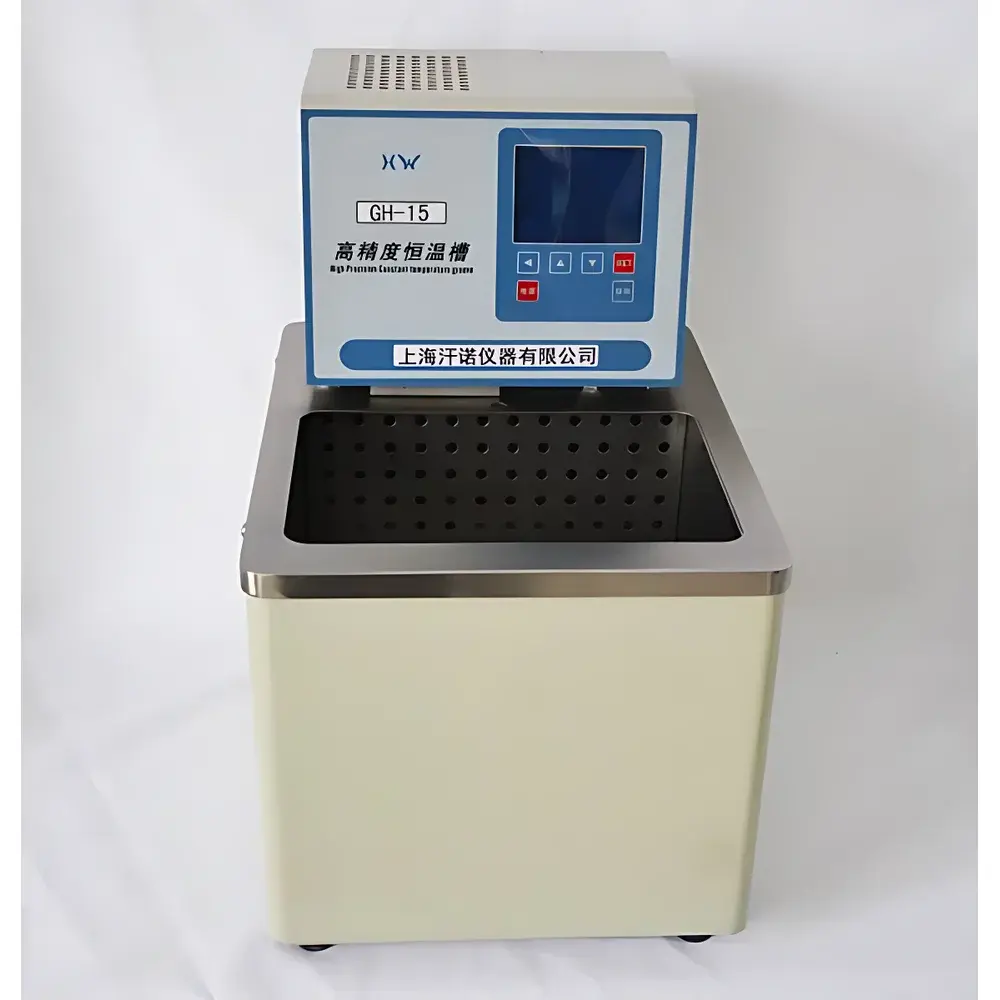
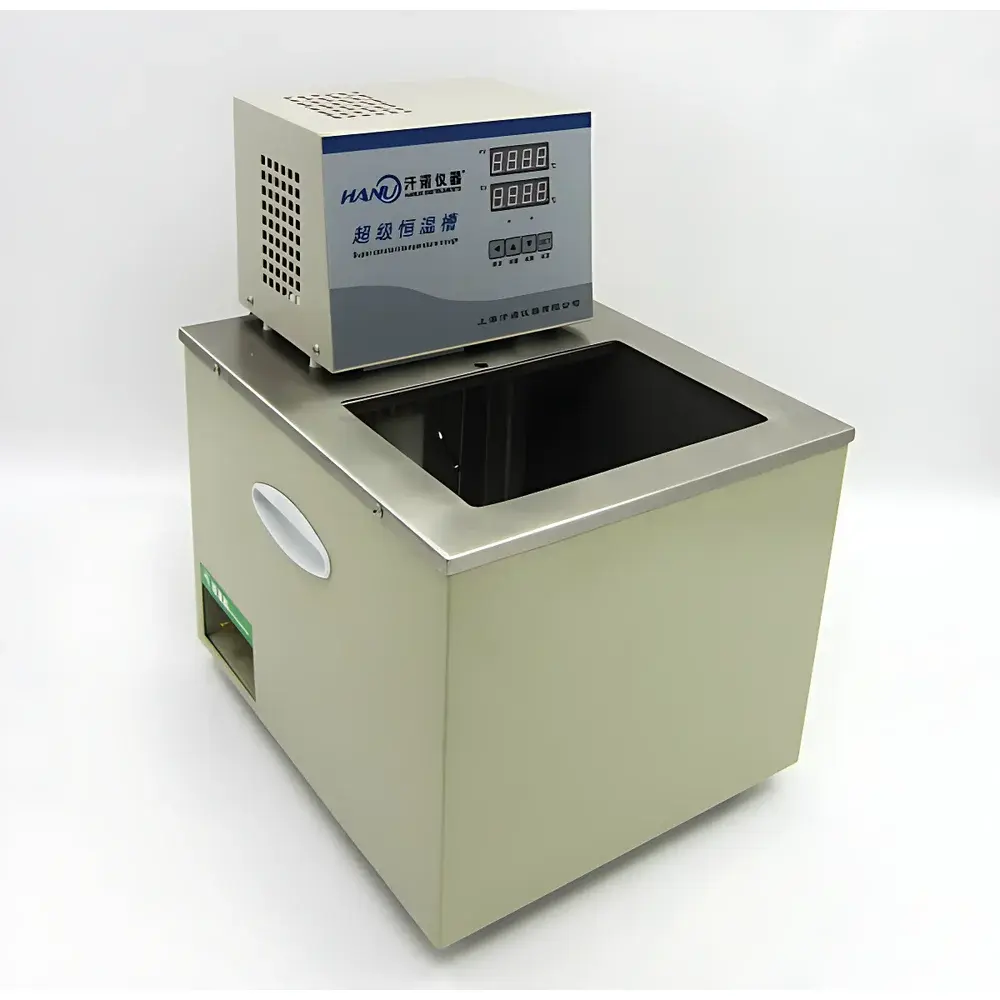
Hanuo GH-4 High-Precision Constant-Temperature Oil/Water Bath Circulator
| Brand | Hanuo |
|---|---|
| Origin | Shanghai, China |
| Model | GH-4 |
| Temperature Range | Ambient to 200 °C |
| Temperature Stability | ±0.005 °C |
| Bath Volume | 15 L |
| Circulation Type | Internal Only |
| Display | Dual LED (Setpoint & Actual Temperature) |
| Control System | PID Algorithm |
| Compatibility | Water and Heat-Stable Silicone Oils |
| External Dimensions (W×D×H) | 280×250×400 mm |
| Bath Opening | 235×160 mm |
| Depth | 400 mm |
| Resolution | 0.001 °C |
Overview
The Hanuo GH-4 High-Precision Constant-Temperature Oil/Water Bath Circulator is an engineered thermal stability platform designed for laboratory applications demanding sub-millidegree temperature control over extended durations. Operating on the principle of resistive heating combined with high-gain PID feedback regulation, the GH-4 maintains thermal equilibrium within a sealed, insulated stainless-steel bath chamber using either deionized water (up to 100 °C) or thermally stable silicone oil (up to 200 °C). Its core architecture emphasizes low thermal mass, minimal convective stratification, and uniform heat distribution—critical for calibration traceability, kinetic studies, viscometry reference standards, and sensor validation workflows. Unlike general-purpose baths, the GH-4 integrates precision thermal sensing (Pt100 RTD with 4-wire configuration), adaptive power modulation, and real-time deviation compensation to achieve ±0.005 °C stability—a specification aligned with ISO/IEC 17025 requirements for reference-grade temperature equipment used in metrology labs and QC environments.
Key Features
- Stainless-steel bath tank with polished interior surface for corrosion resistance and easy cleaning under GLP-compliant protocols.
- Dual LED display showing both setpoint and real-time measured temperature with 0.001 °C resolution—enabling direct visual verification without external dataloggers.
- Intelligent PID controller with auto-tuning capability; eliminates overshoot during ramping and sustains steady-state accuracy across full operating range (ambient to 200 °C).
- Internal recirculation pump ensures homogeneous temperature distribution throughout the 15 L working volume, minimizing axial and radial gradients (<0.01 °C/m).
- Compact desktop footprint (280×250×400 mm) optimized for benchtop integration in analytical laboratories, material testing suites, and R&D cleanrooms.
- Oil/water dual-mode operation validated per ASTM E2251-22 Annex A1 for use with certified reference fluids (e.g., NIST SRM 1965, silicone oils with known viscosity–temperature profiles).
- Over-temperature protection circuitry and dry-run detection safeguard against heater damage during low-fluid conditions.
Sample Compatibility & Compliance
The GH-4 accommodates standard immersion probes (e.g., Pt100, thermistors, glass thermometers), reaction vessels (up to Ø150 mm × 350 mm height), and calibration blocks conforming to ISO 17025 Clause 6.4.2. It supports compliance-driven workflows including thermometer calibration per ISO 17025:2017, USP thermal calibration procedures, and internal audit requirements for GMP-regulated pharmaceutical QC labs. The bath’s thermal stability performance has been verified using calibrated reference thermometers traceable to NIST (National Institute of Standards and Technology) and meets the repeatability criteria outlined in ASTM E77-23 for liquid-in-glass thermometer calibration systems. No external cooling interface is provided; users requiring rapid cooldown must integrate a compatible chiller via optional external circulation kit (sold separately).
Software & Data Management
While the GH-4 operates as a standalone analog-controlled instrument, its RS232 serial port enables connection to PC-based data acquisition software (e.g., LabVIEW, MATLAB, or custom Python scripts via pySerial). Logged temperature values—including timestamped setpoint, actual reading, and deviation—are exportable in CSV format for audit trail generation. The device supports basic SCPI-like command syntax for remote setpoint adjustment and status polling. All operational logs—including power-on events, temperature alarms, and PID parameter changes—can be retained for FDA 21 CFR Part 11 compliance when paired with validated third-party electronic lab notebook (ELN) systems supporting digital signature and user access control.
Applications
- Calibration of contact thermometers, RTDs, and thermocouples in accredited metrology laboratories.
- Thermal conditioning of samples prior to rheological, DSC, or TGA analysis to ensure consistent baseline thermal history.
- Controlled-temperature solvent baths for reflux, extraction, and distillation setups in organic synthesis and polymer processing.
- Reference environment for semiconductor wafer probing stations requiring ambient-to-200 °C thermal soak cycles.
- Stabilization of optical components (e.g., interferometer cavities, laser diodes) where thermal drift impacts measurement fidelity.
- Validation of temperature sensors embedded in bioreactors or sterilization autoclaves per ISO 13485 Annex C.
FAQ
What fluids are compatible with the GH-4 bath?
Deionized water (max. 100 °C) and high-purity methylphenyl silicone oils (e.g., Dow Corning 200 Fluid, max. 200 °C) are recommended. Avoid halogenated solvents, glycols, or mineral oils due to oxidation risk and vapor pressure limitations.
Is external circulation supported out-of-the-box?
No—the GH-4 features internal recirculation only. An external pump interface requires optional adapter hardware and separate plumbing installation.
Can the GH-4 be used for ISO/IEC 17025-accredited calibrations?
Yes, when operated with NIST-traceable reference thermometers and documented SOPs covering environmental monitoring, uncertainty budgeting, and periodic verification per ISO/IEC 17025 Clause 7.7.
Does the unit include a certificate of conformance or calibration?
A factory test report confirming temperature stability at 25 °C, 60 °C, and 150 °C is supplied. Full ISO/IEC 17025 calibration with uncertainty statement requires third-party service.
What maintenance is required to sustain ±0.005 °C stability?
Quarterly verification of RTD sensor linearity, annual inspection of heater insulation resistance (>100 MΩ), and biannual cleaning of pump impeller and bath chamber with isopropyl alcohol to prevent residue buildup.



