
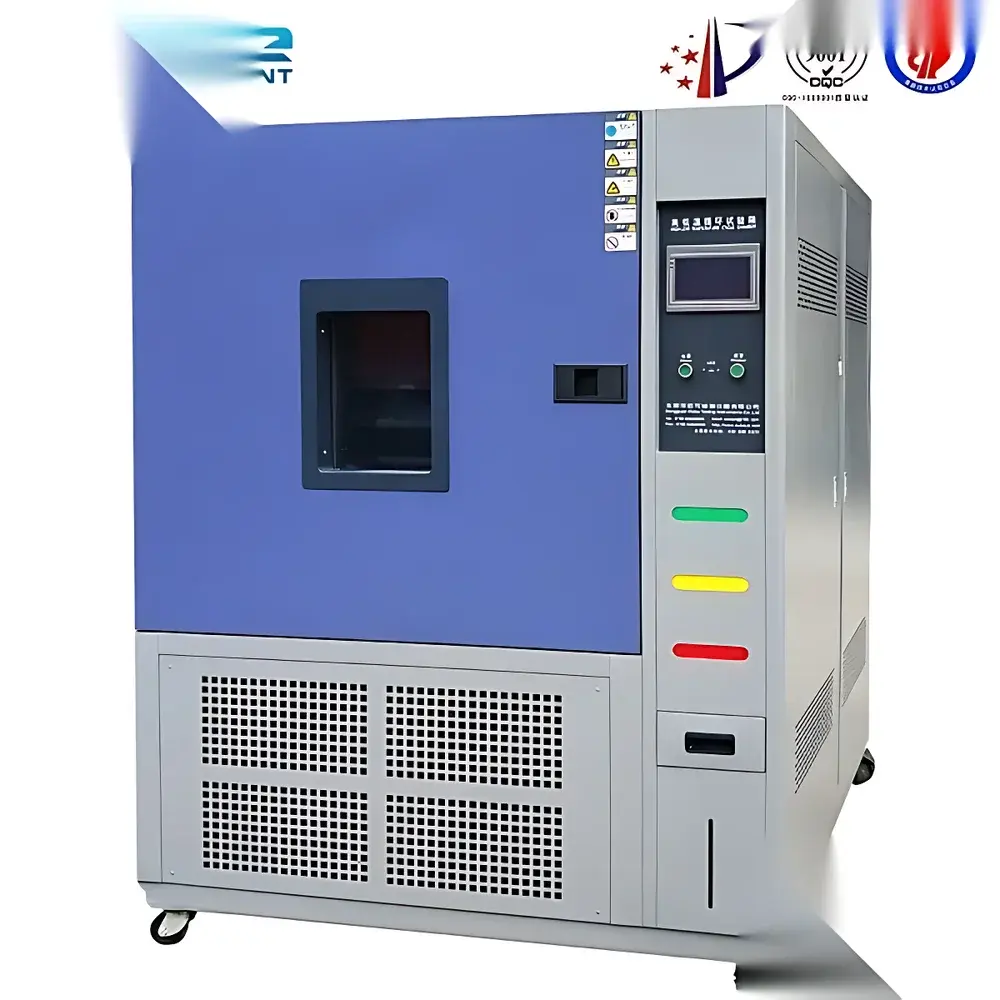
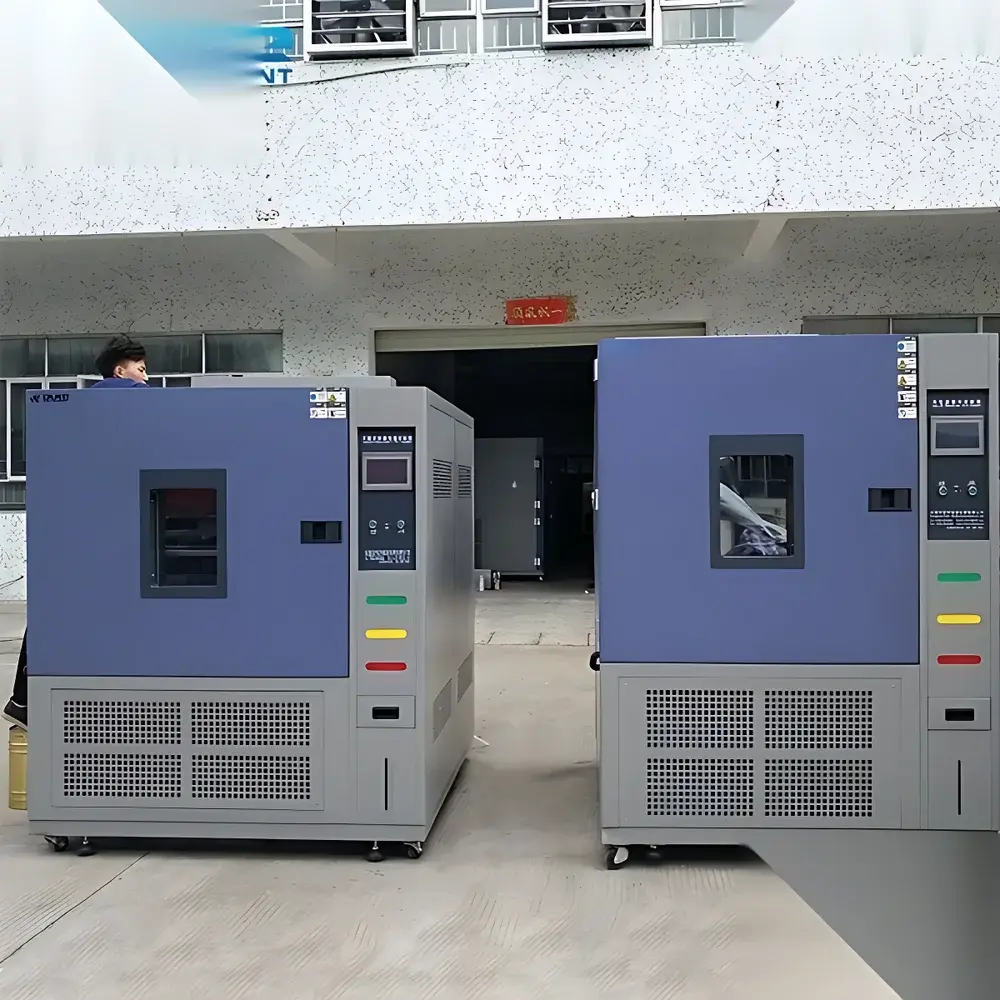
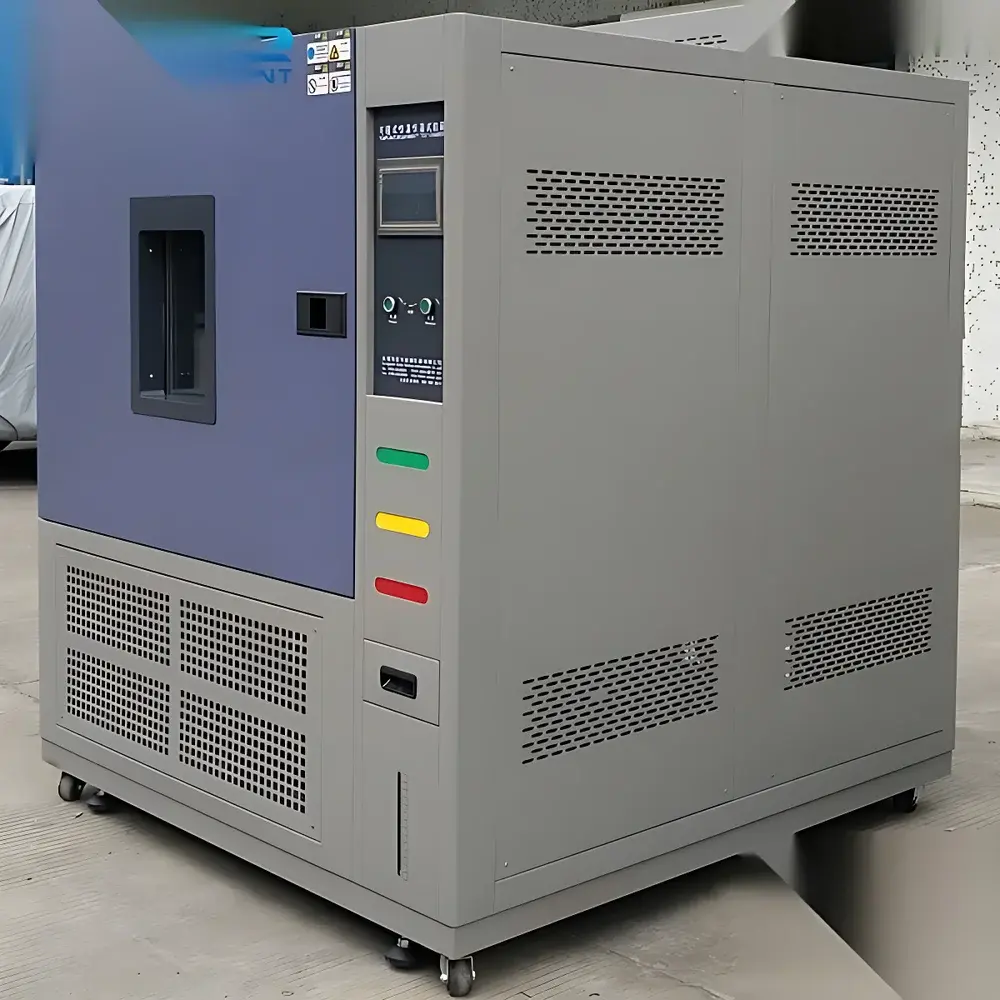
Smart Triple-Chamber Temperature and Humidity Environmental Test Chamber
| Brand | OEM / Custom-Built |
|---|---|
| Origin | Imported |
| Manufacturer Type | Authorized Distributor |
| Price | USD 29,500 (FOB Shanghai) |
| Temperature Range | −65 °C to +150 °C |
| Humidity Range | 20–95 % RH |
| Temp. Uniformity | ±2.0 °C |
| Temp. Stability | ±0.5 °C |
| Humidity Uniformity | ±3.0 % RH |
| Humidity Stability | ±1.5 % RH |
| Heating Rate (20 °C → 85 °C) | <60 min (unloaded, non-linear) |
| Cooling Rate (20 °C → −40 °C) | <70 min (unloaded, non-linear) |
| Airflow Cooling | Water-cooled (inlet water temp. 10–28 °C, pressure 0.1–0.3 MPa) |
| Power Supply | 3-phase 5-wire AC 380 V, 50 Hz, PE grounded |
| Compliance | GB10589, GB10592, GB11158, GB/T 5170.2 & 5170.5, GB 2423.1/2/22, GB 2424.1 |
Overview
The Smart Triple-Chamber Temperature and Humidity Environmental Test Chamber is an engineered solution for accelerated environmental stress testing of electronic components, automotive modules, aerospace subsystems, and medical device packaging under rigorously controlled thermal and hygrothermal conditions. Unlike conventional single-zone chambers, its triple-chamber architecture—comprising independent temperature stabilization, humidity conditioning, and test exposure zones—enables precise decoupling of thermal ramping and moisture saturation dynamics. This design eliminates cross-coupling artifacts during rapid transitions, ensuring that air temperature change rates (not product-core temperature) are maintained within specification across the full operational envelope. The chamber operates on a forced-air convection principle with dual centrifugal circulation fans, stainless-steel finned electric heaters, and a cascade refrigeration system utilizing environmentally compliant R404A/R23 mixed refrigerants. All performance metrics—including temperature uniformity (±2.0 °C), stability (±0.5 °C), humidity uniformity (±3.0 % RH), and stability (±1.5 % RH)—are validated per GB/T 5170.2 and GB/T 5170.5 under no-load, stabilized conditions at ambient 25 °C ±6 °C.
Key Features
- Triple-chamber modular architecture: Isolated pre-conditioning, transition, and test zones minimize thermal inertia and improve repeatability in temperature-humidity cycling protocols.
- Compact footprint design: Optimized structural geometry enables installation in laboratories with limited floor space (<2.5 m² required); reinforced 8# channel-steel base frame supports ≥200 kg/m² static load without deformation.
- Large vertical observation window: Tempered double-glazed viewport with anti-fog coating provides unobstructed visual monitoring of test specimens during operation.
- High-capacity, drawer-style humidification reservoir: Stainless-steel tank with integrated level sensor and quick-release mechanism simplifies maintenance and prevents mineral buildup.
- Multi-layer safety architecture: Includes over-temperature cut-off, compressor high-pressure protection, phase-loss detection, door interlock, and independent humidity over-limit shutdown.
- Water-cooled condenser system: Ensures consistent cooling performance across ambient temperatures from 10–28 °C inlet water supply; rated for continuous operation at full thermal load.
Sample Compatibility & Compliance
This chamber accommodates test specimens up to 600 mm × 600 mm × 600 mm (W×D×H) with standard internal dimensions; custom cavity configurations—including walk-in variants—are available upon engineering review. Internal chamber lining is electropolished SUS304 stainless steel to prevent corrosion under prolonged high-humidity exposure (up to 95 % RH). External cladding uses pre-painted color-coated steel panels with rigid polyurethane foam insulation (density ≥40 kg/m³, thermal conductivity ≤0.022 W/m·K). The system complies with national standards GB10589-89 (low-temperature), GB10592-89 (combined temperature/humidity), GB11158-89 (high-temperature), and GB2423 series (IEC 60068-2 equivalents) for environmental testing of electrical and electronic products. It supports test method execution per ISO 16750-4 (road vehicles), MIL-STD-810H Method 502.7 (temperature shock), and JEDEC JESD22-A104E (temperature cycling), provided external instrumentation meets traceable calibration requirements.
Software & Data Management
Equipped with a 10.1-inch industrial touchscreen HMI running embedded Linux, the controller provides real-time graphing of chamber air temperature and relative humidity, programmable multi-step profiles (up to 99 segments, 999 cycles), and event-triggered data logging at user-defined intervals (minimum 1 s). All operational parameters—including setpoints, actual values, alarm history, and runtime statistics—are stored locally on encrypted microSD and exportable via USB or Ethernet (Modbus TCP). Audit trail functionality meets GLP/GMP documentation requirements: each parameter modification is timestamped, user-ID tagged, and immutable post-recording. Optional PC-based software (Windows 10/11 compatible) enables remote monitoring, report generation (PDF/CSV), and integration with LIMS via OPC UA. Data integrity conforms to FDA 21 CFR Part 11 principles when paired with configured electronic signatures and role-based access control.
Applications
- Qualification testing of PCBAs and semiconductor packages per JEDEC J-STD-020 and AEC-Q200.
- Accelerated aging of polymer-based medical device housings under IEC 60601-1 Clause 11.1.2 environmental stress screening.
- Validation of battery thermal management systems under dynamic charge/discharge loads at extreme ambient conditions.
- Material compatibility assessment of adhesives, sealants, and conformal coatings per ASTM D2247 and ISO 62.
- Reliability screening of automotive ECUs per ISO 16750-4 and LV-124 specifications.
- Stability studies of pharmaceutical primary packaging under ICH Q1A(R2) long-term and accelerated storage conditions.
FAQ
What does “triple-chamber” mean in this context?
It refers to three physically separated, thermally isolated zones: one for rapid heating/cooling preconditioning, one for precise humidity saturation, and one dedicated to specimen exposure—enabling true independent control of temperature and humidity transients.
Is the temperature change rate measured at the chamber air or specimen surface?
All specified ramp rates (e.g., 20 °C → 85 °C in <60 min) refer exclusively to chamber air temperature under no-load, stabilized conditions per GB/T 5170.2. Specimen thermal response depends on mass, thermal diffusivity, and mounting configuration.
Can this chamber perform temperature shock testing?
No—it is not designed for two-zone or three-zone thermal shock per MIL-STD-810H Method 503.7. Its architecture supports only sequential, controlled temperature-humidity cycling with defined dwell times and ramp profiles.
Does it support automated calibration verification?
Yes—the controller includes built-in calibration offset adjustment for temperature and humidity sensors, and supports external reference probe inputs for periodic verification per ISO/IEC 17025 procedures.
What maintenance intervals are recommended for the refrigeration system?
Compressor oil and filter-drier replacement every 24 months; refrigerant leak check and pressure calibration annually; full system performance validation per GB/T 5170.2 every 12 months or after major component service.



