
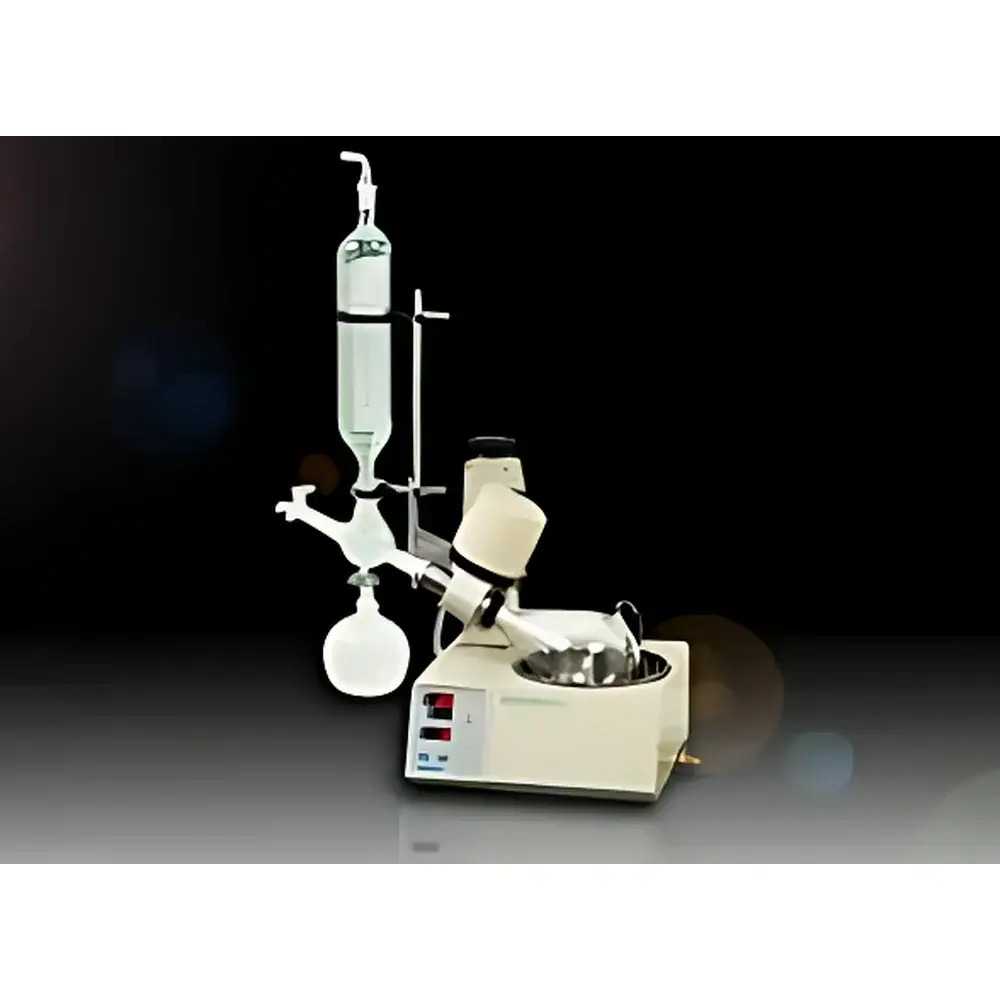
Hanuo RE-52A Rotary Evaporator
| Brand | Hanuo |
|---|---|
| Origin | Shanghai, China |
| Model | RE-52A |
| Capacity | 2 L |
| Ultimate Vacuum | 0.098 MPa (≈740 mmHg) |
| Rotation Speed | 0–120 rpm |
| Bath Temperature Range | Room Temperature to 100 °C |
| Temperature Control Accuracy | ±1 °C (typical for analog thermostatic control) |
| Cooling Surface Area | 0.11 m² |
| Condenser Type | Vertical dual-spiral coil with integrated small-capacity cold trap |
| Lift Mechanism | Manual screw-type vertical lift |
| Total Power Consumption | 1060 W |
Overview
The Hanuo RE-52A Rotary Evaporator is a benchtop-to-floor-standing vacuum distillation system engineered for reproducible solvent removal, concentration, and recovery under controlled reduced-pressure conditions. It operates on the principle of thin-film evaporation: a motor-driven rotating flask immersed in a thermostatically regulated water bath generates a uniform, high-surface-area liquid film along the inner wall of the vessel. Under vacuum (down to 0.098 MPa), the boiling point of solvents is significantly lowered—enabling gentle, efficient evaporation at temperatures well below their atmospheric boiling points. This thermal moderation is critical for thermolabile compounds commonly encountered in pharmaceutical synthesis, natural product isolation, and biochemical sample preparation. The system integrates a vertical dual-spiral condenser with an integrated small-volume cold trap, maximizing vapor capture efficiency and minimizing solvent loss or cross-contamination between runs.
Key Features
- Floor-standing robust aluminum alloy frame with manual screw-type vertical lift mechanism—ensures stable positioning and precise height adjustment for optimal flask immersion and condenser alignment.
- 2 L rotating flask and matching 2 L receiving flask—designed for scalable laboratory processing without requiring frequent intermediate transfers.
- Water bath heating system with analog temperature controller—provides continuous regulation from ambient to 100 °C; typical thermal stability within ±1 °C under steady-state conditions.
- Vertical dual-spiral glass condenser (cooling surface area: 0.11 m²)—enhances heat exchange efficiency and accommodates high vapor loads during rapid evaporation cycles.
- Sealed rotary joint with PTFE-tipped stopcock and borosilicate glass construction—ensures vacuum integrity and chemical resistance to common organic solvents including acetone, ethanol, ethyl acetate, and dichloromethane.
- Motor-driven rotation with continuously adjustable speed (0–120 rpm)—enables optimization of film thickness and mass transfer kinetics across diverse viscosities and boiling points.
Sample Compatibility & Compliance
The RE-52A is compatible with standard ISO/KS/GB-compliant ground-glass joints (typically 29/32 or 35/20), facilitating seamless integration with auxiliary vacuum pumps, chillers, and trapping systems. Its all-glass fluid path—comprising borosilicate 3.3 glass components—meets general laboratory requirements for inertness, transparency, and thermal shock resistance. While not certified to specific regulatory standards (e.g., FDA 21 CFR Part 11 or ISO 17025), the unit supports GLP-aligned workflows when operated with documented SOPs, calibrated bath thermometers, and validated vacuum gauges. Users are advised to pair it with a diaphragm vacuum pump and appropriate solvent traps to comply with local environmental and safety regulations governing volatile organic compound (VOC) emissions.
Software & Data Management
The RE-52A is a manually operated analog instrument with no embedded microprocessor or digital interface. Temperature setpoint and rotation speed are adjusted via mechanical dials; vacuum level is monitored externally using a standalone vacuum gauge. Consequently, it does not generate electronic audit trails or support data export. For laboratories requiring traceability, integration with external logging systems (e.g., USB-connected thermocouple dataloggers or pressure transducers) is recommended. Documentation of operational parameters—including bath temperature, rotation speed, vacuum reading, and run duration—must be maintained manually in lab notebooks or ELN platforms to satisfy internal quality assurance protocols.
Applications
- Concentration of dilute organic extracts in natural product chemistry and phytochemical analysis.
- Solvent recovery and reuse in pilot-scale synthetic chemistry workflows.
- Removal of low-boiling solvents (e.g., hexane, ether, THF) prior to lyophilization or crystallization steps.
- Preparative purification of heat-sensitive APIs and intermediates where conventional distillation would induce degradation.
- Teaching applications in university analytical and organic chemistry laboratories—demonstrating principles of vapor pressure, Raoult’s law, and mass transfer under reduced pressure.
- Environmental sample preparation, including concentration of aqueous pesticide residues or hydrophobic contaminants prior to GC-MS analysis.
FAQ
What vacuum level is required for optimal operation?
The RE-52A achieves effective evaporation at vacuum levels between 0.03–0.098 MPa (225–740 mmHg), depending on solvent volatility and bath temperature. A two-stage diaphragm pump capable of ≤5 mbar ultimate vacuum is recommended.
Is the water bath temperature digitally controlled?
No—the RE-52A uses an analog thermostatic controller. For applications demanding tighter thermal precision (±0.1 °C), external PID-controlled circulators may be connected via inlet/outlet ports.
Can the unit be used with corrosive solvents such as concentrated HCl or HF?
No. The standard glass and PTFE components are incompatible with strong mineral acids and hydrofluoric acid. Alternative corrosion-resistant configurations require custom engineering and are not supported by this model.
What maintenance is required for long-term reliability?
Regular inspection of the rotary seal lubrication, cleaning of condenser coils with appropriate solvents, and verification of vacuum hose integrity are essential. Glass components should be inspected for star cracks or scoring before each use.
Does the RE-52A include a vacuum controller or pressure sensor?
No—vacuum regulation must be managed externally using a vacuum controller valve or variable-speed pump. No built-in pressure feedback or automatic compensation is provided.



