
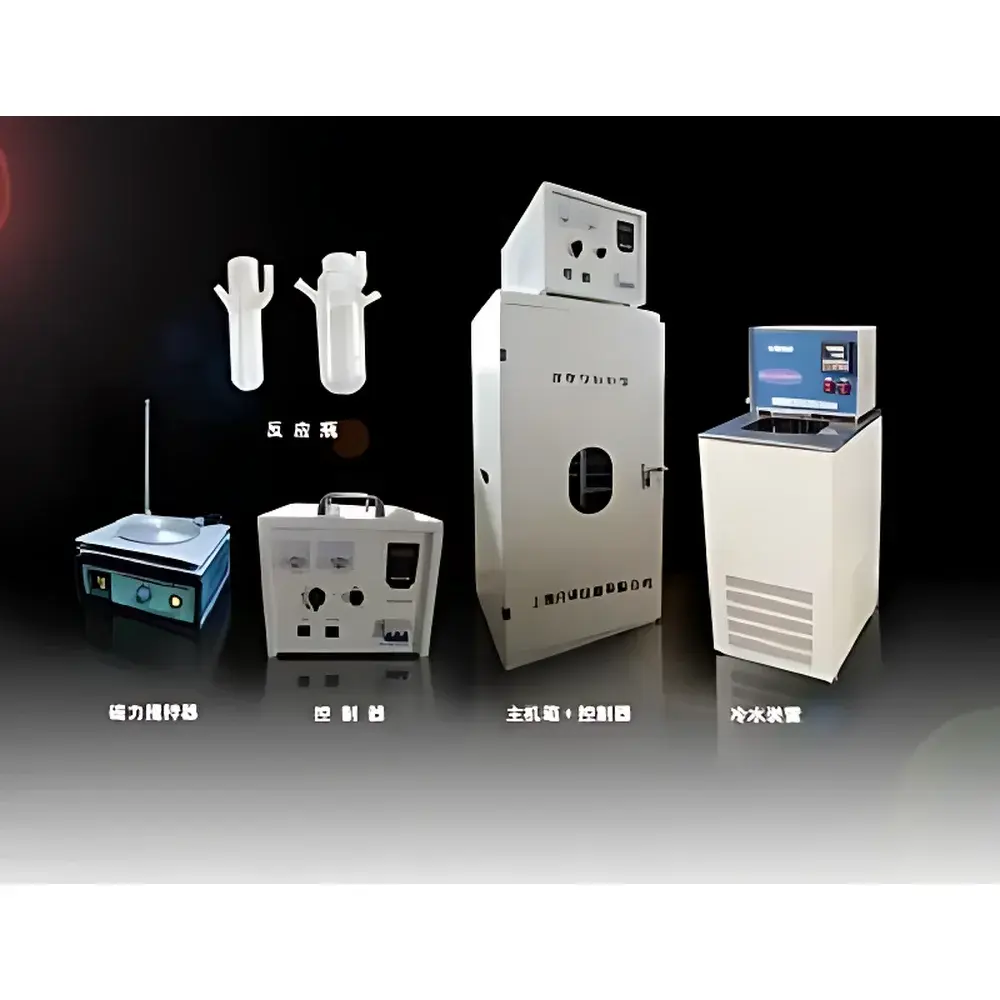
Hanuo HANUO-II Photochemical Reactor
| Brand | Hanuo |
|---|---|
| Model | HANUO-II |
| Light Source Compatibility | Mercury lamp (100–1000 W), Xenon lamp (100–1000 W), Metal halide lamp (100–450 W) |
| Adjustable Light Power | Continuously variable output |
| Cooling System | Recirculating chiller with >1000 W cooling capacity, casters and bottom drain valve |
| Reaction Vessels | Standard quartz reaction vessels (250 mL, 500 mL, 1000 mL) |
| Integrated Controller | Multi-lamp source controller with independent power regulation and safety interlocks |
| Configuration Includes | Chiller unit, light-tight reaction chamber, quartz cold finger, magnetic stirrer, mobile trolley, and lamp set (Hg, Xe, metal halide) |
Overview
The Hanuo HANUO-II Photochemical Reactor is an engineered platform for controlled, reproducible photochemical experimentation under precisely regulated irradiation conditions. Designed around the principles of actinometry and quantum yield determination, it enables quantitative studies of photoinduced processes in both homogeneous (liquid-phase) and heterogeneous (solid-supported catalyst, e.g., TiO₂-coated substrates) systems. The system supports wavelength-selective irradiation via interchangeable high-intensity discharge lamps—mercury, xenon, and metal halide—each independently controllable in power output to modulate photon flux density without altering spectral distribution. Its light-tight reaction chamber, coupled with a quartz cold finger and recirculating chiller (>1000 W cooling capacity), maintains thermal stability during prolonged irradiation, minimizing non-photochemical side reactions and enabling kinetic measurements over extended timeframes. The reactor accommodates standard volumetric quartz vessels (250–1000 mL), facilitating scalability from screening experiments to preparative-scale photolysis.
Key Features
- Multi-lamp compatibility with fully independent, continuously adjustable power control: mercury (100–1000 W), xenon (100–1000 W), and metal halide (100–450 W) lamps—each regulated via integrated digital source controller with real-time feedback and over-temperature cutoff.
- Thermally stabilized optical architecture: quartz cold finger and high-capacity recirculating chiller (>1000 W cooling power) ensure sample temperature deviation remains within ±1.5 °C during 8-hour continuous operation.
- Modular reaction chamber: light-tight dark box with removable access ports, internal reflectivity >92% (spectral range 200–800 nm), and standardized flange interfaces for vacuum/nitrogen purging or gas-flow integration.
- Scalable vessel support: interchangeable borosilicate glass or fused quartz reaction vessels (250 mL, 500 mL, 1000 mL) with PTFE-sealed joints; custom geometries and volume configurations available upon request.
- Integrated magnetic stirring with speed control (0–1200 rpm) and torque compensation, ensuring uniform mass transfer and photon exposure across heterogeneous catalytic suspensions.
- Mobility and serviceability: full-assembly mounted on industrial-grade stainless-steel trolley with locking casters and ergonomic height adjustment; chiller unit includes bottom-mounted drain valve and leveling feet.
Sample Compatibility & Compliance
The HANUO-II accommodates a broad range of photochemical sample formats—including aqueous/organic solutions, colloidal suspensions (e.g., TiO₂, g-C₃N₄), immobilized photocatalyst films, and gas-phase reactant mixtures (via optional flow-through adapters). All wetted components comply with ISO 8573-1 Class 3 purity standards for compressed air/gas handling where applicable. Quartz optics meet ASTM E438 Type I, Class A specifications for UV transmission (≥85% at 254 nm). The system’s electrical architecture conforms to IEC 61010-1:2010 for laboratory equipment safety, including double-insulated lamp sockets, grounded chassis, and emergency stop circuitry. While not pre-certified for GLP or GMP environments, the reactor supports audit-ready operation when paired with validated external data loggers and calibrated radiometers traceable to NIST standards.
Software & Data Management
The HANUO-II operates as a hardware-controlled benchtop instrument without embedded firmware or proprietary software. Lamp power settings, chiller setpoints, and stirrer speed are managed manually via front-panel controls with analog/digital hybrid readouts (±1% full-scale accuracy). For automated data acquisition, users integrate third-party DAQ systems (e.g., National Instruments USB-6009, Keysight 34972A) using standard 0–10 V analog inputs and TTL trigger outputs provided on the controller’s auxiliary interface panel. All operational parameters—including lamp runtime, cumulative energy dose (J/cm²), and chiller coolant temperature—are recordable via external timestamped logging. The system supports 21 CFR Part 11 compliance when deployed with validated electronic lab notebook (ELN) platforms that enforce user authentication, audit trails, and electronic signatures.
Applications
- Quantitative photocatalytic degradation kinetics: determination of pseudo-first-order rate constants (kobs) and apparent quantum yields (Φ) for organic pollutant mineralization (e.g., methylene blue, phenol) under UV-A, visible, or broadband irradiation.
- Photoredox synthetic methodology development: screening of Ru/Ir-based and organic photocatalysts in C–C bond-forming reactions, including [2+2] cycloadditions and dehalogenative couplings.
- Photoelectrochemical interface studies: in situ monitoring of charge-carrier recombination dynamics using transient absorption spectroscopy-compatible sample cells.
- Environmental photolysis modeling: simulation of atmospheric or aquatic photoreaction pathways for pharmaceuticals, pesticides, and endocrine disruptors under environmentally relevant spectral profiles.
- Biological photosensitizer evaluation: ROS generation quantification (¹O₂, •OH, O₂•⁻) in buffered or cellular media using probe-based fluorescence assays (e.g., SOSG, HPF, DHE).
FAQ
What lamp types are supported, and can they be operated simultaneously?
The HANUO-II supports mercury, xenon, and metal halide lamps—but only one lamp may be energized at a time due to thermal and electrical load constraints. Interchange is facilitated by standardized socket mounts and quick-disconnect cooling lines.
Is the quartz cold finger included with all vessel sizes?
Yes. A matched quartz cold finger is supplied for each standard vessel volume (250/500/1000 mL) to maintain consistent optical path length and thermal coupling efficiency.
Can the system be adapted for gas-phase continuous-flow photochemistry?
Yes—via optional quartz flow-cell adapters (catalog #HANUO-FC-xx) and mass-flow controllers compatible with the chamber’s 1/4″ Swagelok inlet/outlet ports.
Does the chiller require external water supply or is it self-contained?
It is a fully self-contained recirculating chiller with internal reservoir, refrigerant circuit, and condenser fan—no tap-water connection required.
Are calibration certificates provided for the lamp power meters?
Factory calibration reports (traceable to national standards) are included with each controller unit; NIST-traceable recalibration services are available through authorized Hanuo service centers.




