
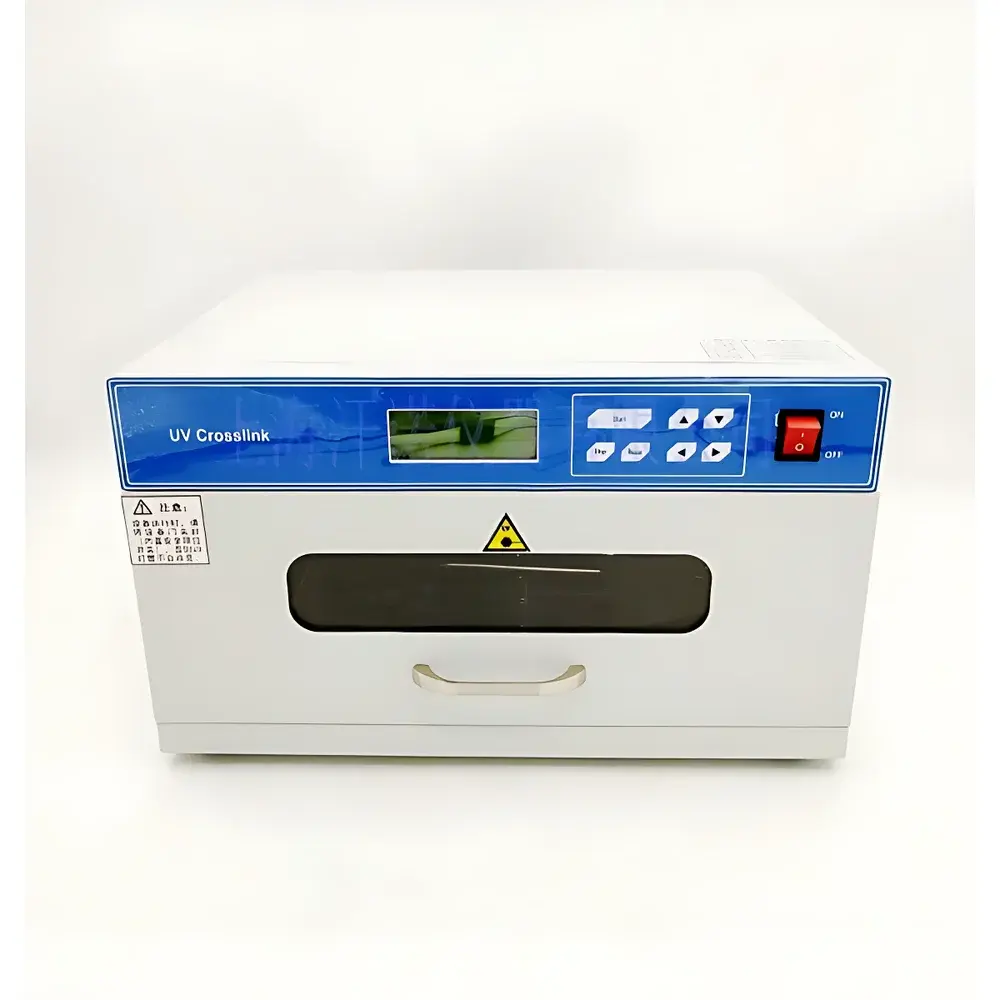
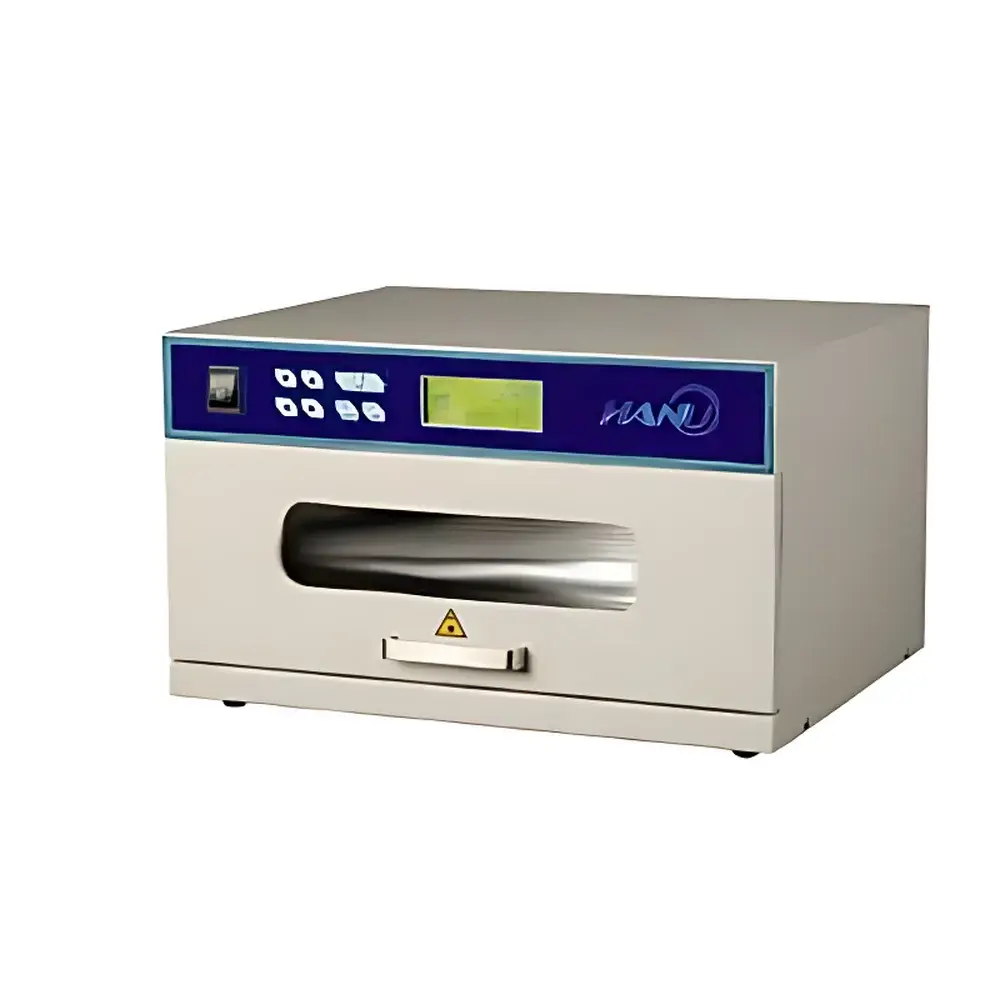
Hanuo HNUV-II UV Crosslinker
| Brand | Hanuo |
|---|---|
| Origin | Shanghai, China |
| Model | HNUV-II |
| UV Wavelength | 254 nm (optional 312 nm / 365 nm lamps) |
| Exposure Time Range | 0–999.9 min |
| Exposure Energy Range | 0–99.99 J |
| UV Source | Five 10 W low-pressure mercury lamps |
| Power Consumption | 60 W |
| Chamber Material | Stainless steel |
| Display | Touch-enabled Chinese LCD interface |
| Memory | Non-volatile storage for up to 9 user-defined time/energy protocols |
| Operating Environment | 5–35 °C, ≤80% RH, 220 V AC ±20%, 50 Hz |
| Compliance | Designed for routine molecular biology workflows under GLP-aligned lab practices |
Overview
The Hanuo HNUV-II UV Crosslinker is a benchtop ultraviolet irradiation system engineered for precise covalent immobilization of nucleic acids onto solid supports—including nylon, nitrocellulose, and PVDF membranes—during Southern, Northern, and dot blot hybridization procedures. It operates at a primary emission wavelength of 254 nm, generated by five low-pressure mercury vapor lamps, delivering consistent, uniform UV-C irradiance across the stainless-steel exposure chamber. Unlike thermal fixation methods requiring 2-hour vacuum baking at 80 °C, the HNUV-II achieves robust nucleic acid crosslinking in seconds, enhancing probe binding efficiency and signal intensity by 5–10× compared to conventional oven-based protocols. Its design adheres to fundamental photobiological principles governing thymine dimer formation and pyrimidine crosslinking kinetics, ensuring reproducible DNA–membrane bond formation without excessive strand breakage or RNA degradation when operated within validated exposure parameters.
Key Features
- Stainless-steel UV exposure chamber with reflective interior surface for uniform irradiance distribution and corrosion resistance
- Touch-enabled Chinese-language LCD interface supporting real-time monitoring of elapsed time and accumulated energy (in joules)
- Non-volatile memory storing up to nine independent exposure protocols—each configurable for either time (0.1–999.9 min) or energy (0.01–99.99 J) mode
- Integrated UV shielding viewport with interlocked safety cutoff to prevent accidental exposure during operation
- Dual-mode control: manual entry of exposure duration or energy dose, with automatic lamp power regulation to maintain dose accuracy across lamp aging
- Five 10 W germicidal UV lamps (254 nm), rated for ≥2,000 hours of stable output; optional lamp kits available for 312 nm (for visualization) and 365 nm (for photochemical activation)
Sample Compatibility & Compliance
The HNUV-II accommodates standard membrane formats (up to 20 × 20 cm) and is routinely employed in nucleic acid blotting, PCR carryover contamination control (UV decontamination of work surfaces and pipette tips), UV-induced mutagenesis (e.g., RecA screening), and UV-mediated cleavage of DNA in agarose gels. While not certified to IEC 61010-1 or ISO 15195, its mechanical and electrical architecture conforms to general laboratory safety expectations for Class 3R UV devices. Operation aligns with common institutional biosafety guidelines for UV-C handling, including mandatory use of protective eyewear and skin coverage. For regulated environments, protocol execution—including operator ID, timestamp, and parameter logs—can be manually documented to support GLP-compliant recordkeeping; however, the device lacks FDA 21 CFR Part 11–compliant electronic audit trails or user authentication.
Software & Data Management
The HNUV-II operates via embedded firmware with no external PC dependency. All settings—including exposure mode, target value, and saved protocols—are retained in non-volatile memory after power cycling. The touch interface displays real-time countdown and cumulative energy in joules, calculated from lamp wattage (60 W nominal), chamber geometry, and empirically calibrated irradiance profiles. No proprietary software, drivers, or cloud connectivity are provided. Data export is not supported; users must transcribe protocol parameters and run logs manually into LIMS or electronic lab notebooks. This architecture prioritizes operational simplicity and electromagnetic compatibility in shared instrumentation spaces—avoiding USB/Bluetooth interference with adjacent sensitive detection systems such as chemiluminescence imagers or mass spectrometers.
Applications
- Nucleic acid fixation on hybridization membranes prior to prehybridization and probe incubation
- Deactivation of PCR amplicons and plasmid templates on benchtop surfaces and reusable plasticware to prevent cross-contamination
- Induction of cyclobutane pyrimidine dimers (CPDs) for mutagenesis studies and DNA repair pathway analysis
- UV-assisted cleavage of ethidium bromide–stained DNA bands in agarose gels for downstream cloning
- Surface sterilization of UV-tolerant polymers used in microfluidic device fabrication
- Photoactivation of UV-curable adhesives and hydrogels in biomaterials research
FAQ
What UV wavelength is emitted by default, and can it be changed?
The HNUV-II ships with five 10 W lamps emitting predominantly at 254 nm. Optional lamp sets for 312 nm (for UV-transilluminator compatibility) and 365 nm (for long-wave photochemistry) are available as accessories.
Is the exposure energy measurement traceable to a radiometric standard?
No. The energy value (J) displayed is calculated from nominal lamp power and exposure time, not measured in situ with a NIST-traceable UV radiometer. Users requiring metrologically validated dosimetry should integrate a calibrated sensor.
Does the unit support automated protocol recall via barcode or RFID?
No. Protocol selection is manual via touchscreen navigation only.
Can the HNUV-II be integrated into a robotic liquid handling workflow?
It has no digital I/O ports, Ethernet, or API interface; therefore, it cannot be triggered or monitored by external automation controllers.
What maintenance is required for long-term performance stability?
Lamp output declines gradually over time; we recommend lamp replacement every 2,000 operating hours or annually—whichever occurs first—to ensure consistent crosslinking efficiency. Clean the quartz viewport regularly with isopropanol to prevent UV attenuation.





