
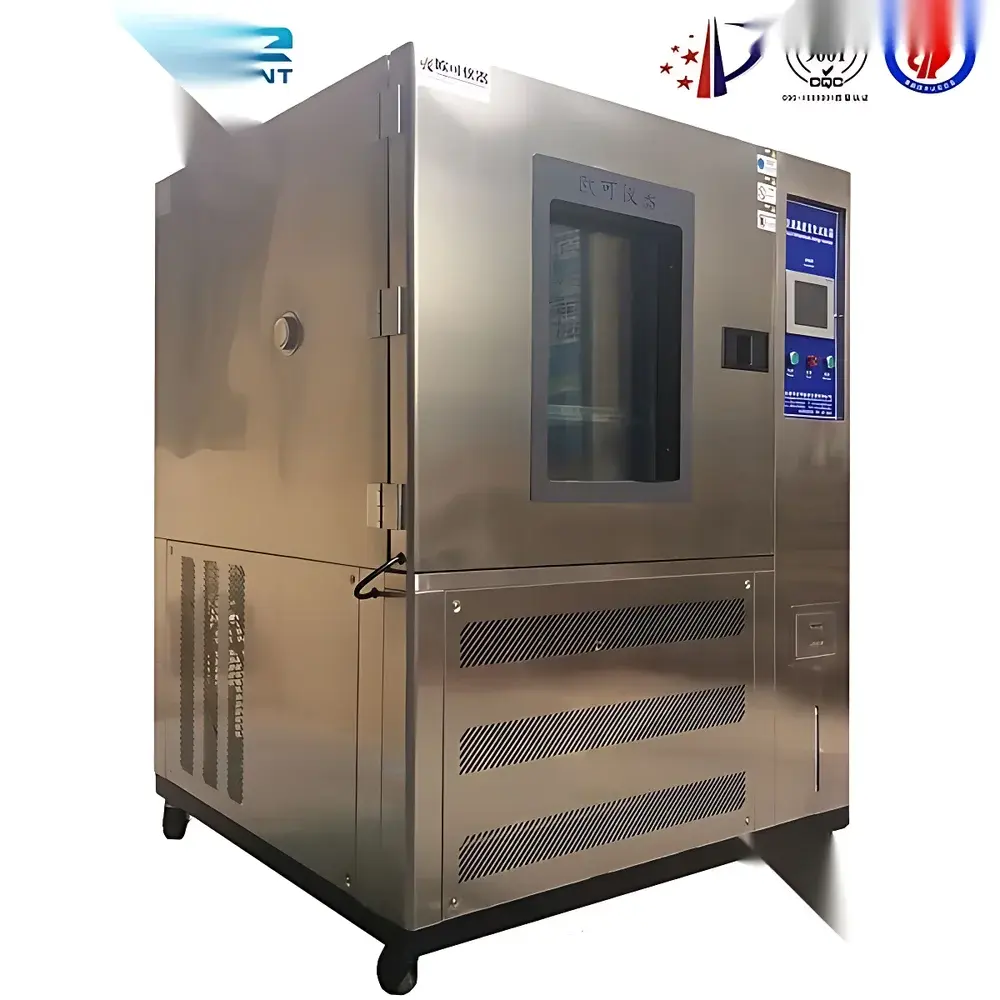
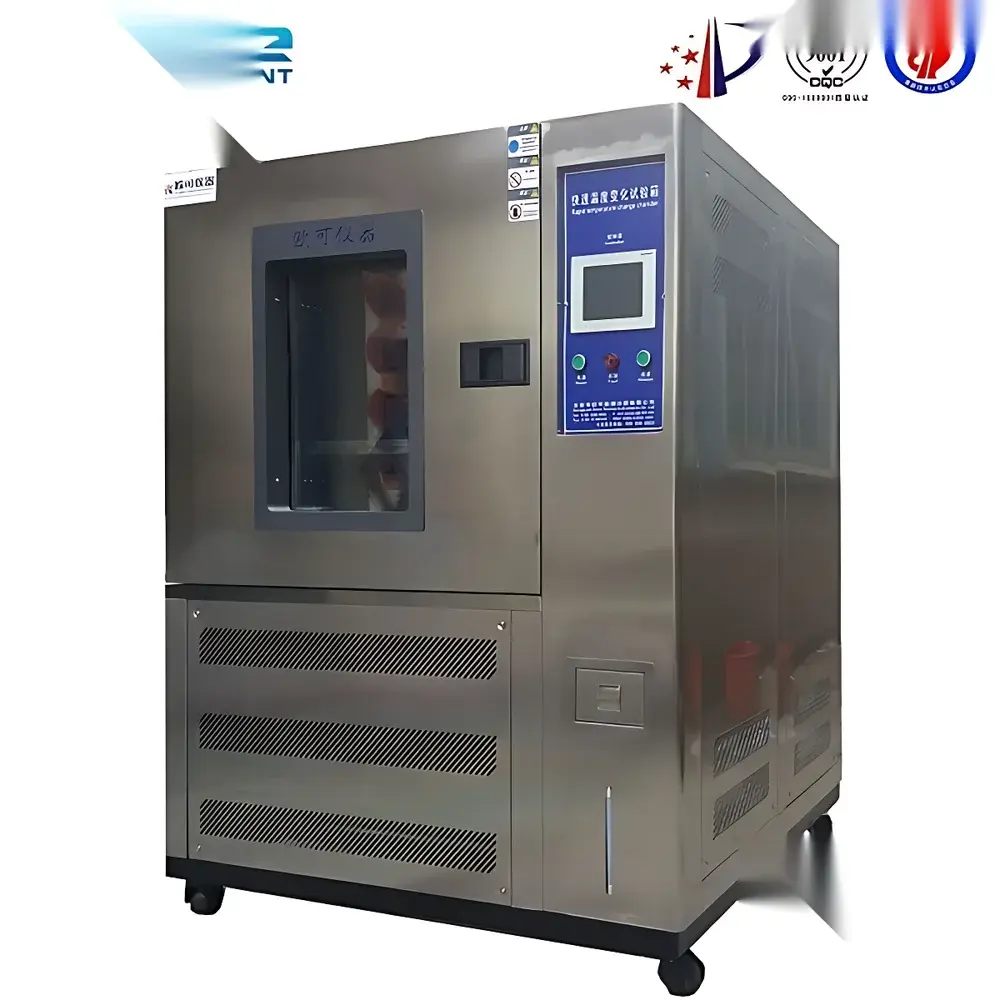
Programmable Rapid Temperature Change Chamber – KS-TH Series
| Key | Brand: Other Brands |
|---|---|
| Origin | Imported |
| Manufacturer Type | Authorized Distributor |
| Price | USD 13,800 (FOB) |
| Temperature Range | −70 °C to +150 °C |
| Humidity Range | 20–98% RH (optional: 5–98% RH) |
| Ramp Rates | 5–25 °C/min (selectable) |
| Temp. Uniformity | ±2 °C |
| Humidity Uniformity | ±3.0% RH (≥75% RH) |
| Temp. Stability | ±0.5 °C |
| Humidity Stability | ±2.5% RH |
| Internal Dimensions (W×H×D, cm) | 50×75×60 / 60×85×80 / 100×100×80 / 100×100×100 |
| Test Port | Ø50 mm (left side) |
| Refrigerant | R507/R23 (zero ODP, low GWP HFC blend) |
| Controller | 7-inch color LCD touch interface with bilingual (EN/CN) GUI, 96 programmable test profiles, max cycle count: 999, max dwell time: 999 h 59 min |
| Safety Protections | Overcurrent, ground fault, compressor high-pressure/overheat, phase failure, overtemperature, leakage current, and PLC-monitored interlock logic |
Overview
The KS-TH Series Programmable Rapid Temperature Change Chamber is an engineered environmental stress screening (ESS) platform designed for accelerated reliability validation of electronic components, automotive ECUs, aerospace subsystems, and medical devices under dynamically controlled thermal gradients. It operates on the principle of forced-air convection combined with a dual-stage cascade refrigeration system—enabling precise, repeatable transitions between extreme temperature extremes without condensation-induced thermal shock or dew-point violation. Unlike standard thermal chambers, the KS-TH series achieves ramp rates up to 25 °C/min across its full operating range (−70 °C to +150 °C), meeting the stringent thermal cycling requirements defined in MIL-STD-810H Method 503.6, IEC 60068-2-14, and JEDEC JESD22-A104E. Its architecture integrates thermodynamic modeling with real-time PID feedback control, ensuring traceable, GLP-compliant thermal profiles suitable for qualification testing in ISO/IEC 17025-accredited laboratories.
Key Features
- High-fidelity temperature ramping: Selectable linear rates of 5, 10, 15, 20, or 25 °C/min—validated per ASTM E1545 calibration protocol using NIST-traceable PT100 sensors mounted at nine spatial locations within the working volume.
- Dual-stage cascade refrigeration: Primary stage employs R404A; secondary stage uses R23, achieving stable sub-zero operation down to −70 °C with zero ozone depletion potential (ODP = 0) and reduced global warming potential (GWP < 3,500).
- Intelligent controller: 7-inch resistive touch LCD with embedded real-time OS supports 96 independent test programs, cycle repetition (1–999), dwell duration (up to 999 h 59 min), and automatic start/stop scheduling—including calendar-based triggers and remote event logging via RS485/Modbus RTU.
- Uniformity-optimized airflow: Computational fluid dynamics (CFD)-validated blower array and baffle geometry deliver ±2 °C temperature uniformity and ±3.0% RH humidity uniformity (at ≥75% RH) across the entire test volume—verified per IEC 60068-3-5.
- Comprehensive safety architecture: PLC-monitored hardware interlocks enforce fail-safe shutdown on overtemperature, refrigerant high-pressure, phase loss, ground fault, compressor overheating, and door-open events—fully compliant with EN 61000-6-2/6-4 EMC and UL 61010-1 safety standards.
Sample Compatibility & Compliance
The KS-TH chamber accommodates DUTs up to 100 cm × 100 cm × 100 cm (KS-TH-1000 model), with optional through-wall ports (Ø50 mm standard, custom sizes available) enabling live power delivery, signal monitoring, or sensor integration during thermal transients. All models conform to mandatory regulatory frameworks including CE marking (2014/30/EU EMC Directive, 2014/35/EU LVD), RoHS 2011/65/EU, and REACH SVHC compliance. Test execution adheres to internationally recognized standards: GB/T 2423.1–2023 (cold), GB/T 2423.2–2023 (heat), GB/T 2423.22–2012 (thermal shock), GJB 150.3A–2009 (military high-temp), GJB 150.4A–2009 (military low-temp), and IEC 60068-2-14:2021. Optional IQ/OQ documentation packages support FDA 21 CFR Part 11–compliant validation workflows.
Software & Data Management
Built-in controller firmware includes audit-trail-enabled data logging (1-second resolution, >1 million point capacity), CSV export, and USB mass storage support. Optional PC-based software (KS-LogSuite Pro) provides advanced analysis: derivative-based ramp rate verification, statistical process control (SPC) charts, deviation heatmaps, and automated report generation aligned with ISO/IEC 17025 clause 7.8. All logged parameters—chamber setpoint, actual temperature/humidity, compressor status, alarm history, and user actions—are time-stamped with microsecond precision and cryptographically signed to satisfy ALCOA+ data integrity principles.
Applications
- Thermal cycling qualification of PCBAs per IPC-9701A and AEC-Q200 Rev D.
- Pre-conditioning of lithium-ion battery modules prior to vibration or HALT testing.
- Material coefficient-of-thermal-expansion (CTE) characterization of encapsulants and underfills.
- Validation of hermetic seal integrity in MEMS sensors and optoelectronic housings.
- Stress screening of avionics LRUs per DO-160G Section 4 (temperature variation).
FAQ
What is the maximum allowable thermal load inside the chamber?
The KS-TH series supports continuous internal heat loads up to 500 W (KS-TH-225) to 2,000 W (KS-TH-1000), assuming ambient ≤25 °C and proper ventilation clearance.
Can the chamber be integrated into a factory MES or SCADA system?
Yes—standard Modbus RTU (RS485) enables bi-directional communication with PLCs and supervisory systems; optional Ethernet/IP or OPC UA gateways are available.
Is humidity control available below 10% RH?
Standard configuration covers 20–98% RH; extended-range dehumidification to 5% RH is offered as a factory-installed option using desiccant-assisted cooling.
How is temperature calibration performed and documented?
Each unit ships with a NIST-traceable calibration certificate (per ISO/IEC 17025) covering nine-point uniformity mapping and ramp-rate verification at three critical zones: −40 °C→+85 °C, +25 °C→−70 °C, and +85 °C→+150 °C.
What maintenance intervals are recommended for the refrigeration system?
Compressor oil and filter-drier replacement every 24 months; annual inspection of refrigerant charge, condenser coil cleanliness, and PID tuning validation per manufacturer’s service manual.



