
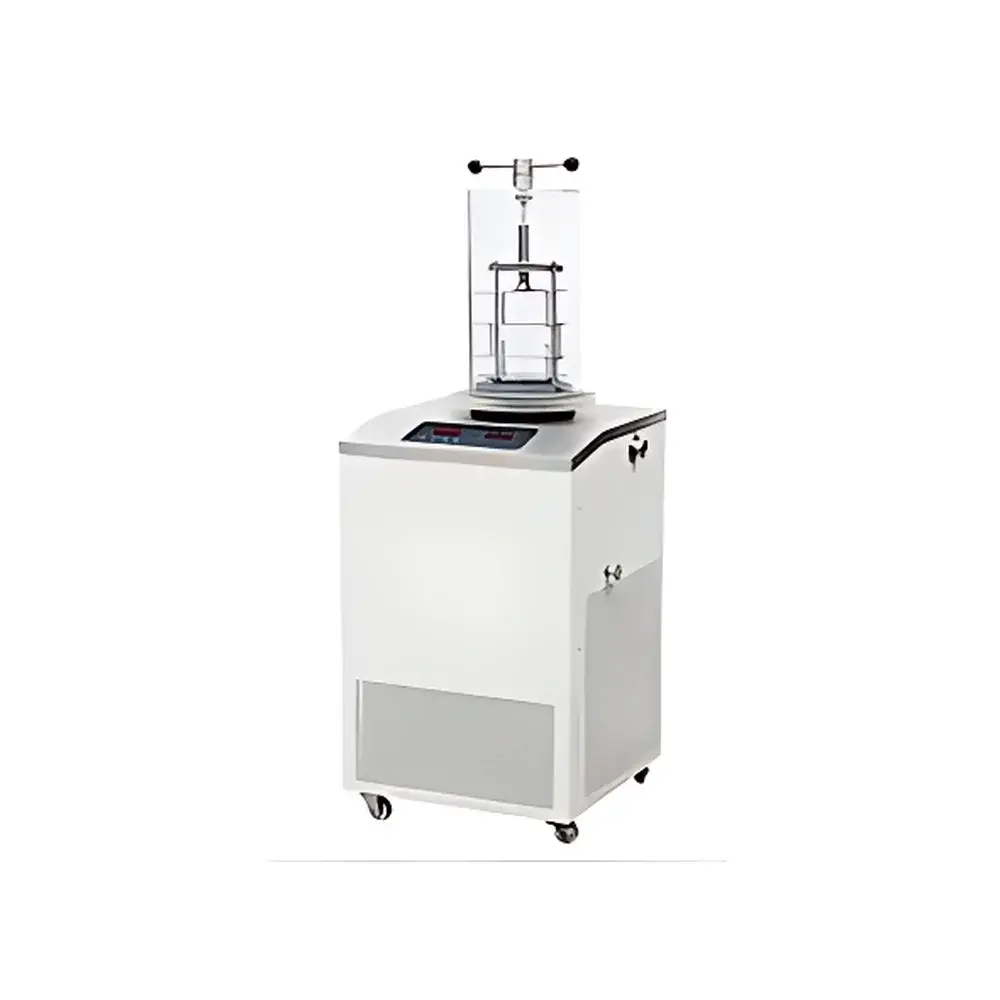
Hanuo FD-1B-50 Benchtop Stoppering Freeze Dryer
| Brand | Hanuo |
|---|---|
| Origin | Shanghai, China |
| Model | FD-1B-50 |
| Instrument Type | Stoppering (Vacuum-Sealing) Freeze Dryer |
| Application | Laboratory-Scale Lyophilization |
| Shelf Area | 0.07 m² |
| Ultimate Vacuum | < 20 Pa |
| Condenser Temperature | –50 °C |
| Water Capture Capacity | 3 kg/24 h |
| Chamber Dimensions (W×D×H) | 380 × 600 × 345 mm |
| Power Supply | 220 V, 50 Hz, 850 W |
| Standard Configuration | Benchtop Main Unit, 2 L Domestic Vacuum Pump, Stoppering Drying Chamber with Three Φ180 mm Stainless Steel Trays |
| Sample Loading Volume (Bulk) | 0.7 L |
Overview
The Hanuo FD-1B-50 is a compact, benchtop stoppering freeze dryer engineered for precise, reproducible lyophilization of heat-sensitive biological and pharmaceutical samples in research laboratories and quality control environments. It operates on the fundamental principle of sublimation—removing water from frozen materials under deep vacuum while maintaining product integrity through low-temperature condensation. The system employs a dual-stage refrigeration cycle to achieve a stable condenser temperature of –50 °C, enabling efficient vapor capture during primary drying. With a shelf area of 0.07 m² and a maximum bulk loading capacity of 0.7 L across three stainless steel trays (Φ180 mm), the FD-1B-50 supports small-batch processing aligned with early-stage formulation development, stability testing, and analytical sample preparation. Its integrated stoppering mechanism allows for in-chamber sealing of vials under vacuum or inert gas, minimizing post-drying exposure to moisture and oxygen—critical for preserving sterility and potency of biologics such as monoclonal antibodies, recombinant proteins, and live-attenuated vaccines.
Key Features
- Benchtop footprint (380 × 600 × 345 mm) optimized for limited lab space without compromising structural rigidity or thermal stability
- –50 °C condenser temperature achieved via high-efficiency hermetic compressor, ensuring consistent ice trapping across extended drying cycles
- Vacuum performance rated at < 20 Pa (absolute), compatible with standard two-stage rotary vane vacuum pumps (2 L/s nominal pumping speed supplied)
- Three-tier stainless steel tray assembly (Φ180 mm each) with uniform heat transfer characteristics; designed for flat-bottom vials, serum bottles, and shallow petri-style dishes
- Manual or semi-automated stoppering function using a calibrated hydraulic piston, enabling controlled lid compression during final vacuum hold
- Front-access condenser chamber with removable ice trap for rapid defrosting and maintenance; no tools required for routine cleaning
- Integrated safety interlocks including over-temperature cutoff, vacuum loss alarm, and door-open shutdown protocol compliant with IEC 61010-1
Sample Compatibility & Compliance
The FD-1B-50 accommodates aqueous-based formulations typical of preclinical and pilot-scale bioprocessing—including buffer solutions, cell lysates, purified enzymes, and sterile-filtered protein suspensions. Its design supports lyophilization protocols referenced in USP , Ph. Eur. 2.9.40, and ISO 22058 (lyophilization process validation). While not GMP-certified out-of-the-box, the unit’s mechanical repeatability, traceable vacuum calibration points, and documented thermal mapping capability make it suitable for GLP-compliant studies and method development under FDA 21 CFR Part 11–aligned data governance frameworks when paired with validated external logging systems. All wetted surfaces are electropolished 316L stainless steel or borosilicate glass—compatible with autoclaving and SIP-compatible cleaning agents.
Software & Data Management
The FD-1B-50 operates via an embedded microcontroller with a tactile membrane keypad and dual-line LCD display showing real-time condenser temperature, chamber pressure, and elapsed time. Although it lacks built-in PC connectivity or graphical trending, its analog outputs (0–10 V DC for pressure and temperature signals) permit integration with third-party data acquisition systems (e.g., LabVIEW, DeltaV, or custom SCADA platforms) for full-cycle monitoring and electronic batch record generation. Users may manually log critical parameters at defined intervals per SOPs—supporting audit-ready documentation for internal QA reviews and regulatory submissions.
Applications
- Stabilization of thermolabile diagnostics reagents prior to packaging and shelf-life assessment
- Preparation of reference standards for HPLC, ELISA, and mass spectrometry workflows
- Preservation of microbial cultures and tissue homogenates for long-term cryoarchiving
- Process optimization trials for vial-based lyophilization cycles (annealing, ramped primary drying, secondary drying endpoints)
- Small-volume excipient screening under variable shelf temperature and vacuum ramp profiles
- Teaching laboratory demonstrations of phase behavior, eutectic collapse, and collapse temperature (Tc’) determination
FAQ
What types of containers can be used with the FD-1B-50’s stoppering function?
Standard 10–20 mL serum vials with aluminum crimp seals and butyl rubber stoppers are fully compatible; compatibility with polymer-coated or fluoropolymer-lined closures requires verification of compression force tolerance.
Is the vacuum pump included in the standard configuration oil-free?
No—the supplied 2 L/s rotary vane pump uses mineral oil lubrication; an oil-free diaphragm pump option is available upon request for solvent-sensitive applications.
Can the FD-1B-50 perform controlled-rate freezing?
No—it does not include programmable shelf cooling; samples must be pre-frozen externally (e.g., in a –80 °C freezer or controlled-rate freezer) prior to loading.
What is the typical drying time for a 5 mL aqueous solution at 5% w/v solids?
Under standard conditions (–30 °C shelf, < 15 Pa, no heating), primary drying typically requires 18–24 hours; total cycle time including secondary drying ranges from 28–36 hours depending on residual moisture target.
Does the unit support nitrogen backfilling during stoppering?
Yes—via optional inlet port and regulator kit; inert gas purging is configurable before and during the stoppering sequence to reduce oxidation risk.



