
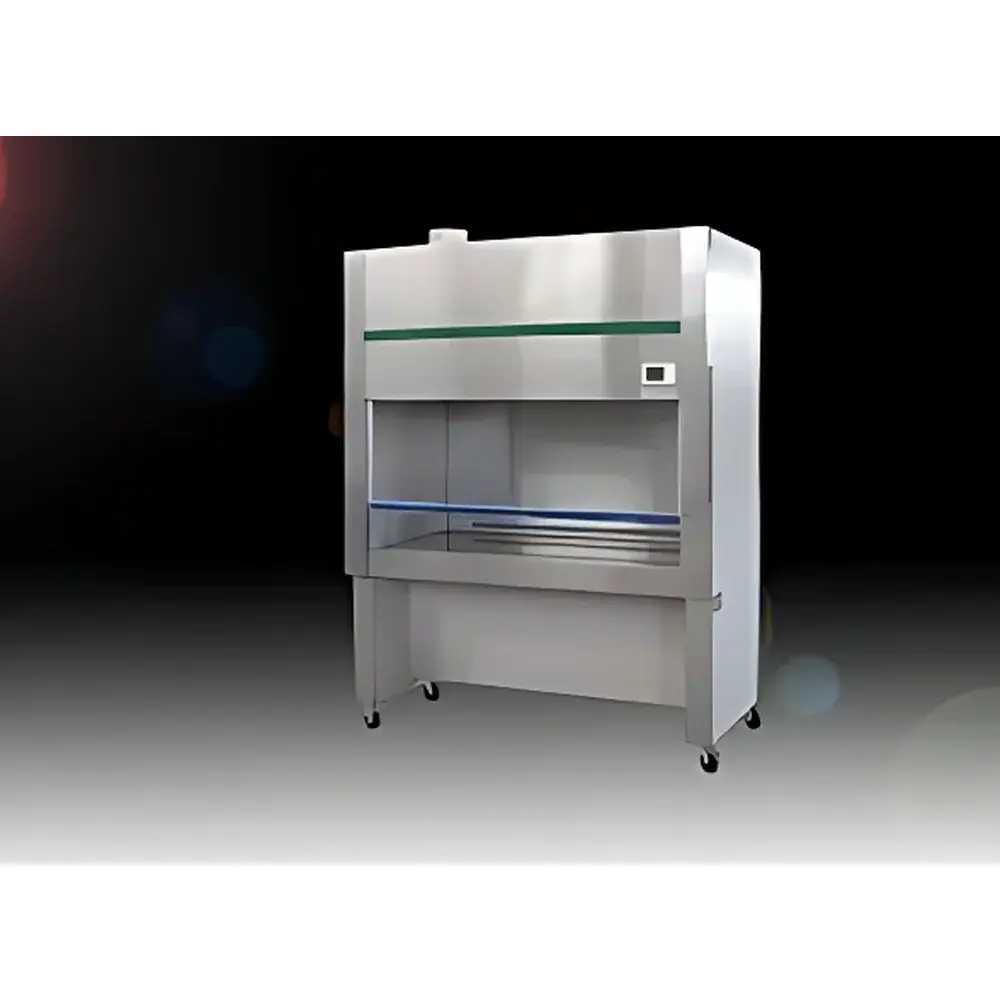
Bio-Safety Cabinet BHC-1300A2
| Origin | Shanghai, China |
|---|---|
| Manufacturer Type | Authorized Distributor |
| Origin Category | Domestic (China) |
| Model | BHC-1300A2 |
| Price | USD 3,750 (FOB Shanghai) |
| Cleanliness Class | ISO Class 5 (equivalent to US FED STD 209B Class 100) |
| Microbial Contamination | ≤0.5 CFU/plate·hour |
| Noise Level | ≤60 dB(A) |
| Inflow Velocity | 0.38 ± 0.025 m/s |
| Downflow Velocity | 0.27 ± 0.025 m/s |
| Vibration Peak-to-Peak | ≤10 µm |
| Power Supply | AC 220 V / 50 Hz |
| Max. Power Consumption | 0.6 kW |
| Work Area Dimensions (W×D×H) | 1000 × 650 × 580 mm |
| Cabinet Weight | 200 kg |
| Airflow Mode | Vertical laminar downflow with dual-mode exhaust (recirculation + external ducting) |
Overview
The Bio-Safety Cabinet BHC-1300A2 is a Class II, Type A2 biological safety cabinet engineered for personnel, product, and environmental protection in microbiological, pharmaceutical, and biomedical laboratories. It operates on the principle of inward airflow (front intake), vertical laminar downflow (HEPA-filtered recirculated air), and partially exhausted airflow (via dedicated ducting or thimble connection). Designed in accordance with NSF/ANSI 49–2022 and EN 12469:2000 standards, the BHC-1300A2 maintains ISO Class 5 (US FED STD 209B Class 100) cleanroom conditions within the work area while ensuring operator exposure remains below 1.0 CFU/m³—validated by microbial challenge testing per ISO 14644-1. Its negative-pressure chamber architecture, combined with a dual-stage HEPA filtration system (pre-filter + main 99.995% @ 0.3 µm HEPA), provides reliable containment for Risk Group 2 (RG2) agents and selected RG3 applications when used with appropriate procedural controls.
Key Features
- Air curtain isolation system with precisely calibrated inflow velocity (0.38 ± 0.025 m/s) and downflow velocity (0.27 ± 0.025 m/s), ensuring stable laminar flow and effective containment at the sash opening.
- Motorized, counterbalanced sash with dual-height positioning and audible/visual height-limit alarm to enforce safe operating sash height (typically 200 mm), minimizing turbulence and cross-contamination risk.
- Dual-mode exhaust configuration: accommodates both hard-ducted and canopy-connected installations; includes integral exhaust HEPA filter (99.995% @ 0.3 µm) and dedicated exhaust plenum with static pressure monitoring port.
- Stainless steel 304 work surface and sidewalls (electropolished finish), corrosion-resistant and compliant with ISO 15223-1 labeling requirements for medical device environments.
- Integrated 2 kW grounded power outlet (IEC 60320 C14), IPX4-rated waterproof utility socket, and floor-level waste drainage interface—designed for integration into GLP-compliant lab infrastructure.
- Infrared remote control with dual-speed fan regulation (low/high), real-time status LED indicators (sash position, airflow fault, UV lamp status, filter life), and auto-shutdown sequence upon sash closure.
Sample Compatibility & Compliance
The BHC-1300A2 supports open-vessel manipulations involving liquid cultures, agar plates, centrifuge tubes, and small-scale bioreactors. It is validated for use with non-volatile, low-to-moderate toxicity chemical agents (when compatible with stainless steel and HEPA media), including ethanol, isopropanol, and diluted disinfectants. All electrical components meet IEC 61010-1:2010 safety requirements for laboratory equipment. The cabinet complies with NSF/ANSI 49–2022 (Class II, Type A2), EN 12469:2000, and GB/T 25915.3–2021 (Chinese national standard for cleanrooms). Documentation includes factory-assembled airflow certification reports, HEPA filter integrity test records (DOP/PAO scan), and electrical safety test certificates—fully traceable for FDA 21 CFR Part 11–aligned audit trails.
Software & Data Management
While the BHC-1300A2 operates as a standalone hardware platform without embedded software, its control module logs operational parameters—including total runtime, sash position history, UV lamp usage hours, and airflow fault events—into non-volatile memory. These logs are accessible via IR remote diagnostic mode and exportable in CSV format using optional USB data logger (sold separately). For regulated environments, the unit supports integration into centralized lab monitoring systems via 4–20 mA analog output (airflow velocity) and dry-contact relay outputs (alarms, sash open/closed, UV on/off). Audit trail functionality meets ALCOA+ principles when paired with validated LIMS or ELN platforms.
Applications
- Microbiological culture handling: streaking, subculturing, and antibiotic susceptibility testing under sterile ISO Class 5 conditions.
- Pharmaceutical aseptic processing: preparation of sterile solutions, media fill simulations, and QC sample handling in non-sterile compounding areas.
- Cell culture maintenance: passaging, transfection, and cryopreservation workflows requiring protection against aerosolized contaminants.
- Diagnostic laboratory operations: handling clinical specimens (e.g., sputum, blood cultures) where biosafety containment and particulate control are co-required.
- Academic and industrial R&D labs conducting molecular biology protocols involving plasmid transformation, PCR setup, and CRISPR reagent handling.
FAQ
What biosafety level (BSL) does the BHC-1300A2 support?
It is certified for BSL-2 applications and limited BSL-3 procedures when used with supplemental engineering controls and institutional biosafety committee approval.
Can this cabinet be installed without external ducting?
Yes—it operates safely in recirculating mode with 70% air recirculated and 30% exhausted through the built-in carbon pre-filter and exhaust HEPA; however, ducted installation is required for volatile chemicals or high-risk agents.
Is the HEPA filter certified per ISO 14644-3?
All HEPA filters are individually tested per ISO 14644-3 Annex B (scan method) and supplied with full traceability documentation, including filter serial number, efficiency rating, and leak-test report.
Does the unit comply with FDA 21 CFR Part 11 requirements?
The base unit does not include electronic signature capability, but its data logging interface and alarm relay outputs are designed to integrate with Part 11–compliant LIMS or SCADA systems for electronic record retention.
What maintenance intervals are recommended?
Pre-filters require cleaning every 2 weeks; main HEPA filters are rated for 5 years under typical lab use (validated annually via DOP testing); UV lamp replacement is recommended every 12 months or after 1,000 hours of operation.



