
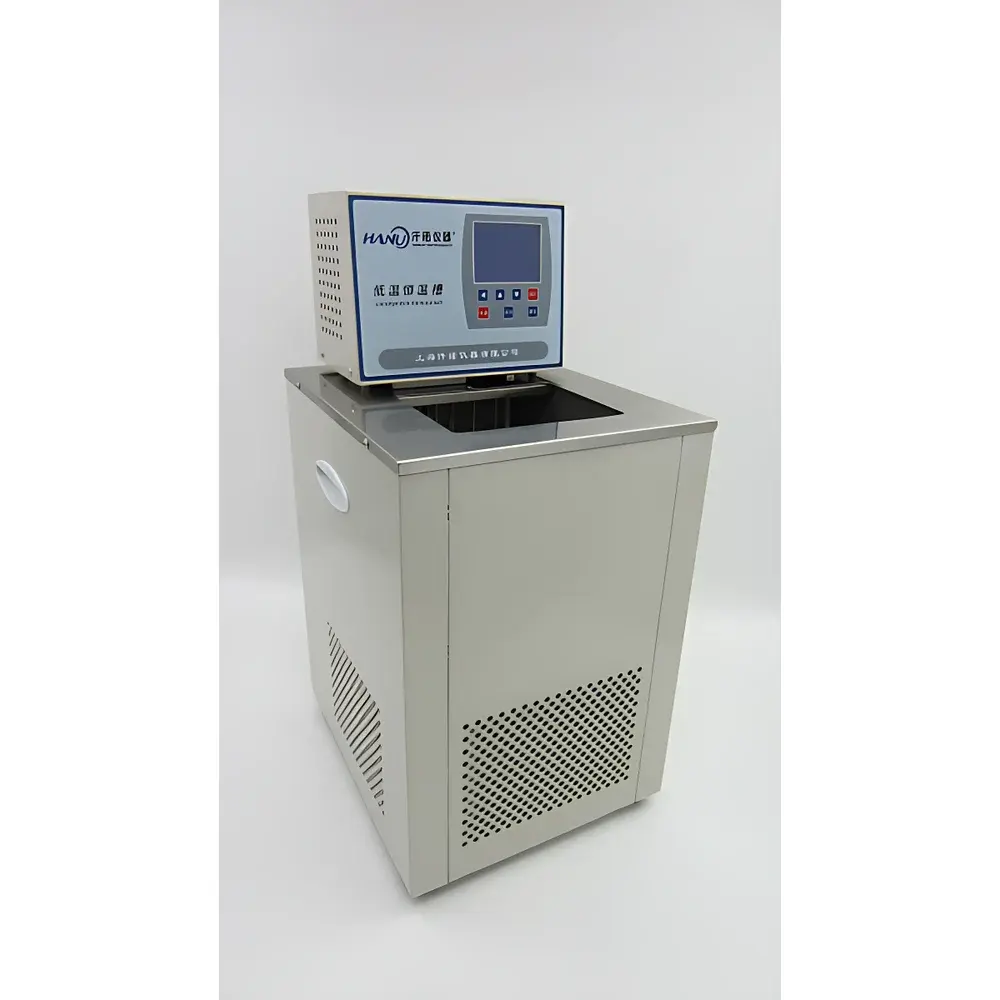
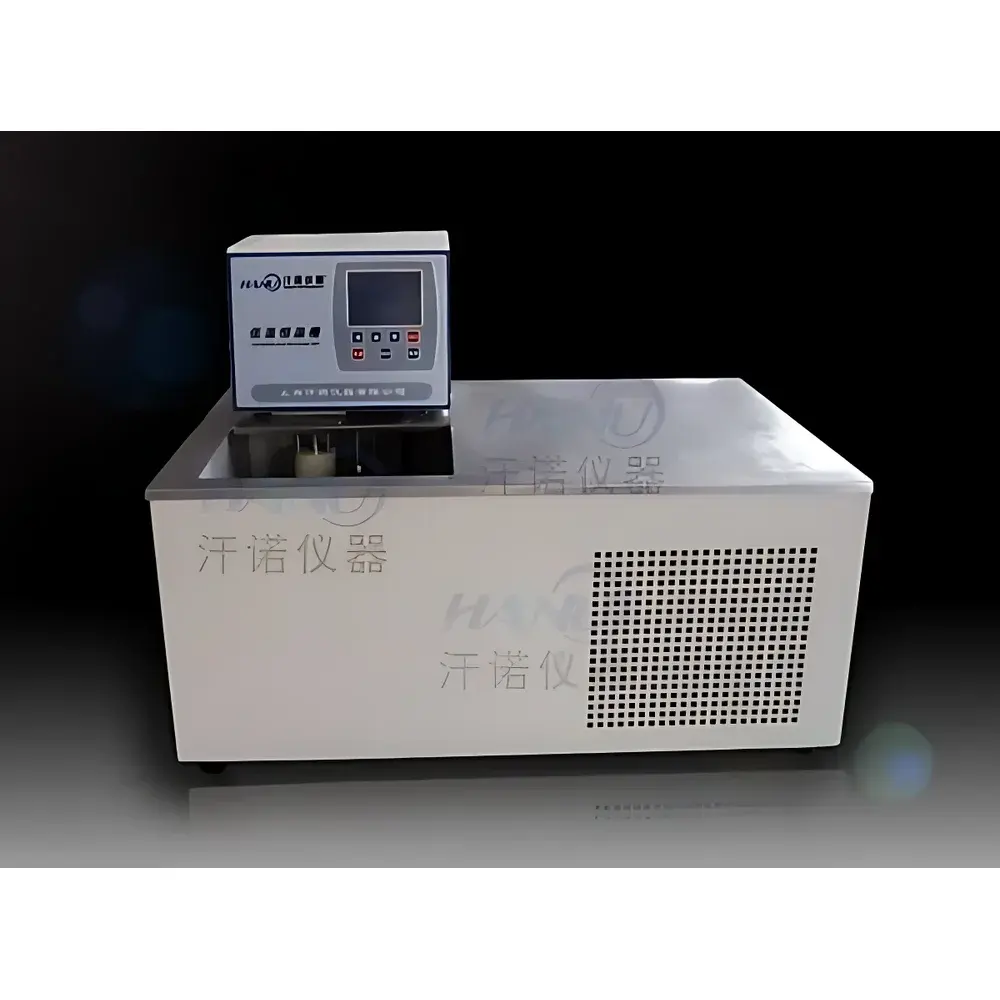
Hanuo GDH-3005 High-Precision Low-Temperature Circulating Chiller
| Brand | Hanuo |
|---|---|
| Origin | Shanghai, China |
| Model | GDH-3005 |
| Temperature Range | −30 °C to 100 °C |
| Temperature Stability | ±0.01 °C |
| Resolution | 0.001 °C |
| Bath Volume | 5 L |
| Circulation Flow Rate | 6 L/min |
| Pump Pressure | Not Specified |
| Cooling Method | Air-Cooled |
| Construction | Integral (All-in-One) |
| Operating Mode | Continuous |
| Bath Dimensions (W×D×H) | 250 mm × 200 mm × 120 mm |
| Opening Size | 180 mm × 140 mm |
| Refrigeration System | Hermetically Sealed Compressor with Overheat & Overcurrent Protection |
| Control System | XMT Digital PID Controller with LED Display |
| Materials | Full Stainless Steel Interior and Work Surface |
Overview
The Hanuo GDH-3005 High-Precision Low-Temperature Circulating Chiller is an integral, air-cooled thermal management system engineered for laboratory environments requiring stable, programmable temperature control across a wide operational range—from −30 °C to +100 °C. It operates on the principle of closed-loop liquid circulation, utilizing a hermetically sealed refrigeration compressor coupled with a high-efficiency heat exchanger and precision-matched centrifugal circulation pump. Unlike passive water baths or open-loop chillers, the GDH-3005 maintains thermal equilibrium through active feedback regulation: the XMT-based digital PID controller continuously monitors bath temperature via a calibrated PT100 sensor and dynamically adjusts refrigerant flow and heater output to sustain setpoint stability within ±0.01 °C—critical for applications demanding high reproducibility in kinetic studies, calibration traceability, or material property testing. Its all-stainless-steel construction ensures chemical resistance, long-term dimensional stability, and compliance with ISO 17025 laboratory infrastructure requirements for cleanliness and durability.
Key Features
- Hermetically sealed compressor refrigeration system with dual-stage overheat and overcurrent protection—ensuring uninterrupted operation under extended duty cycles.
- High-resolution digital PID control (0.001 °C resolution) with real-time LED display and intuitive front-panel interface for precise setpoint entry and deviation monitoring.
- Integrated 6 L/min circulation pump with adjustable flow output—enabling external temperature control of auxiliary equipment (e.g., spectrophotometer jackets, reactor jackets, or calorimeter cells) without secondary chillers.
- Full stainless steel bath interior (AISI 304), work surface, and fluid pathways—resistant to corrosion from aqueous buffers, organic solvents (e.g., ethanol, ethylene glycol/water mixtures), and mild acids commonly used in low-temperature chemistry.
- Compact integral design (250 mm × 200 mm × 120 mm bath volume; 5 L capacity) optimized for benchtop integration, including under-bench or fume hood installation where space is constrained.
- Air-cooled condenser with intelligent thermal load balancing—eliminates dependency on facility cooling water, reducing infrastructure complexity and permitting deployment in non-dedicated lab spaces.
Sample Compatibility & Compliance
The GDH-3005 accommodates a broad spectrum of sample containers and external devices via its standardized bath opening (180 mm × 140 mm) and flexible circulation port configuration. Compatible loads include glass jacketed reactors (up to 5 L volume), rotary evaporator condensers, UV-Vis cuvette holders, and differential scanning calorimetry (DSC) cell blocks. The unit complies with IEC 61010-1:2010 for electrical safety in laboratory equipment and meets CE marking requirements for EMC (EN 61326-1) and low-voltage directives. While not certified to FDA 21 CFR Part 11 out-of-the-box, its deterministic control logic, non-volatile parameter storage, and absence of user-modifiable firmware support audit-ready documentation practices required under GLP and GMP frameworks—particularly when paired with external data loggers validated per ASTM E2877-22 for thermal mapping.
Software & Data Management
The GDH-3005 operates as a standalone instrument with no proprietary software dependency. All operational parameters—including setpoint, actual temperature, pump status, and alarm history—are accessible via the front-panel interface. For integration into automated workflows, optional RS485/Modbus RTU communication (available on GDH-3005A variant) enables bidirectional control and real-time telemetry to SCADA systems, LIMS, or custom Python/NI LabVIEW scripts. Temperature logs can be exported at user-defined intervals (1–60 s) using third-party Modbus polling tools, supporting traceability in ISO/IEC 17025-accredited calibration labs. No cloud connectivity or remote access features are implemented—preserving data sovereignty and minimizing cybersecurity attack surface per NIST SP 800-53 Rev. 5 guidelines for scientific instrumentation.
Applications
- Calibration of thermistors, RTDs, and infrared thermometers against NIST-traceable reference standards in metrology labs.
- Stabilization of optical components (e.g., laser diodes, interferometer stages) where thermal drift must remain below 50 mK/hour.
- Controlled-rate cooling in polymer crystallization studies (e.g., DSC pre-conditioning, rheological hysteresis testing).
- Condenser temperature regulation in rotary evaporation systems using low-boiling solvents (e.g., dichloromethane, pentane) at sub-zero setpoints.
- Long-duration enzymatic assays requiring strict thermal uniformity across multi-well plates mounted on custom aluminum cold blocks.
- Pre-conditioning of battery electrode slurries prior to rheological characterization under controlled thermal history.
FAQ
What is the minimum achievable temperature with 100% glycol/water mixture?
The GDH-3005 achieves its rated −30 °C with a 30% propylene glycol / 70% deionized water mixture. Pure glycol reduces heat transfer efficiency and may limit low-end performance; consult the viscosity-temperature chart for your specific coolant before operation.
Can the unit maintain stability during rapid setpoint transitions?
Yes—the PID algorithm includes adaptive gain scheduling that suppresses overshoot during ramp rates up to 2 °C/min. For optimal stability after large changes (>10 °C), allow ≥15 minutes for thermal equilibration before initiating critical measurements.
Is external fluid level monitoring supported?
No. The system relies on internal float-switch detection for low-level shutdown. Users must manually verify coolant volume before startup and inspect for evaporation loss during prolonged operation above 80 °C.
Does the chiller meet ISO 13485 requirements for medical device R&D?
While not certified, its documented design controls, material traceability (stainless steel grade certificates available upon request), and alarm logging capability align with Clause 7.5.2.1 for equipment verification in QMS-compliant environments.
What maintenance intervals are recommended for continuous 24/7 operation?
Compressor oil and refrigerant integrity should be verified annually by authorized service personnel. Air filter cleaning is required every 90 days in dust-prone environments; condenser coil inspection is advised quarterly.



