
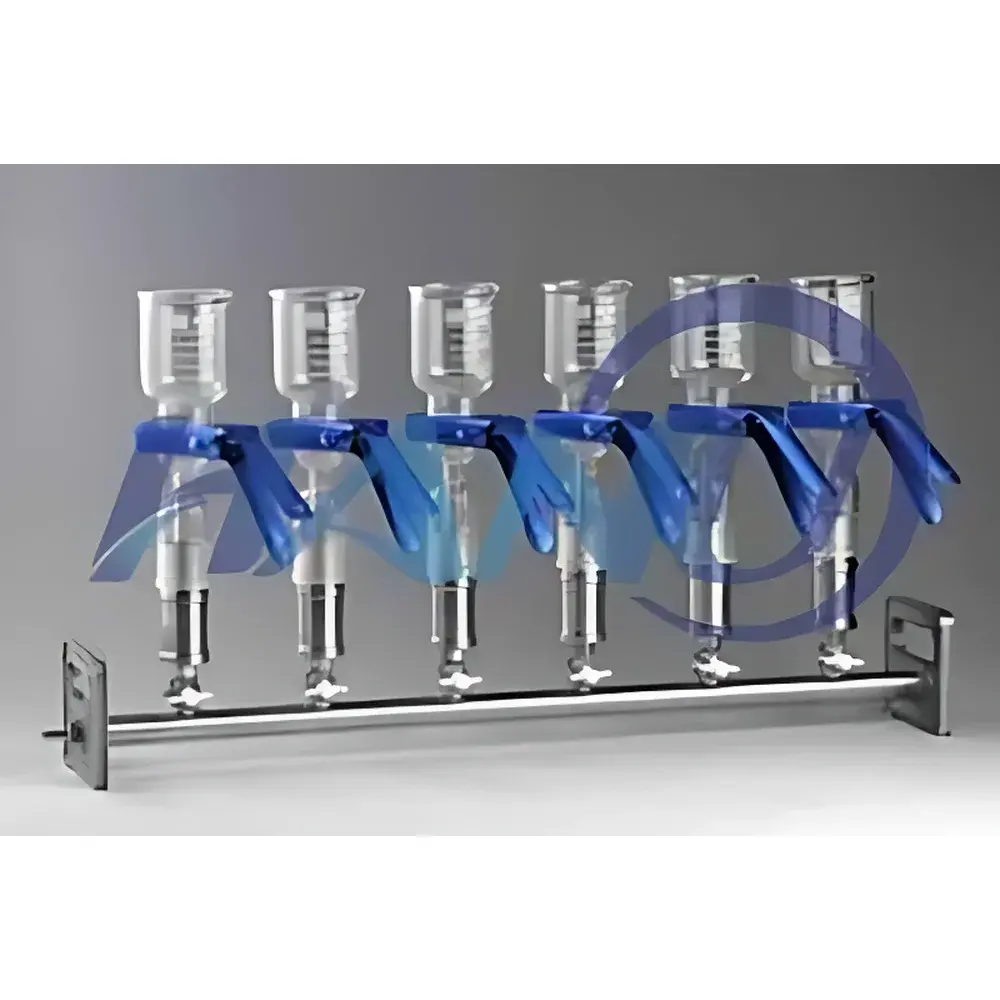
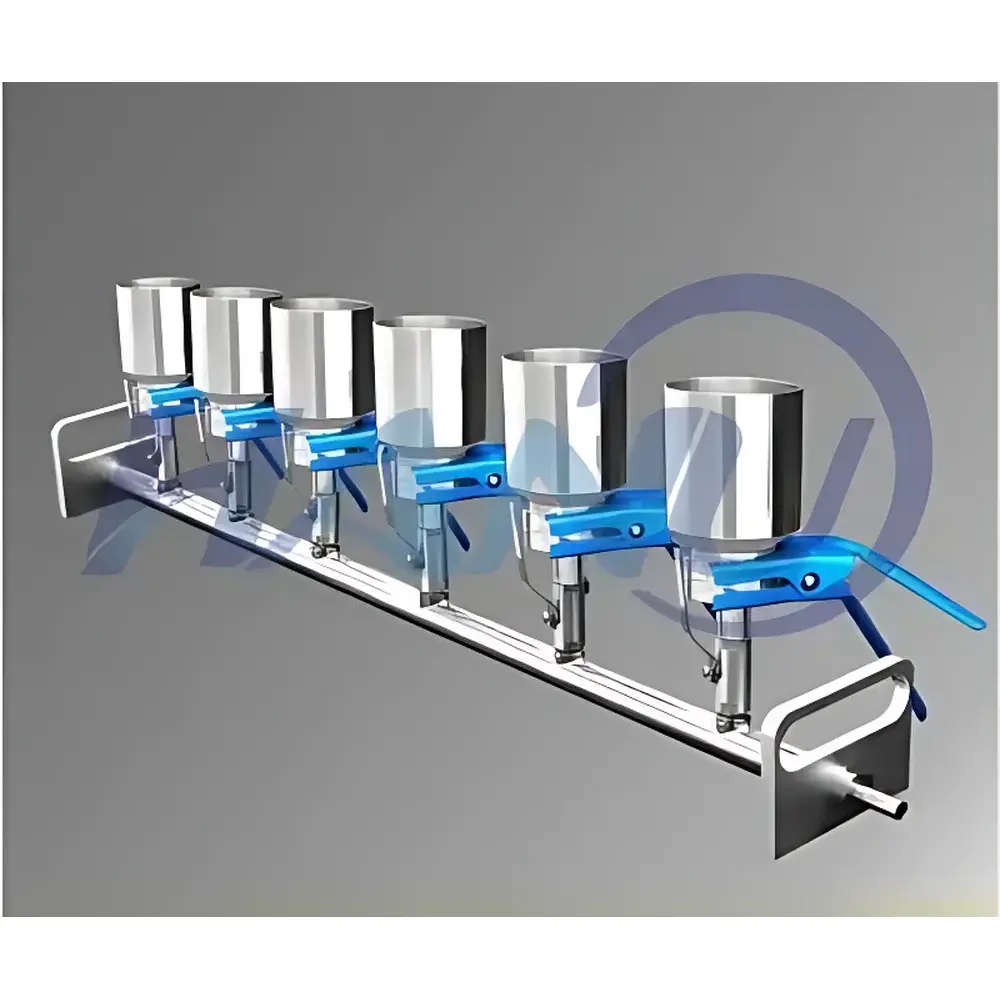
Hanuo MS-6 Standard Six-Position Vacuum Filtration Manifold
| Brand | Hanuo |
|---|---|
| Origin | Shanghai, China |
| Manufacturer Type | Authorized Distributor |
| Country of Origin | China |
| Model | MS-6 |
| Price | USD 985 (excl. VAT & shipping) |
| Material | Electropolished 316L Stainless Steel Frame |
| Dimensions (L×W×H) | 914 × 110 × 118 mm |
| Sample Capacity | 6 independent filtration stations |
| Connection Interface | Standard #9 rubber stopper ports for glass or stainless steel membrane filter holders |
| Individual Valve Control | Yes, per station |
| Structural Design | Low-center-of-gravity base with anodized aluminum dual-handled support frame |
Overview
The Hanuo MS-6 Standard Six-Position Vacuum Filtration Manifold is an engineered laboratory solution for parallel sample processing in life science and bioprocessing workflows. Designed around the principle of vacuum-driven membrane filtration, the system enables simultaneous sterile or particulate removal from up to six liquid samples using a single centralized vacuum source—eliminating the need for multiple pumps or manual valve switching. Its core architecture adheres to fundamental fluidic design principles: laminar flow paths, minimized dead volume, and pressure-balanced channel distribution ensure consistent vacuum transmission across all six stations. The manifold is not a standalone filtration device but a precision interface platform—intended for integration with standard 47 mm or 25 mm diameter membrane filters housed in reusable glass or autoclavable stainless steel filter holders. This modular compatibility supports both qualitative (e.g., microbial colony isolation) and quantitative (e.g., suspended solids recovery) applications under controlled environmental conditions.
Key Features
- Independent on/off control per filtration station via integrated PTFE-coated stainless steel pinch valves—enabling selective operation without interrupting ongoing filtrations.
- Electropolished 316L stainless steel manifold body—resistant to corrosion from organic solvents, acidic/basic buffers (pH 2–12), and oxidizing agents commonly used in cell culture media preparation and downstream purification.
- Low-center-of-gravity structural geometry—validated to remain stable under full-load conditions (up to 500 mL per funnel), mitigating tipping risk during high-volume or viscous sample processing.
- Anodized aluminum dual-handled base frame—provides ergonomic lifting points and mechanical reinforcement while maintaining non-magnetic, non-reactive surface integrity.
- Standardized #9 rubber stopper interface—ensures leak-tight coupling with commercially available glass funnels (e.g., Nalgene, Corning) and stainless steel filter holders compliant with ASTM F838-22 for bacterial retention testing.
- Tool-free assembly and disassembly—facilitating rapid cleaning, inspection, and validation between batches in GLP- or GMP-aligned laboratories.
Sample Compatibility & Compliance
The MS-6 manifold accommodates aqueous, alcoholic, and mild organic solvent-based solutions—including phosphate-buffered saline (PBS), Tris-HCl buffers, ethanol/water mixtures, and clarified fermentation broths. It is routinely deployed in pre-filtration steps prior to HPLC sample injection, sterility testing per USP , and bioburden assessment per ISO 11737-1. While the manifold itself carries no intrinsic regulatory certification, its material composition and dimensional conformity enable full traceability within validated filtration protocols. When paired with certified 0.22 µm PVDF or PES membranes and calibrated vacuum gauges, the complete setup meets requirements for ISO/IEC 17025-compliant laboratories performing method verification per ICH Q5A(R2). Surface finish Ra ≤ 0.4 µm (verified via profilometry) satisfies ASME BPE-2022 criteria for sanitary process equipment contact surfaces.
Software & Data Management
The MS-6 is a manually operated, analog filtration manifold with no embedded electronics, firmware, or digital connectivity. As such, it requires no software installation, driver configuration, or cybersecurity validation. All operational parameters—including vacuum pressure (monitored externally via analog gauge), filtration time, and membrane lot traceability—are recorded manually in laboratory notebooks or electronic lab notebooks (ELNs) compliant with 21 CFR Part 11 when paired with audit-trail-enabled systems. This absence of digital components simplifies IQ/OQ documentation, reduces qualification scope, and ensures long-term operational consistency across facility-wide deployments—particularly advantageous in regulated QC environments where hardware stability and procedural reproducibility are prioritized over automation.
Applications
- Sterile filtration of cell culture media, antibiotics, and enzyme solutions prior to aseptic filling.
- Microbial enumeration via membrane filtration (ISO 9308-1, EPA Method 1603) for drinking water, pharmaceutical water systems, and cleanroom environmental monitoring.
- Particulate matter recovery from biological fluids (e.g., synovial fluid, bronchoalveolar lavage) for microscopy or elemental analysis.
- Clarification of crude lysates and antibody-containing supernatants before chromatographic purification.
- Pre-concentration of low-abundance analytes (e.g., exosomes, viral particles) using ultra-low-binding hydrophilic PVDF membranes.
- Parallel solvent exchange in nanoparticle synthesis workflows requiring rapid buffer replacement under inert atmosphere.
FAQ
Is the MS-6 compatible with vacuum pumps rated above 0.8 bar suction pressure?
Yes—the manifold’s sealed valve design and 316L construction tolerate continuous vacuum levels up to –95 kPa (–0.95 bar), provided the connected pump includes an inline vacuum regulator and condensate trap to prevent backflow.
Can the manifold be autoclaved?
No—the electropolished stainless steel body is autoclavable (121°C, 20 min), but the PTFE-coated valves and anodized aluminum handles are not rated for repeated steam sterilization; alternative disinfection methods (e.g., 70% ethanol wipe, VHP exposure) are recommended.
Does Hanuo provide validation documentation for the MS-6?
Hanuo supplies a Certificate of Conformance (CoC) with batch-specific material certifications (ASTM A276 for 316L) and dimensional inspection reports; full IQ/OQ protocol templates are available upon request for integration into site-specific validation packages.
What filter holder diameters does the MS-6 support?
It is configured for standard 47 mm membrane filters; optional adapter sleeves allow use with 25 mm holders, though flow rate uniformity across all six channels must be verified empirically for non-standard configurations.




