
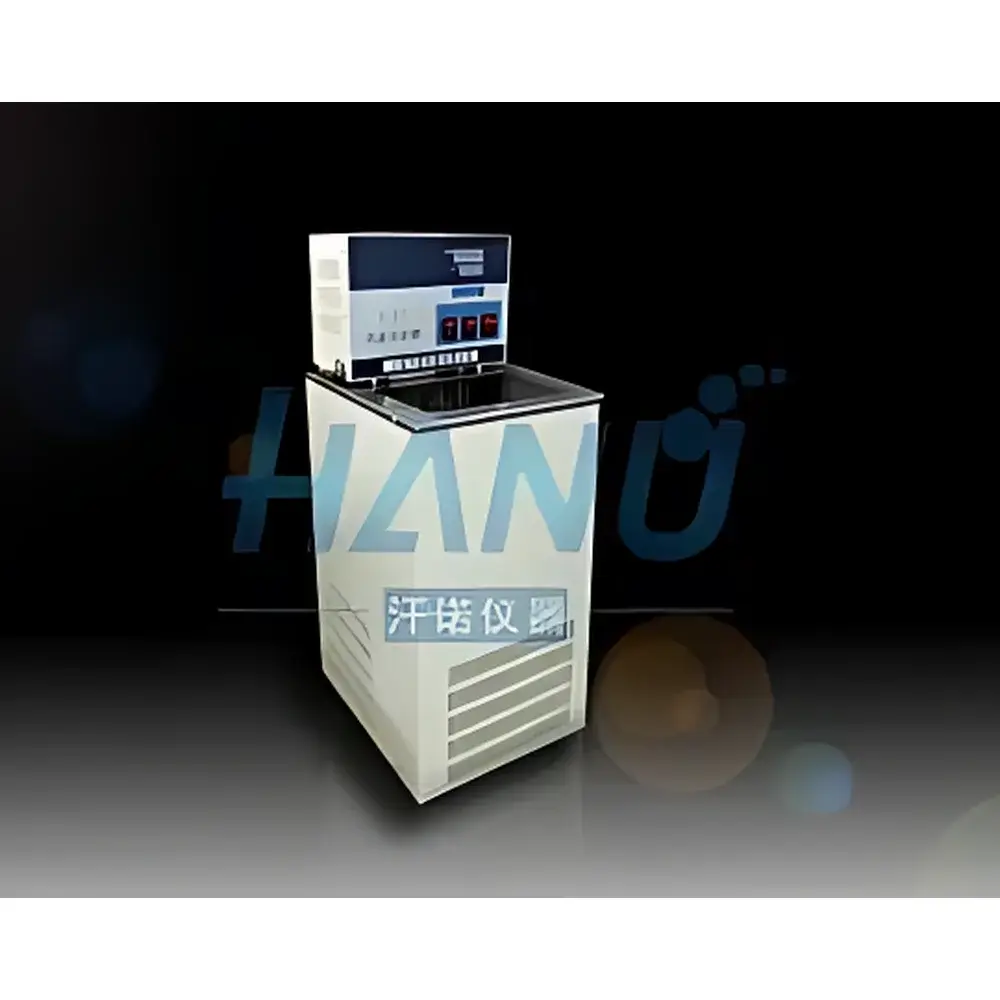
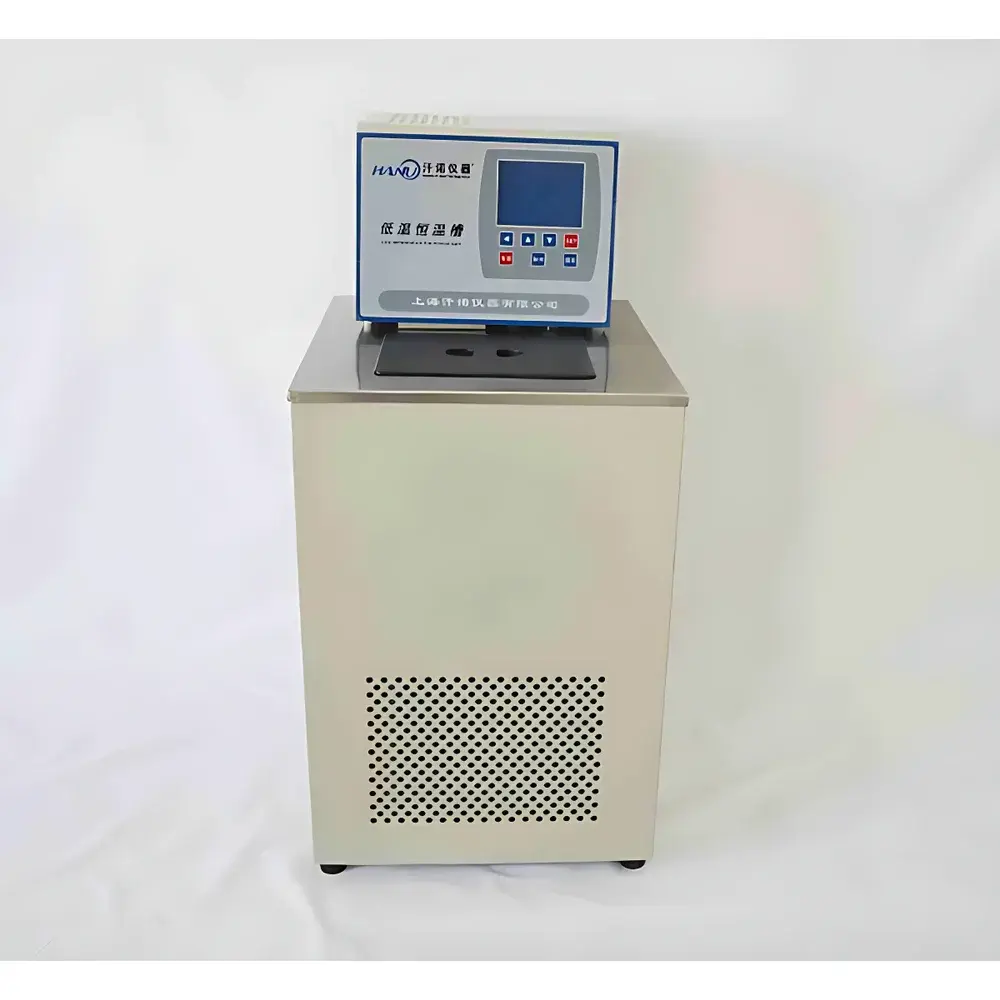
Hanuo DC-4015 Low-Temperature Constant-Temperature Circulating Bath
| Brand | Hanuo |
|---|---|
| Origin | Shanghai, China |
| Model | DC-4015 |
| Instrument Type | Constant-Temperature Bath |
| Temperature Range | −40 °C to 100 °C |
| Temperature Stability | ±0.1 °C |
| Bath Volume | 15 L |
| Circulation Mode | Internal & External |
| Temperature Control | Refrigeration & Heating |
| Construction | Stainless Steel Interior & Work Surface |
| Control System | XMT Digital PID Controller |
| Refrigeration System | Hermetically Sealed Compressor with Overheat & Overcurrent Protection |
| Pump Flow Rate | 4 L/min |
| External Port | Standard NPT or BSP Fitting for Auxiliary Loop Integration |
Overview
The Hanuo DC-4015 Low-Temperature Constant-Temperature Circulating Bath is a precision-engineered thermal management system designed to deliver stable, uniform, and controllable temperature environments for laboratory and industrial applications. Operating on a dual-mode thermodynamic principle—combining vapor-compression refrigeration with resistive heating—the unit maintains setpoint accuracy across its full operational range of −40 °C to 100 °C. Its integrated closed-loop circulation architecture enables both internal temperature homogenization and external heat transfer via a high-efficiency centrifugal pump (4 L/min flow rate), making it suitable as either a primary thermal source or a secondary conditioning loop for calorimeters, viscometers, spectrophotometers, reaction jackets, and other externally connected instrumentation. The bath’s stainless steel tank and top plate ensure chemical resistance, mechanical durability, and compliance with GLP-aligned cleaning protocols in regulated analytical environments.
Key Features
- Stainless steel construction (304 grade) for corrosion resistance, ease of decontamination, and long-term dimensional stability under thermal cycling.
- Digital PID temperature controller (XMT series) with real-time digital display, programmable setpoint memory, and adjustable proportional-integral-derivative tuning parameters for optimized response across viscosity- and load-dependent conditions.
- Hermetically sealed refrigeration system featuring R404A or R507 refrigerant (model-dependent), equipped with dual-stage safety interlocks: compressor discharge temperature monitoring and motor overcurrent protection.
- Simultaneous internal and external circulation modes—internal mode ensures rapid thermal equilibration within the 15 L reservoir; external mode supports closed-loop integration with jacketed reactors, rotary evaporators, or custom test fixtures via standardized fluid ports.
- Thermal stability of ±0.1 °C at steady state (measured per ASTM E742–22 methodology using calibrated PT100 probe at geometric center), validated across ambient temperatures from 15 °C to 30 °C and load variations up to 2 kg immersed mass.
- Compact vertical footprint (300 × 250 × 200 mm working槽 dimensions) optimized for benchtop integration without compromising thermal inertia or fluid dynamics performance.
Sample Compatibility & Compliance
The DC-4015 accommodates a wide spectrum of sample configurations—including glassware (e.g., U-tube viscometers, Dewar flasks), metal reaction vessels, polymer test specimens, and electronic sensor housings—provided immersion depth and thermal mass remain within specified operational envelopes. It complies with IEC 61010-1:2010 for electrical safety in laboratory equipment and meets CE marking requirements for electromagnetic compatibility (EN 61326-1). While not intrinsically rated for hazardous locations, its sealed refrigeration circuit and grounded chassis support use in ISO 17025-accredited testing laboratories when operated per manufacturer-specified maintenance intervals (e.g., annual refrigerant pressure verification, biannual pump seal inspection). Documentation includes factory calibration certificates traceable to NIM (National Institute of Metrology, China) standards.
Software & Data Management
The DC-4015 operates as a standalone analog-digital hybrid instrument with no embedded firmware-based data logging. However, its 0–5 V analog output (proportional to measured temperature) and RS485 Modbus RTU interface (optional add-on module) enable seamless integration into centralized SCADA or LIMS platforms. When paired with third-party DAQ systems compliant with IEEE 1451.2 or ASTM E1461–21, users can achieve time-stamped temperature recording, alarm-triggered event capture, and audit-trail generation satisfying FDA 21 CFR Part 11 requirements for electronic records—provided the host system implements appropriate user authentication, electronic signatures, and data integrity safeguards.
Applications
- Calibration of temperature-sensitive transducers (RTDs, thermistors, infrared sensors) across extended low-temperature ranges.
- Controlled-rate cooling/heating cycles for polymer crystallinity studies (DSC pre-conditioning) and phase transition analysis.
- Thermal stabilization of optical components during spectroscopic measurements requiring sub-0.2 °C drift limits.
- Support of accelerated stability testing per ICH Q1A(R2) guidelines in pharmaceutical QC labs, particularly for liquid dosage forms subjected to freeze-thaw stress protocols.
- Material testing per ASTM D5276 (impact resistance at low temperature) and ISO 6722 (automotive wiring harness cold-bend performance).
- Biological incubation support for cryopreservation workflow validation where precise ramp-and-hold profiles are required prior to liquid nitrogen transfer.
FAQ
What is the recommended maintenance schedule for the DC-4015’s refrigeration system?
Compressor oil level and refrigerant pressure should be verified annually by authorized service personnel; condenser coil cleaning is advised every six months in non-laminar airflow environments.
Can the DC-4015 maintain −40 °C with an ethylene glycol/water mixture?
Yes—when filled with 30% v/v ethylene glycol solution, the unit achieves nominal −40 °C setpoint with ≤15 min stabilization time (empty bath, ambient 25 °C); viscosity increase above 50% glycol concentration degrades pump efficiency and thermal response.
Is external circulation compatible with pressurized reactor systems?
The standard pump delivers up to 0.25 bar head pressure; for integration with jacketed reactors requiring >0.3 bar supply pressure, a booster pump must be installed upstream of the DC-4015’s outlet port.
Does the unit support remote start/stop via digital I/O?
No native dry-contact control; however, the RS485 interface (with optional module) allows command-driven operation via Modbus function codes 05 (coil write) and 03 (holding register read).
How is temperature uniformity validated inside the bath chamber?
Per ISO 17025 Clause 5.10.4, uniformity is assessed using ≥3 calibrated PT100 probes positioned at bottom-center, mid-height center, and surface-center locations; maximum deviation across points must remain ≤±0.15 °C at any stable setpoint.



