
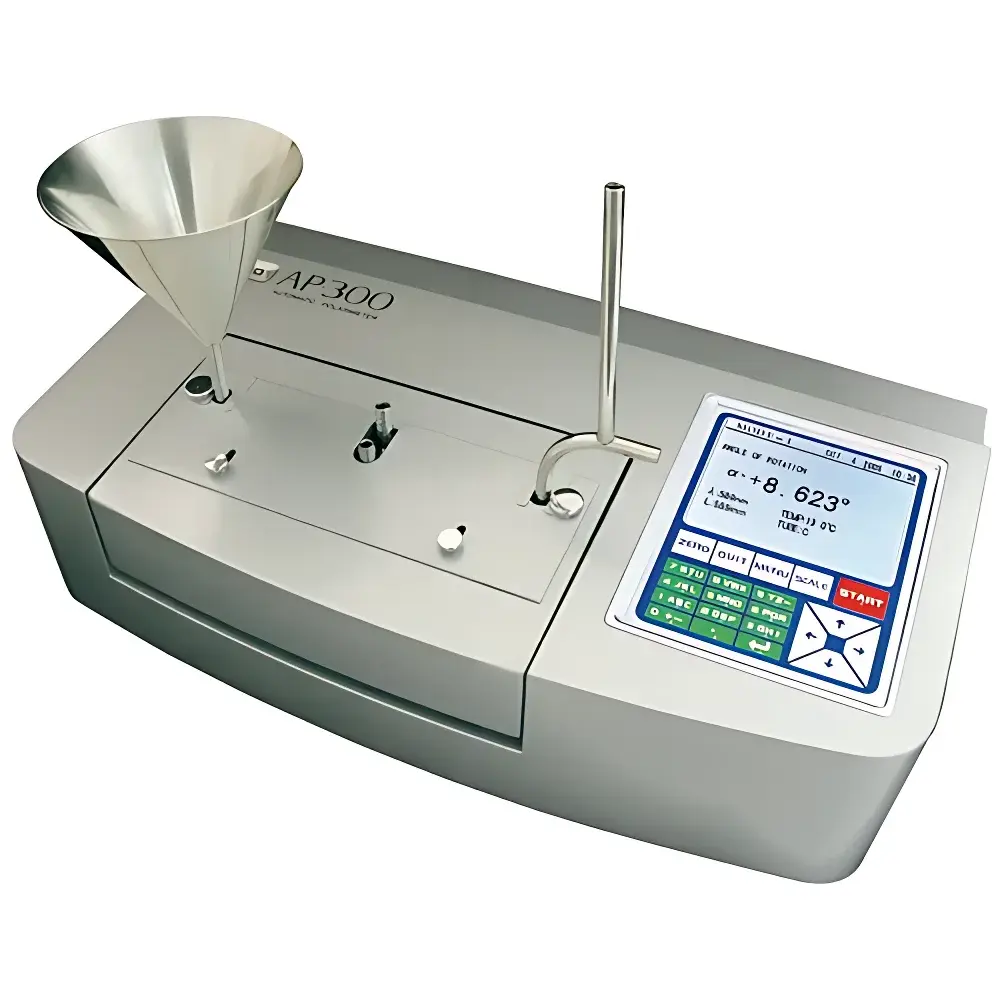
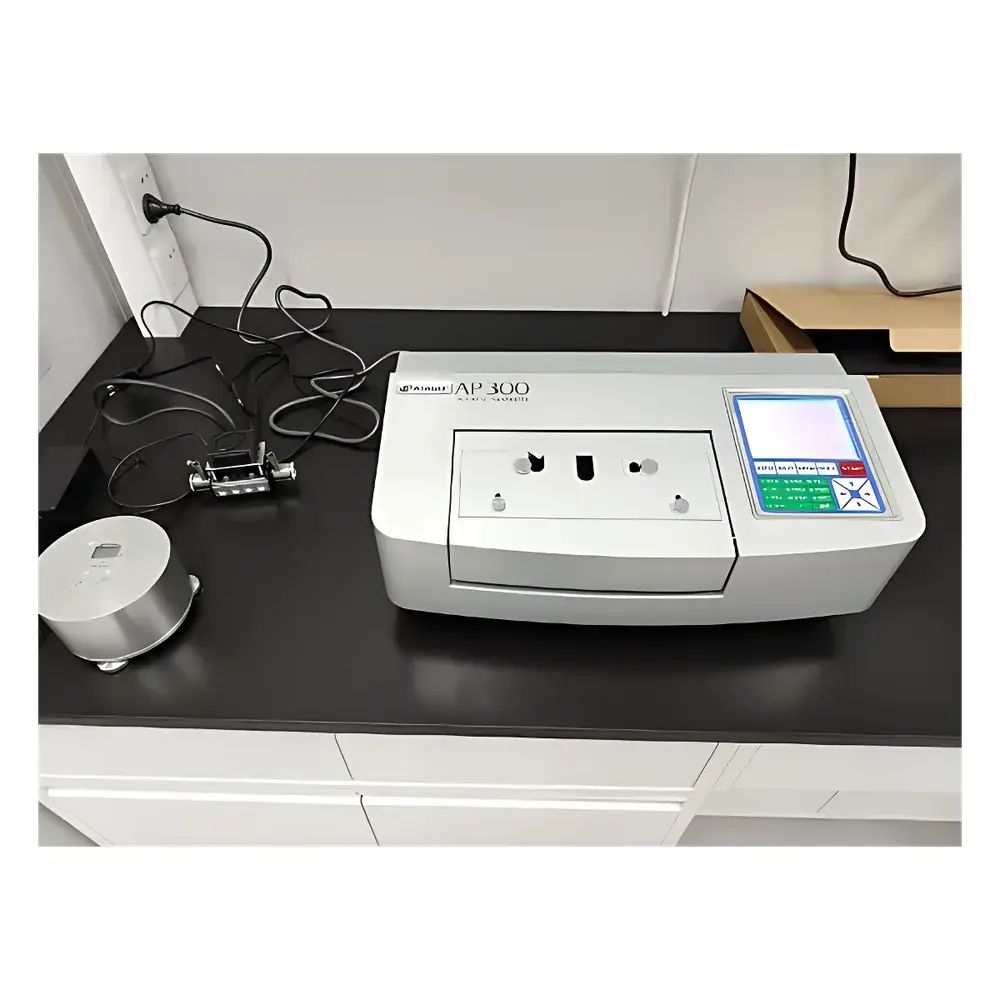
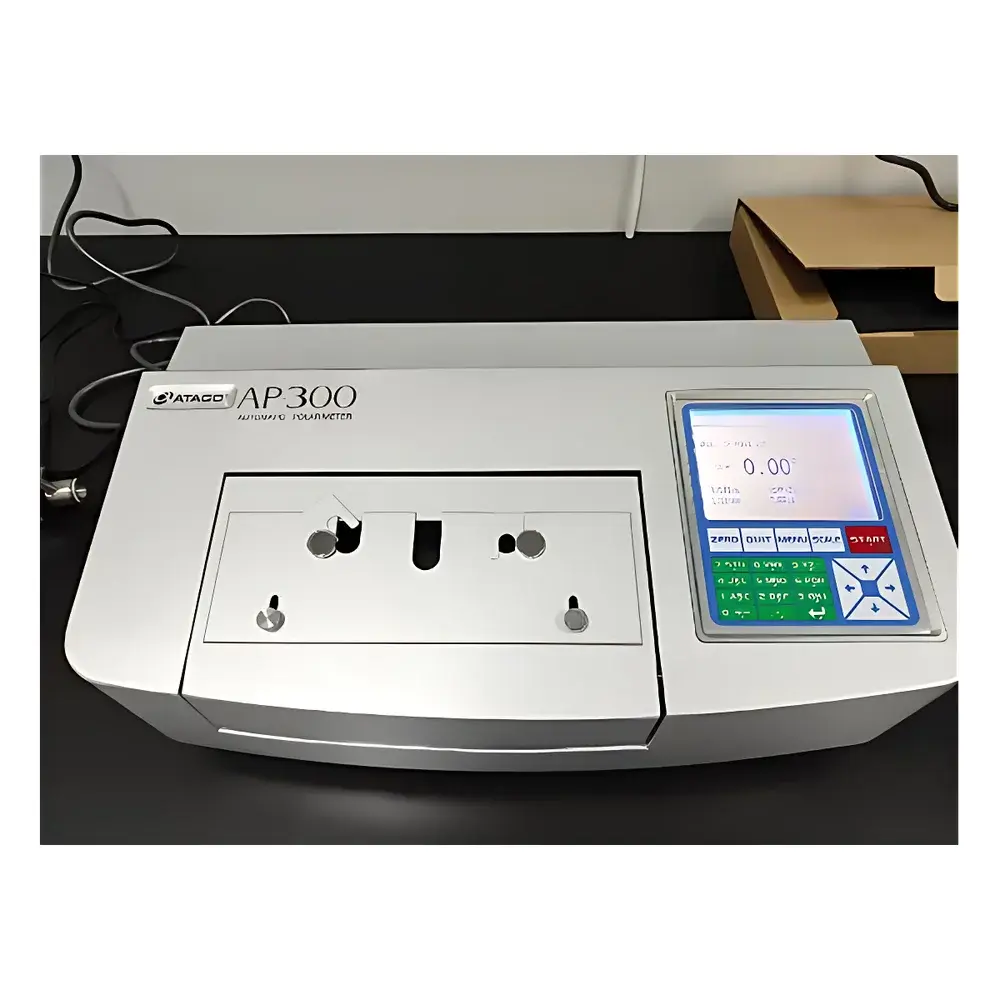
ATAGO AP-300 Automated Polarimeter for Sugar Industry
| Brand | ATAGO |
|---|---|
| Origin | Japan |
| Model | AP-300 |
| Product Type | Automatic Polarimeter |
| Temperature Control | Yes (optional integrated water-jacketed cell with external circulator) |
| Display | Backlit Color LCD |
| Light Source | LED (589 nm, sodium D-line equivalent) |
| Optical Rotation Range | −89.999° to +89.999° |
| Specific Rotation Resolution | 0.001° |
| Accuracy | ±0.01° (optical rotation), ±0.03°Z (International Sugar Scale) |
| Temperature Compensation Range | 18.0–30.0°C (automatic) |
| Extended Temperature Operation | 5–90°C (with optional thermostatic circulation bath and jacketed cell) |
| Data Interface | RS-232C |
| Data Storage | Internal memory |
| Calibration | Manual zero-point and standard-solution calibration |
| Cell Length | 200 mm (≈15 mL capacity) |
| Compliance | Designed per ISO 5725 (accuracy/trueness), ASTM E1254 (polarimetric measurement), and USP <781> (Optical Rotation) |
Overview
The ATAGO AP-300 Automated Polarimeter for Sugar Industry is a precision optical instrument engineered for high-reproducibility measurement of optical rotation in sucrose solutions and other optically active substances used throughout sugar refining, cane/beet processing, and quality assurance laboratories. Based on the fundamental principle of polarimetry—quantifying the angular rotation of plane-polarized light induced by chiral molecules—the AP-300 delivers traceable, temperature-compensated results aligned with internationally recognized sugar measurement standards. Its core optical path utilizes a stable, long-life 589 nm LED source approximating the sodium D-line wavelength, ensuring spectral consistency critical for compliance with the International Sugar Scale (°Z). The instrument operates under strict photometric linearity and thermal stability protocols, enabling direct reporting in °Z, degrees of optical rotation (°), or specific rotation ([α])—all calculated in real time using built-in algorithms compliant with ICUMSA Method GS2/3-11 and ISO 2049:2016.
Key Features
- High-resolution optical rotation measurement: ±0.01° accuracy and 0.001° resolution, validated against NIST-traceable quartz control plates
- Dual-mode temperature handling: automatic 18.0–30.0°C compensation for ambient lab use; full 5–90°C thermostatic operation via optional water-jacketed cell (200 mm pathlength) and external circulation bath (e.g., ATAGO 60-C3)
- Integrated color backlit LCD display with intuitive icon-driven interface—no PC required for routine operation
- One-touch automated measurement cycle: auto-zero, sample insertion detection, rotation calculation, and result display within <8 seconds
- RS-232C serial port supporting bidirectional communication with LIMS or Excel-based data logging systems; password-protected access control prevents unauthorized parameter changes
- Onboard memory stores up to 1,000 measurement records with timestamp, operator ID, and temperature metadata
- Modular configuration options: Type A (includes jacketed cell, temperature probe, and recommended circulator); Type B (standard cell only, optimized for controlled-room-temperature environments)
Sample Compatibility & Compliance
The AP-300 accommodates standard 200 mm optical cells with ~15 mL capacity, compatible with both clarified syrup samples and filtered molasses extracts following ICUMSA pre-treatment guidelines. Its design supports routine validation per GLP and GMP frameworks: audit trails are maintained through manual calibration logs and system verification checks (e.g., zero-point stability test, standard sucrose solution verification at 10%, 20%, and 50% w/w). The instrument meets essential requirements of ISO/IEC 17025 for testing laboratories, including documented uncertainty budgets for °Z measurements (k=2, ≤±0.04°Z). All firmware and calibration routines are developed in accordance with FDA 21 CFR Part 11 principles—electronic signatures, change control, and data integrity safeguards are implemented at the embedded software level.
Software & Data Management
While fully functional as a standalone unit, the AP-300 supports seamless integration into digital QA/QC workflows. Its RS-232C interface enables automated data export to laboratory information management systems (LIMS) or custom SCADA interfaces without proprietary drivers. Exported CSV files include columns for date/time stamp, measured °Z value, temperature reading, operator code, and measurement mode (e.g., “Auto-Compensated”, “Thermostatic”). Firmware updates are delivered via secure USB key—each release includes version-controlled release notes and impact assessments per ICH Q5A. Internal storage retains raw sensor output and processed values separately, allowing retrospective re-evaluation using updated correction algorithms without re-measurement.
Applications
- Raw juice and clarified syrup concentration monitoring in cane sugar mills
- Final product purity verification of refined white sugar (ICUMSA color correlation support)
- In-process control during carbonatation, sulfitation, and crystallization stages
- Batch release testing of invert syrups, dextrose monohydrate, and lactose powders
- Reference method validation for inline near-infrared (NIR) or density-based sugar analyzers
- Teaching and method development in food science and carbohydrate chemistry curricula
FAQ
What is the difference between Type A and Type B configurations?
Type A includes the water-jacketed 200 mm cell, integrated temperature probe, and is intended for use with an external thermostatic circulator (e.g., ATAGO 60-C3) to maintain precise 20.00°C measurement conditions. Type B uses the same cell geometry but relies solely on automatic temperature compensation across 18–30°C and is suitable for labs with stable ambient temperature control.
Does the AP-300 comply with ICUMSA official methods?
Yes—the AP-300 implements ICUMSA GS2/3-11 calculation logic for °Z conversion, applies mandatory temperature corrections per ICUMSA GS1/3-10, and supports the required 20°C reference condition when used with Type A configuration and certified circulator.
Can the instrument be calibrated in-house without external service?
Yes—users perform daily zero-point calibration using the supplied dark filter and periodic verification using certified sucrose reference standards (e.g., NIST SRM 84g). Full calibration certificates are generated internally and exportable.
Is FDA 21 CFR Part 11 compliance supported?
The AP-300 provides electronic signature capability, audit trail logging (including parameter changes and calibration events), and role-based access control—meeting foundational technical controls outlined in Part 11 Subpart B for closed systems.
What maintenance is required beyond routine cleaning?
LED light source lifetime exceeds 50,000 hours; no lamp replacement is needed during typical instrument service life. Annual verification of temperature probe accuracy and optical alignment is recommended using ATAGO-certified service kits.



