
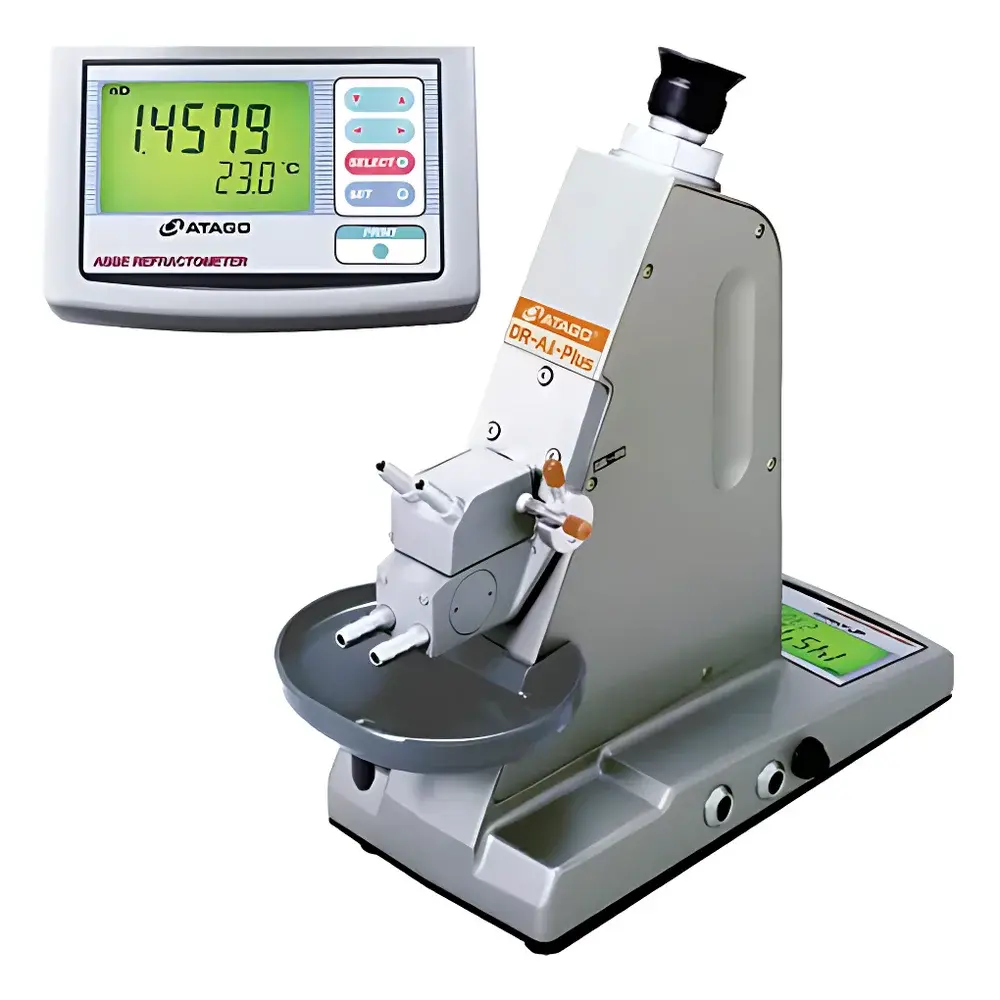
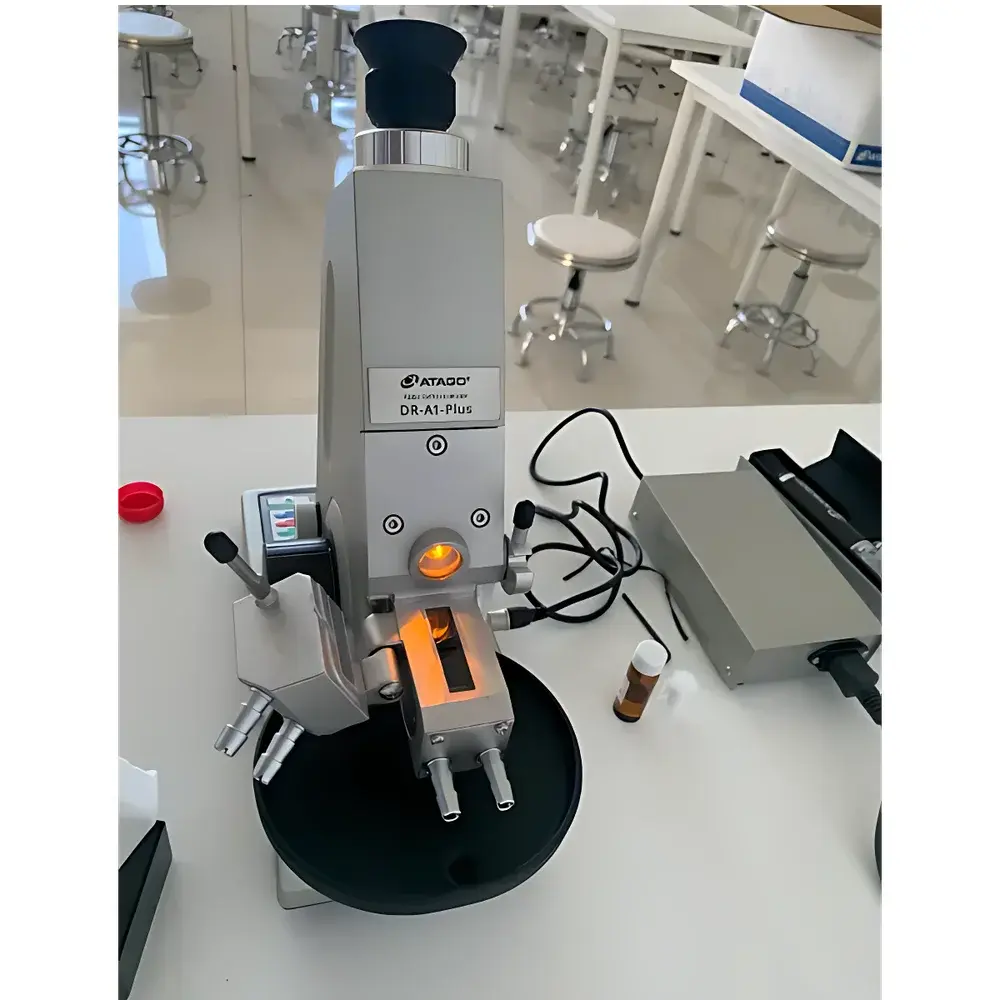
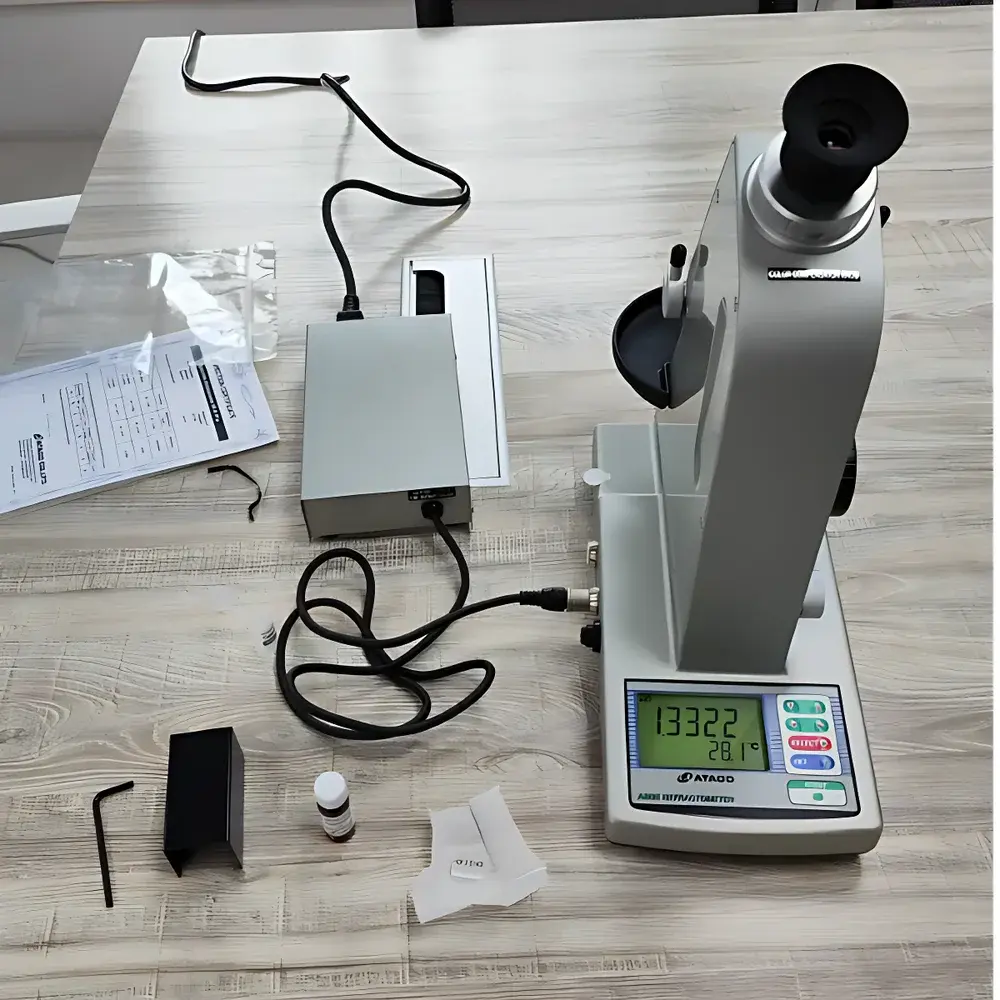
ATAGO DR-A1-Plus Digital Abbe Refractometer
| Brand | ATAGO |
|---|---|
| Origin | Japan |
| Model | DR-A1-Plus |
| Product Type | Benchtop Refractometer |
| Temperature Control | Yes (ATC) |
| Digital Display | Yes |
| Measurement Range | Refractive Index (nD): 1.3000–1.7100 |
| Brix | 0.0–100.0% |
| Accuracy | Refractive Index: ±0.0002 |
| Brix | ±0.1% |
| Resolution | Refractive Index: 0.0001 |
| Brix | 0.1% |
| Operating Temperature Range | 5–50°C (with Automatic Temperature Compensation) |
| Interface | RS-232C for printer and PC connectivity |
| Power Supply | AC adapter (100–240 V, 50/60 Hz) |
| Power Consumption | 16 VA |
| Dimensions (main unit) | 13 × 29 × 31 cm |
| Weight (main unit) | 6.0 kg |
Overview
The ATAGO DR-A1-Plus Digital Abbe Refractometer is a precision benchtop optical instrument engineered for high-accuracy measurement of refractive index (nD) and Brix concentration in liquid and semi-liquid samples. Based on the classical Abbe principle—utilizing total internal reflection at the prism-sample interface—the DR-A1-Plus delivers traceable, repeatable results across a broad optical range (nD: 1.3000–1.7100; Brix: 0.0–100.0%). Unlike traditional visual Abbe refractometers requiring subjective ocular alignment and interpolation, this model integrates a high-resolution digital display, eliminating parallax and observer-dependent variability. Its built-in Automatic Temperature Compensation (ATC) ensures compliance with standard reference conditions (20°C or 25°C), enabling direct correlation to ISO 2173, AOAC 932.12, and ICUMSA Method GS5/8-4 for sugar analysis. Designed for laboratory environments where reproducibility and audit readiness are critical—including QC labs in food & beverage, pharmaceutical excipient testing, and chemical R&D—the DR-A1-Plus meets foundational requirements for GLP-compliant documentation when paired with validated data capture workflows.
Key Features
- Digital Abbe optics with dual-parameter real-time display: simultaneous readout of refractive index (nD) and Brix (% w/w), both resolved to 0.0001 (nD) and 0.1% (Brix)
- Integrated ATC system (5–50°C operating range) using high-stability thermistor feedback, minimizing thermal drift and ensuring measurement consistency per ISO 17025 calibration guidelines
- High-transmittance sapphire prism (refractive index >1.76) resistant to abrasion and chemical etching—suitable for viscous, pigmented, or particulate-laden samples including fruit concentrates, essential oils, and polymer solutions
- RS-232C serial interface for direct connection to label printers (e.g., Epson TM-T series) and laboratory PCs, supporting ASCII-based data export for LIMS integration or Excel-based trending
- Robust aluminum alloy chassis with vibration-damped base plate, optimized for stable operation on shared lab benches without external leveling feet
- Compliance-ready design: CE-marked, RoHS-conformant, and compatible with FDA 21 CFR Part 11–enabled software platforms when used with validated third-party data acquisition modules
Sample Compatibility & Compliance
The DR-A1-Plus accommodates heterogeneous and optically dense samples that challenge conventional refractometers—such as turbid emulsions, dark syrups, aromatic extracts, and high-viscosity gels—thanks to its enhanced light throughput and wide dynamic range. Sample volume requirement is ≤0.2 mL, applied directly onto the temperature-controlled sapphire prism surface. Cleaning is facilitated by solvent-resistant prism seals and non-corrosive stainless-steel sample stage. The instrument conforms to international standards governing optical metrology, including JIS K 0061 (Japanese Industrial Standard for refractometers), ASTM D1218 (refractive index of hydrocarbon liquids), and USP (Refractometry). For regulated environments, its deterministic output and stable calibration traceability support IQ/OQ protocols under GMP Annex 15 and ISO/IEC 17025 accreditation frameworks.
Software & Data Management
While the DR-A1-Plus operates as a standalone instrument, its RS-232C port enables seamless integration into structured data ecosystems. Raw measurement outputs (nD, Brix, temperature) are transmitted as ASCII strings with configurable baud rate (9600 default) and termination characters (CR/LF). Users may deploy generic terminal emulators (e.g., Tera Term) for manual logging or integrate with validated laboratory software such as LabWare LIMS, Thermo Fisher SampleManager, or custom Python-based acquisition scripts using pySerial. Audit trail functionality—including timestamped records, operator ID tagging, and change history—is achievable through middleware layer configuration. No proprietary software is bundled; this architecture prioritizes interoperability, long-term data sovereignty, and compatibility with institutional IT security policies.
Applications
- Food & Beverage: Brix quantification in fruit juices, jams, honey, and dairy-based concentrates; quality control of syrup density and sugar inversion kinetics
- Pharmaceuticals: Excipient concentration verification (e.g., glycerin, propylene glycol), osmolality estimation in liquid dosage forms, and stability-indicating assays for hydrolytic degradation
- Chemical Manufacturing: Refractive index profiling of solvent blends, monomer purity assessment in polymer synthesis, and concentration monitoring in etchants and photoresist developers
- Agricultural Science: Rapid field-to-lab assessment of crop sap Brix as a proxy for photosynthetic efficiency and nutrient status
- Academic Research: Teaching core optical principles (Snell’s law, dispersion, critical angle) and conducting comparative studies on solute-solvent interactions
FAQ
Does the DR-A1-Plus require user calibration before each use?
No. It features factory-calibrated prisms traceable to NIST SRM 1484 (sodium D-line refractive index standards). Daily verification using distilled water (nD = 1.3330 at 20°C) is recommended per ISO 2173.
Can it measure samples below 5°C or above 50°C?
No. The ATC mechanism is rated for 5–50°C ambient and sample temperature. For cryogenic or high-temperature applications, external thermostatic cells (e.g., ATAGO Model TSC-100) must be used with manual temperature input override.
Is the sapphire prism replaceable by the end user?
Yes—prism replacement kits (Cat. No. 1311-PRISM) are available with torque-spec wrenches and alignment jig. Replacement does not void calibration if performed per ATAGO Technical Bulletin TB-DR-A1-02.
What is the minimum sample volume required for reliable measurement?
0.15–0.20 mL is sufficient to fully cover the 22 mm × 12 mm prism aperture. Excess volume does not improve accuracy and may impair temperature equilibration.
How often should the instrument undergo formal recalibration?
Annually, or after 2,000 measurement cycles—whichever occurs first—as defined in ATAGO’s Calibration Service Protocol CSP-DR-A1-Rev.4. Certificate of Calibration includes uncertainty budget per GUM (JCGM 100:2008).






