
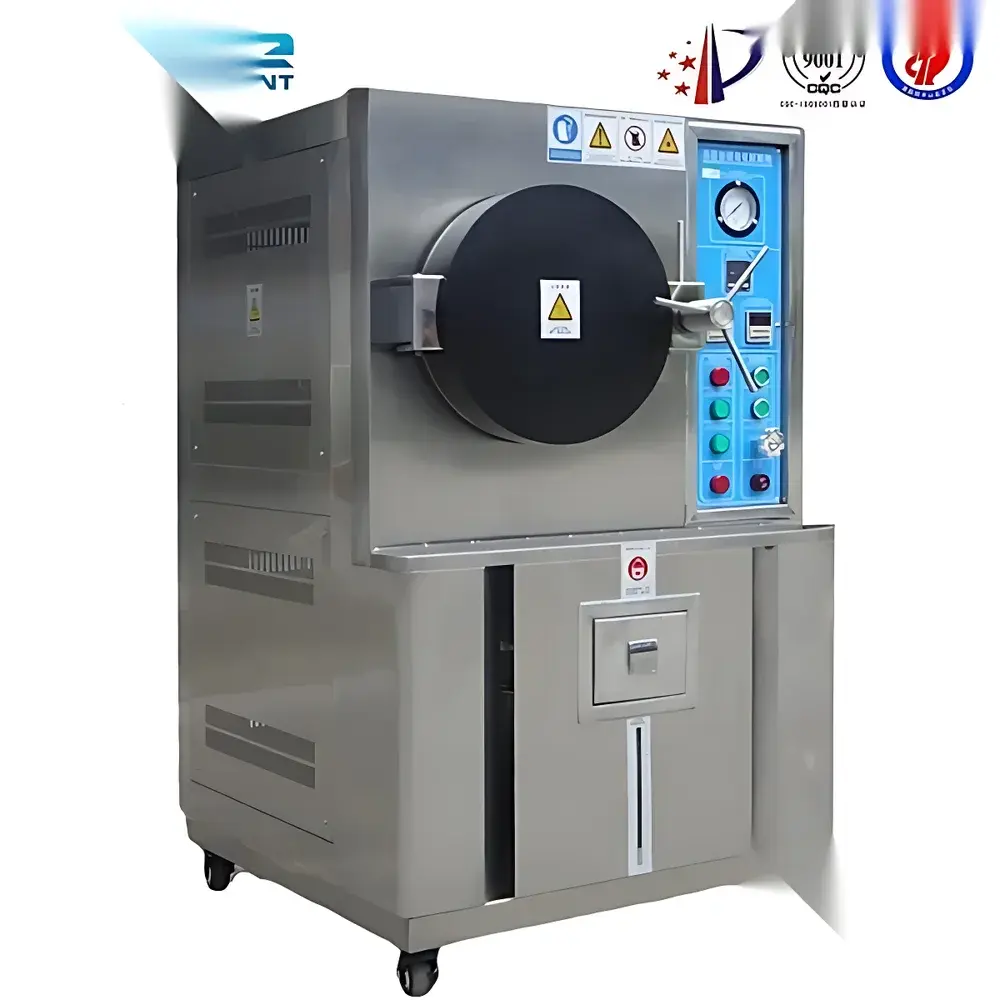
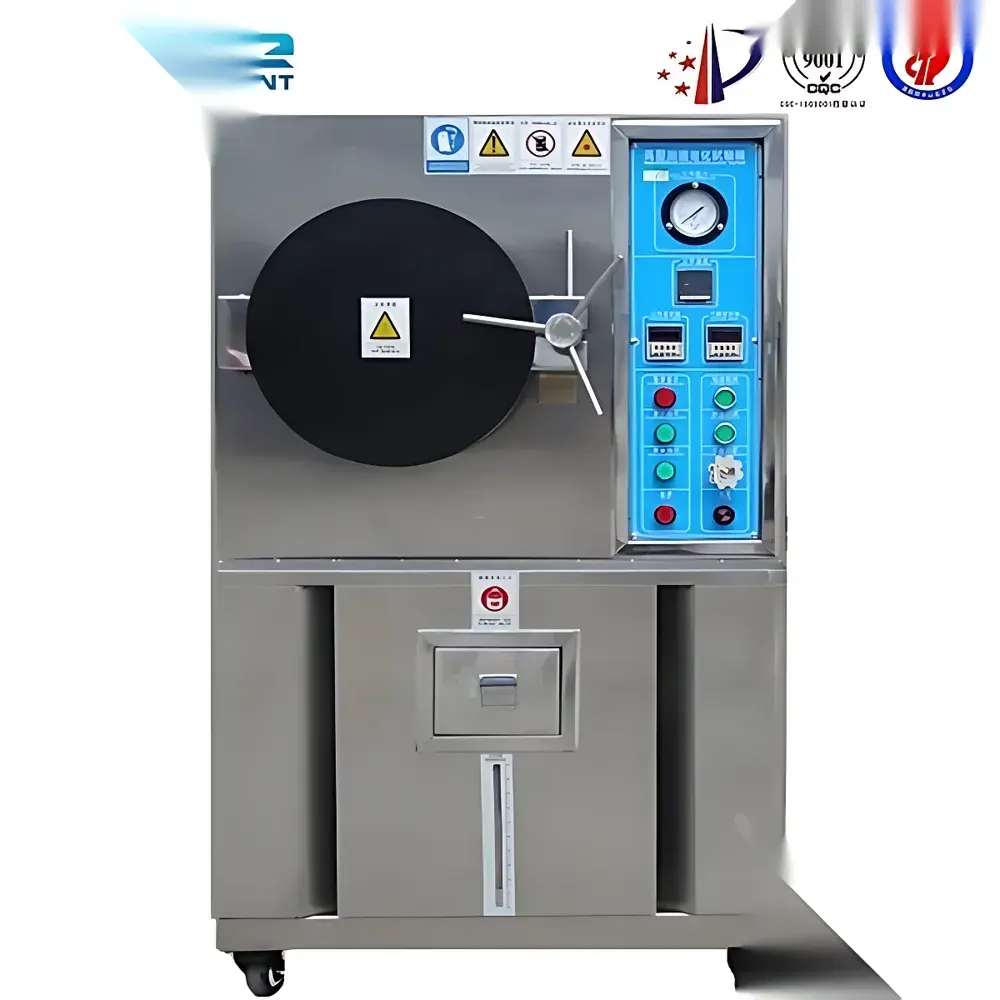
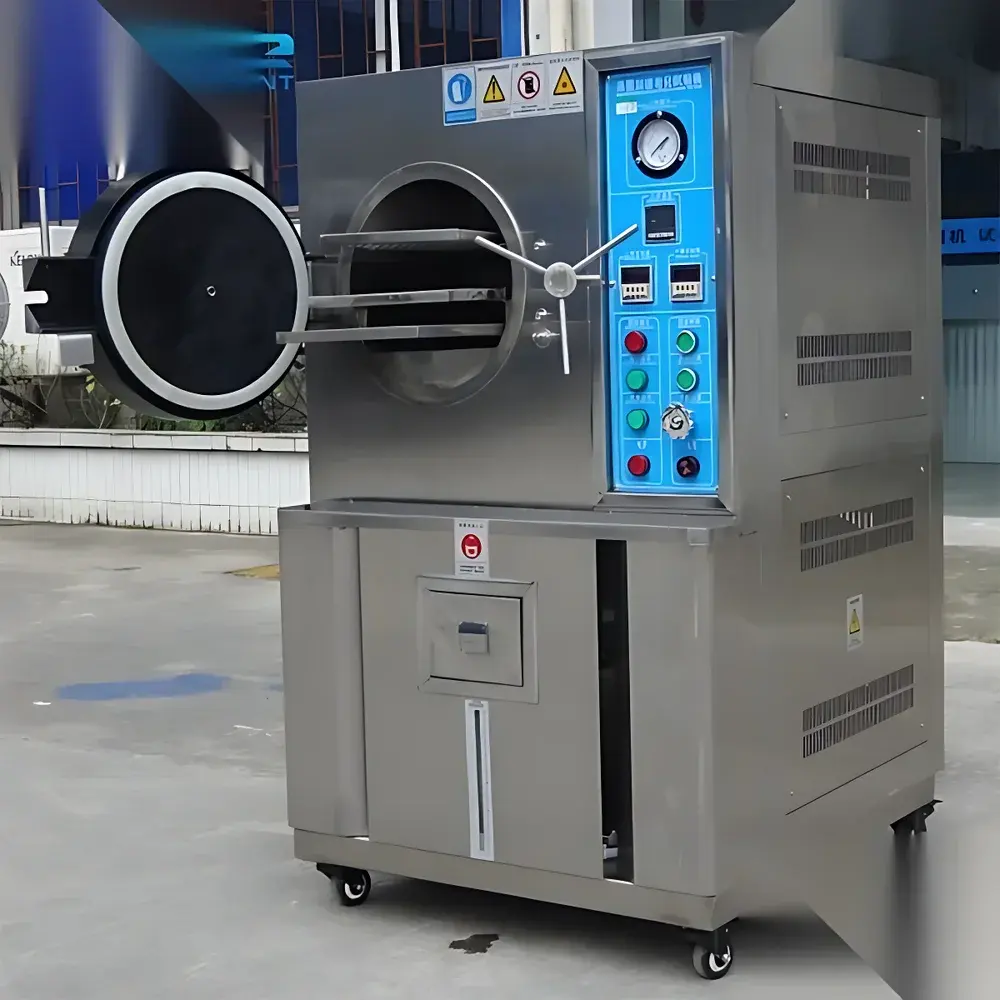
Ouke PCT High-Pressure Accelerated Aging Chamber for Automotive Components
| Brand | Ouke |
|---|---|
| Origin | Imported |
| Manufacturer Type | Authorized Distributor |
| Temperature Range | 105–132 °C (control point) |
| Temperature Uniformity | ±2.0 °C |
| Temperature Stability | ±0.5 °C |
| Humidity Range | 100 % RH |
| Humidity Stability | ±2.5 % RH |
| Humidity Uniformity | ±5.0 % RH |
| Pressure Range | 0.05–0.196 MPa (0.5–2 kg/cm², control point) |
| Heating Time | 35 min (ambient to 132 °C) |
| Pressurization Time | 40 min (ambient to 2 kg/cm²) |
| Capacity | Standard chamber configuration for automotive subassemblies and electronic packages |
| Safety Features | Dual interlocked circular door, automatic pressure relief, vacuum pre-conditioning, real-time LED timer with start-trigger logic, fault-indicating safety LIMIT system |
| Compliance | Designed per IEC 60068-2-66, JESD22-A102D, MIL-STD-202G Method 108, and aligned with JEDEC A110B for HAST/PCT testing protocols |
Overview
The Ouke PCT High-Pressure Accelerated Aging Chamber for Automotive Components is an engineered environmental stress test system designed specifically for evaluating the long-term reliability of hermetically sealed and moisture-sensitive devices under elevated temperature, saturated humidity, and controlled overpressure conditions. Based on the Pressure Cooker Test (PCT) principle—defined in JEDEC JESD22-A102D and IEC 60068-2-66—the chamber accelerates moisture ingress into semiconductor packages, plastic housings, connectors, and multilayer PCB assemblies by maintaining a supersaturated steam environment at pressures up to 0.196 MPa (2 kg/cm²) and temperatures up to 132 °C. Unlike conventional damp heat tests, PCT eliminates the vapor-phase boundary layer resistance, enabling rapid diffusion of water molecules along epoxy–leadframe interfaces, die attach layers, and micro-cracks—thereby exposing latent failure mechanisms such as bond wire corrosion, solder joint degradation, and intermetallic delamination within hours rather than months.
Key Features
- Robust stainless-steel chamber with electropolished interior surface—resistant to steam erosion, non-porous, and compliant with ISO 14644-1 Class 8 cleanroom-compatible maintenance requirements.
- Integrated vacuum pre-conditioning cycle prior to pressurization: removes ambient air and residual oxygen to prevent oxidation artifacts and ensures consistent saturation kinetics during test execution.
- Dual-safety interlocked circular door mechanism: mechanical and pressure-based locking prevents operation unless both temperature and internal pressure are within safe operational thresholds; initiation only permitted when door is fully sealed and verified.
- Automated water replenishment system: maintains optimal water level throughout extended-duration tests (e.g., 200-h cycles) without operator intervention, minimizing evaporation-induced drift in humidity stability.
- Real-time digital monitoring interface: high-accuracy PT100 sensors and calibrated diaphragm pressure transducers feed continuous data to a front-panel LED display showing actual temperature (±0.5 °C), relative humidity (100 % RH, ±2.5 % RH), and absolute pressure (0.05–0.196 MPa).
- Fail-safe protection architecture: includes redundant overpressure relief valves (automatic + manual), thermal cut-off switches, and discrete fault-indicating LIMIT circuitry that halts operation and logs error codes upon deviation from preset operational envelopes.
Sample Compatibility & Compliance
The chamber accommodates automotive-grade components including ECU housings, sensor modules, power electronics enclosures, and hybrid electric vehicle battery management system (BMS) subassemblies. It supports standard JEDEC trays (JEDEC STD-20), 300-mm wafer carriers (with optional fixtures), and custom mounting jigs for large-format modules. All test procedures align with automotive quality standards including AEC-Q200 for passive components and ISO/TS 16949 process validation requirements. The system’s environmental profile satisfies the accelerated aging criteria defined in USP for package integrity assessment and FDA 21 CFR Part 11-compliant audit trail generation when integrated with optional data logging software.
Software & Data Management
While the base unit operates via embedded microcontroller with local LED interface, optional Ethernet-enabled data acquisition firmware enables remote monitoring, real-time CSV export, and timestamped event logging—including door status, vacuum phase completion, pressure ramp rate, and thermal soak duration. All recorded parameters meet GLP/GMP traceability requirements: user authentication, electronic signatures, and immutable audit trails are supported through third-party validated software packages compatible with LabVantage and TrackWise LIMS platforms.
Applications
This PCT chamber serves critical roles across R&D validation, incoming quality assurance, and production lot release testing. Primary use cases include: qualification of molded compound adhesion in power modules; evaluation of conformal coating effectiveness on automotive lighting PCBs; verification of gasket seal integrity in ADAS radar housings; screening of moisture sensitivity levels (MSL) per J-STD-020; and accelerated life testing of MEMS-based pressure sensors exposed to humid under-hood environments. Its reproducible stress profile enables comparative analysis between material sets, process variants, and supplier batches—supporting Design Failure Mode and Effects Analysis (DFMEA) and APQP Stage 3 validation.
FAQ
What standards does this PCT chamber comply with?
It is engineered to meet JEDEC JESD22-A102D, IEC 60068-2-66, MIL-STD-202G Method 108, and supports protocol alignment with AEC-Q200 and ISO/TS 16949.
Can the chamber perform vacuum saturation prior to pressurization?
Yes—integrated vacuum pump and HEPA-filtered air purge ensure oxygen removal and controlled re-filling before steam generation begins.
Is automated water top-up available during long-duration tests?
Yes—the system features a closed-loop water level sensor and solenoid-controlled reservoir refill, sustaining stable 100 % RH for up to 200 hours unattended.
How is safety enforced during overpressure conditions?
Dual redundant pressure relief mechanisms: one automatic spring-loaded valve set at 0.21 MPa, plus a manually operable secondary vent—both independently certified to PED 2014/68/EU Annex I requirements.
Does the chamber support data export for regulatory audits?
With optional firmware upgrade, it delivers time-stamped, user-logged CSV files with full audit trail metadata compliant with FDA 21 CFR Part 11 and EU Annex 11 expectations.



