
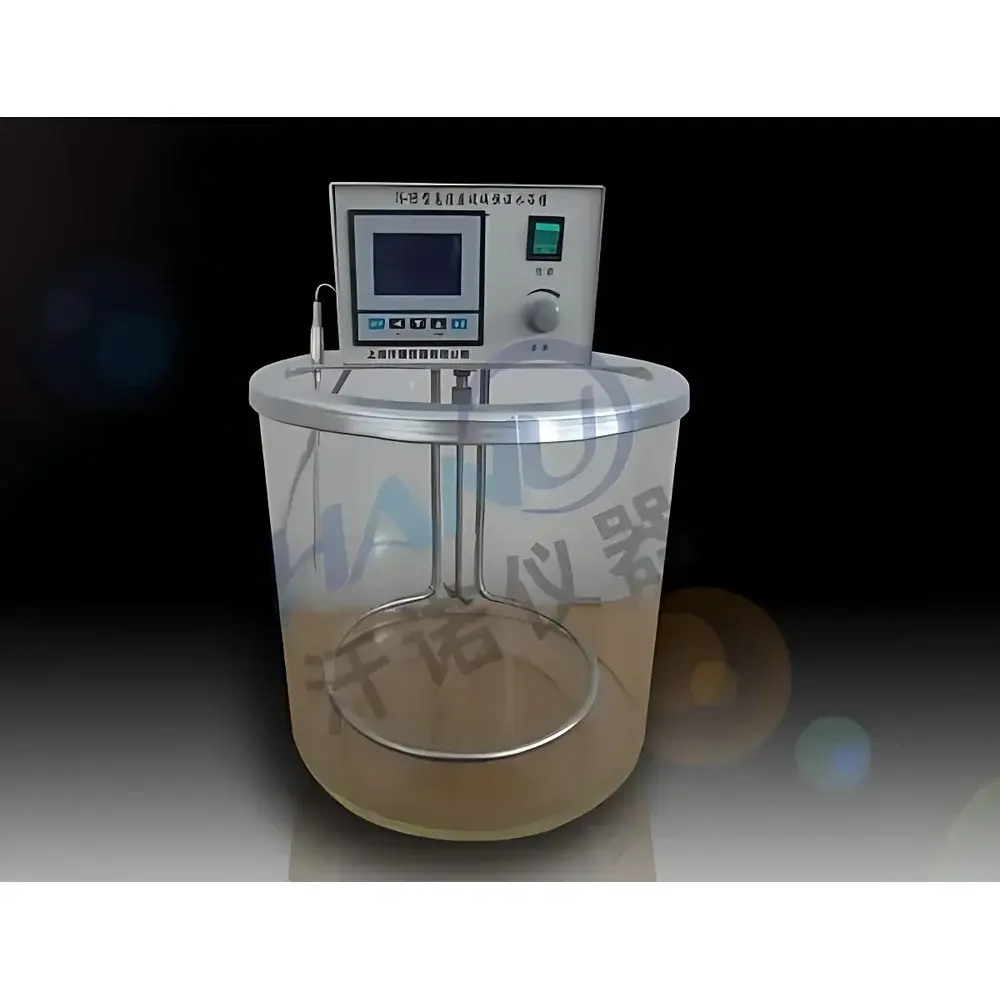
Hanuo 76-1B Precision Stirred Glass Water Bath Circulator
| Brand | Hanuo |
|---|---|
| Origin | Shanghai, China |
| Model | 76-1B |
| Instrument Type | Constant-Temperature Water Bath |
| Circulation Mode | Internal Recirculation |
| Temperature Control | Heating-Only |
| Bath Dimensions | Ø300 × 300 mm (D × H) |
| Temperature Range | Ambient to 100 °C |
| Temperature Stability | ±0.05 °C |
| Heating Power | 900 W |
| Stirring Power | 30 W |
| Stirring Speed | Continuously Adjustable (0–600 rpm typical range) |
| Supply Voltage | 220 V AC, 50 Hz |
| Construction | Borosilicate Glass Bath Vessel with Stainless Steel Housing Base |
Overview
The Hanuo 76-1B Precision Stirred Glass Water Bath Circulator is an engineered thermal platform designed for laboratory applications requiring precise, uniform, and stable temperature control in aqueous environments. Based on resistive heating and forced convection via integrated mechanical stirring, this unit maintains thermal equilibrium across the entire bath volume—critical for reproducible chemical reactions, solvent evaporation, enzymatic assays, and sample equilibration. Its transparent borosilicate glass bath vessel enables real-time visual monitoring of samples, immersion probes, or reaction vessels without compromising thermal integrity. Unlike open-loop heated baths, the 76-1B incorporates a closed internal recirculation loop combined with PID-controlled heating and continuous stirring—minimizing axial and radial temperature gradients and achieving ±0.05 °C stability under steady-state conditions at setpoints between ambient and 100 °C.
Key Features
- Borosilicate glass bath chamber (Ø300 × 300 mm) offering optical clarity, thermal shock resistance, and chemical inertness toward common solvents and buffer solutions.
- Digital PID temperature controller with LED display for intuitive setpoint entry and real-time readout—calibrated to NIST-traceable reference standards during factory verification.
- Integrated high-torque, brushless DC stirring motor (30 W) delivering continuously variable speed control (0–600 rpm typical range), ensuring homogeneous heat distribution without vortex formation or localized hot spots.
- 900 W stainless steel-sheathed heating element embedded within the base assembly, enabling rapid warm-up (typically <25 min from 25 °C to 100 °C) and low-drift thermal regulation.
- Stainless steel structural frame with non-slip rubber feet and recessed cable management—designed for long-term placement on standard laboratory benches under ISO 14644 Class 7 cleanroom-compatible conditions.
Sample Compatibility & Compliance
The 76-1B accommodates standard laboratory glassware including Erlenmeyer flasks (up to 2 L), beakers (50–1000 mL), graduated cylinders, and immersion-type sensors (e.g., Pt100 RTDs, thermocouples). Its open-top configuration supports both direct immersion and jacketed vessel setups. The unit complies with IEC 61010-1:2010 for electrical safety in laboratory equipment and meets CE marking requirements for electromagnetic compatibility (EN 61326-1). While not certified for GMP or GLP environments out-of-the-box, its digital temperature logging capability (via optional RS232/USB interface) supports audit-ready data capture aligned with FDA 21 CFR Part 11 principles when paired with validated third-party software. It is routinely deployed in workflows conforming to ASTM E2877 (Standard Guide for Calibration of Liquid-in-Glass Thermometers) and ISO/IEC 17025-accredited testing laboratories for method validation.
Software & Data Management
The 76-1B operates as a standalone analog-digital hybrid system. Its front-panel interface provides local setpoint adjustment, real-time temperature feedback, and stir speed selection—requiring no external software for basic operation. For advanced integration, an optional serial communication module (RS232 or USB-to-serial adapter) enables remote parameter control and time-stamped temperature/stir-speed logging via host PC using terminal emulation or custom Python/LabVIEW scripts. Logged data exports to CSV format support traceability, statistical process control (SPC), and inclusion in electronic lab notebooks (ELN) compliant with ALCOA+ data integrity principles. Firmware updates are performed via secure offline protocol to preserve calibration integrity.
Applications
- Controlled-rate solvent evaporation in analytical sample preparation prior to GC-MS or HPLC injection.
- Enzyme kinetic studies requiring strict thermal maintenance during spectrophotometric absorbance measurement.
- Calibration of liquid-in-glass thermometers and digital temperature probes against fixed-point references (e.g., water triple point, gallium melt).
- Pre-equilibration of culture media, reagents, or biological samples before cell seeding or immunoassay execution.
- Supporting reflux condensation systems in organic synthesis where bath temperature directly governs distillation efficiency and product yield.
- Soil extractant conditioning per EPA Method 3050B and ASTM D5687 for heavy metal leaching analysis.
FAQ
Does the 76-1B support external temperature probe input for chamber feedback control?
No—the unit relies solely on its built-in PT100 sensor located near the bath centerline; external probe integration is not supported in standard configuration.
Can the glass bath be replaced with a stainless steel insert for organic solvent use?
The design is optimized for the supplied borosilicate vessel; alternative inserts are not offered or validated by Hanuo and may compromise thermal uniformity and safety.
Is the stirring mechanism compatible with magnetic stir bars?
No—the 76-1B uses a mechanical overhead impeller; it does not include magnetic coupling and is not intended for concurrent use with magnetic stirrers.
What is the maximum recommended fill level for optimal thermal performance?
For uniformity and safety, maintain liquid level between 80 mm and 250 mm above the bath base—avoid overfilling beyond 280 mm to prevent overflow during stirring at high speeds.
Does the unit include overtemperature protection?
Yes—a redundant bimetallic cut-off switch de-energizes the heater if the PID controller fails, limiting maximum temperature to ≤105 °C under fault conditions.



