
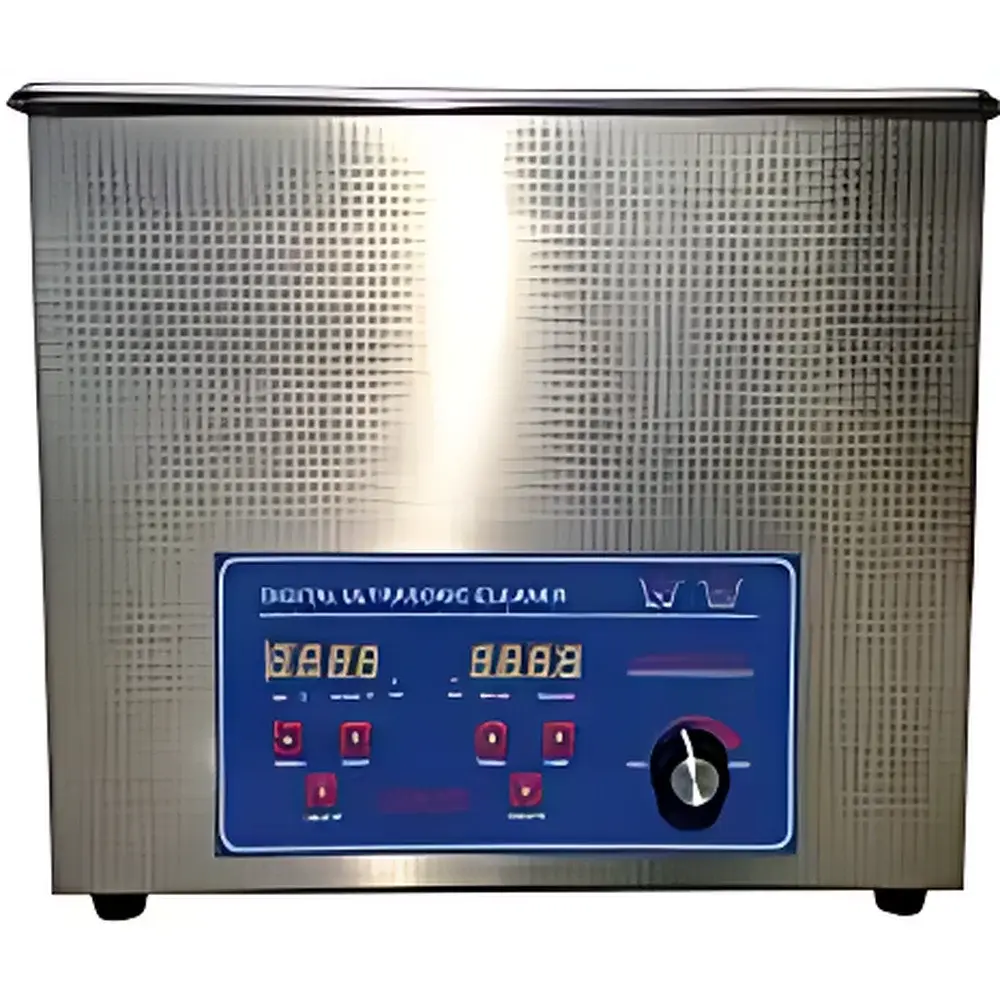
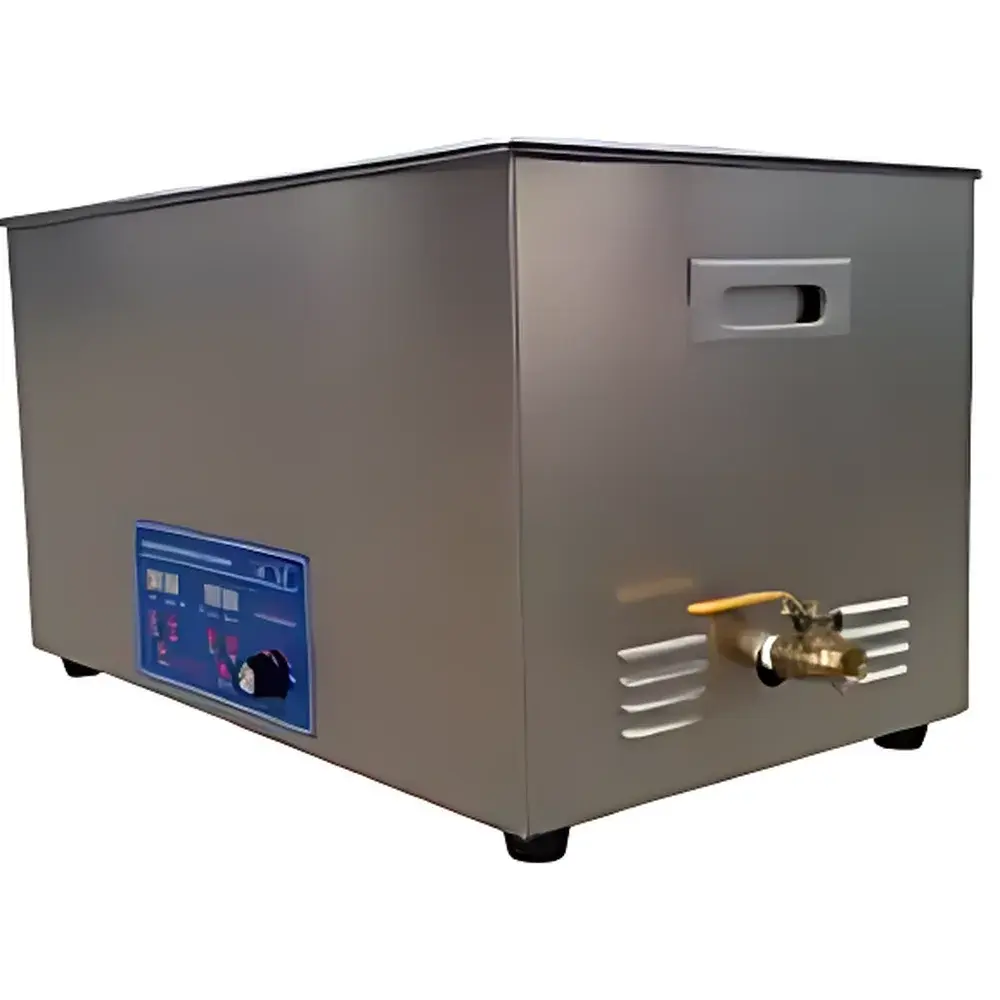
Hanuo HN-15A Benchtop Heated Ultrasonic Cleaner
| Brand | Hanuo |
|---|---|
| Origin | Shanghai, China |
| Model | HN-15A |
| Capacity | 15 L |
| Ultrasonic Frequency | 40 kHz |
| Ultrasonic Power | 360 W |
| Adjustable Power | Yes |
| Adjustable Heating Temperature | 20–80 °C |
| Adjustable Timer | 0–30 min |
| Sound-Dampening Lid | Included |
| Manual Fill/Drain | Yes |
| Construction | Stainless Steel Tank |
Overview
The Hanuo HN-15A is a benchtop heated ultrasonic cleaner engineered for precision cleaning, degassing, and sample preparation in research laboratories, quality control environments, and industrial maintenance settings. It operates on the principle of ultrasonic cavitation—where high-frequency sound waves (40 kHz) generate microscopic vacuum bubbles in aqueous or mild solvent-based cleaning solutions; their rapid collapse produces localized high-pressure shockwaves that dislodge particulate contaminants, oxides, oils, and biological residues from complex geometries—including blind holes, crevices, and microstructured surfaces. Integrated heating (20–80 °C) enhances cleaning efficacy by reducing solution surface tension and accelerating chemical reaction kinetics, particularly for waxy, viscous, or thermally sensitive soils. Designed with a robust 304 stainless steel tank (330 × 300 × 150 mm internal dimensions), the HN-15A delivers consistent acoustic energy distribution and long-term corrosion resistance under repeated thermal and chemical exposure.
Key Features
- Benchtop form factor with compact footprint (400 × 335 × 270 mm) suitable for standard laboratory countertops and ISO Class 5–7 cleanroom peripheries.
- Digitally controlled ultrasonic power output (0–360 W), enabling optimization for delicate components (e.g., optical lenses, MEMS devices) or heavily soiled metal parts without erosion risk.
- Precise temperature regulation via PID-controlled heating element (400 W max), maintaining ±2 °C stability across the 20–80 °C range to support validated cleaning protocols.
- Programmable digital timer (0–30 minutes) with auto-shutdown and audible end-of-cycle alert—critical for GLP-compliant documentation and operator safety.
- Integrated sound-dampening lid reduces ambient noise to <55 dB(A) at 1 m distance, meeting OSHA and EU Directive 2003/10/EC occupational noise exposure thresholds.
- Manual inlet/outlet ports allow controlled filling and gravity-assisted drainage; compatible with deionized water, ethanol/water mixtures, and low-foaming alkaline detergents approved per ASTM D4169 and ISO 15883-5.
Sample Compatibility & Compliance
The HN-15A accommodates a broad spectrum of substrates—including stainless steel, aluminum, titanium, glassware, ceramic crucibles, printed circuit boards (PCBs), surgical instruments, and polymer-based fixtures (e.g., PTFE, polypropylene). Its non-abrasive cleaning mechanism preserves dimensional integrity and surface finish (Ra < 0.8 µm) of precision-machined parts. The unit complies with IEC 61000-6-3 (EMC emissions) and IEC 61000-6-2 (immunity), and its electrical safety design conforms to IEC 61010-1:2010 for laboratory equipment. While not certified for sterile processing per ISO 17664 or AAMI ST79, it supports pre-sterilization cleaning steps aligned with FDA Guidance for Industry: Reprocessing Medical Devices in Health Care Settings (2022) and USP Cleaning Validation Protocols.
Software & Data Management
The HN-15A features an embedded microcontroller with local parameter storage—retaining last-used settings (temperature, time, power level) across power cycles. Though it lacks Ethernet or USB data export, all operational parameters are displayed on a high-contrast LCD interface with backlighting for low-light lab conditions. For audit-ready workflows, users may integrate external logging via RS-232 (optional adapter) or document cycle parameters manually into electronic lab notebooks (ELNs) compliant with 21 CFR Part 11 when paired with secure user authentication and timestamped entries. Calibration certificates for temperature and timer accuracy are available upon request for IQ/OQ validation packages.
Applications
- Pre-analytical sample preparation: removal of residual solvents, salts, or tissue debris from HPLC vials, NMR tubes, and ICP-MS nebulizer components.
- QC/QA in electronics manufacturing: cleaning solder paste residues, flux remnants, and particulate contamination from SMT stencils and semiconductor wafer carriers.
- Pharmaceutical R&D: degassing of buffer solutions prior to filtration, cleaning of lyophilizer trays and stopper-washing fixtures.
- Mechanical engineering labs: descaling of calibration standards, deburring of additive-manufactured metal parts, and restoration of reference gauges.
- Environmental testing facilities: decontamination of air sampling filters, Teflon-coated impingers, and passive diffusion samplers prior to gravimetric or GC-MS analysis.
FAQ
What cleaning solutions are compatible with the HN-15A?
Aqueous alkaline detergents (pH 9–11), ethanol/water (70:30 v/v), and isopropanol are routinely used. Avoid strong acids (e.g., HCl, HNO₃), halogenated solvents (e.g., chloroform), and undiluted acetone—these may degrade seals or accelerate tank pitting.
Can the HN-15A be used for sterilization?
No. It performs cleaning and disinfection—not sterilization. For microbiological kill validation, downstream autoclaving or ethylene oxide treatment is required per ISO 14937.
Is the stainless steel tank electropolished?
Standard configuration uses brushed 304 stainless steel. Electropolished tanks (Ra ≤ 0.4 µm) are available as a custom option for ultra-low particle retention in semiconductor or biopharma applications.
How often should the transducer array be serviced?
Under normal use (≤4 hrs/day), no scheduled maintenance is required. Visual inspection of tank bottom for delamination or cavitation erosion is recommended quarterly; transducer replacement is typically needed after 10,000 operating hours.
Does the unit include a degas function?
Yes—the default startup sequence includes a 3-minute degassing mode to remove dissolved air from the cleaning bath, improving cavitation efficiency and reproducibility across consecutive cycles.



