
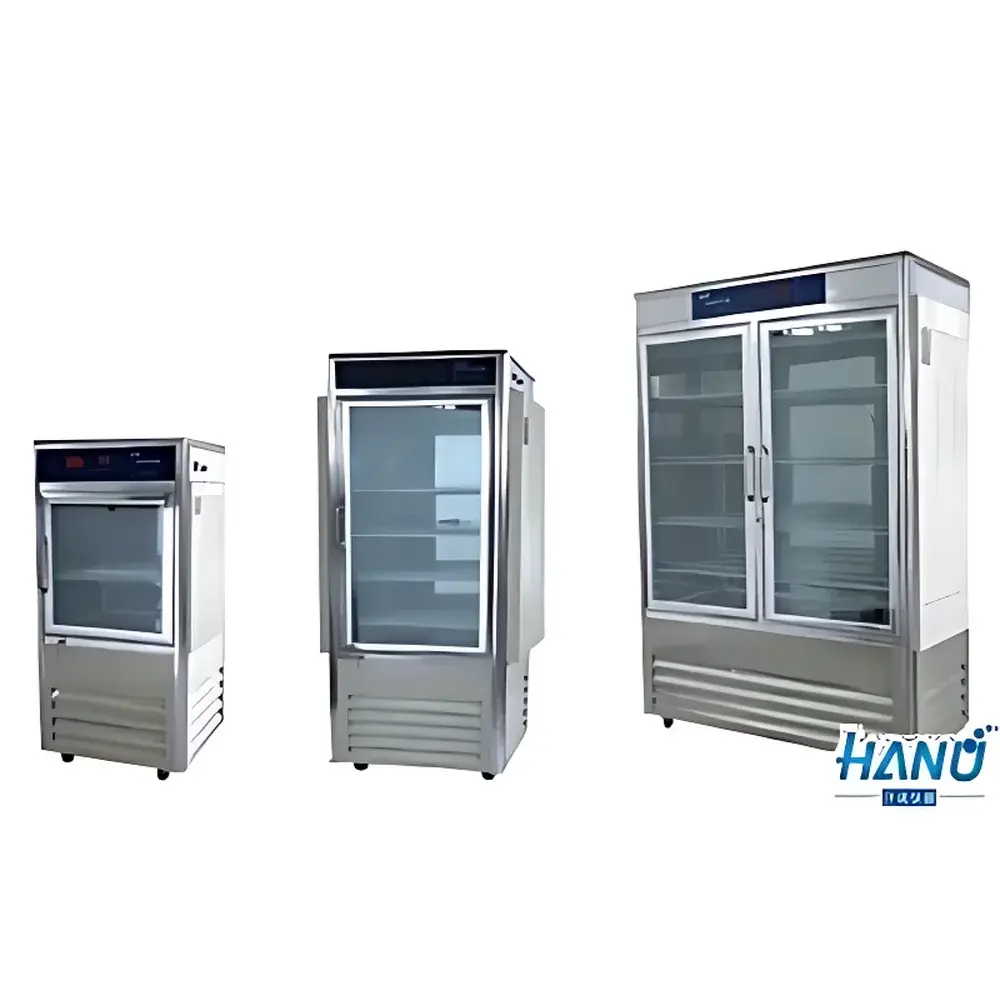
Hanuo SPX-80 Intelligent Biochemical Incubator
| Brand | Hanuo |
|---|---|
| Origin | Shanghai, China |
| Model | SPX-80 |
| Temperature Range | 0–50 °C |
| Temperature Uniformity | ±0.5 °C |
| Chamber Volume | 80 L |
| External Dimensions (W×D×H) | 544×544×1000 mm |
| Inner Chamber Material | Mirror-finish Stainless Steel |
| Control System | Microprocessor-based PID Controller with Dual Digital Display |
| Insulation | Double-layer High-efficiency Polyurethane Foam |
| Door | Full Tempered Glass with Large Observation Window |
| Air Circulation | Forced-air Convection via Stainless Steel Ductwork |
| Refrigeration System | Modular Compressor Unit with Delayed Start & High/Low Pressure Protection |
| Compliance | Designed for GLP-compliant laboratory environments |
Overview
The Hanuo SPX-80 Intelligent Biochemical Incubator is a precision-engineered, microprocessor-controlled environmental chamber designed for stable, uniform temperature maintenance across a broad operational range of 0–50 °C. It operates on the principle of forced-air convection combined with high-efficiency thermal insulation and closed-loop PID temperature regulation—ensuring minimal spatial deviation (<±0.5 °C) and long-term stability required for sensitive biological processes. Unlike basic benchtop incubators, the SPX-80 integrates modular refrigeration architecture, enabling reliable low-temperature operation without condensation buildup or thermal overshoot. Its application scope spans microbial cultivation (bacteria, yeasts, molds), mammalian and insect cell culture support, biochemical oxygen demand (BOD) testing per ISO 5815-1, seed germination studies, and short-term tissue storage—making it suitable for academic research labs, QC departments in biopharmaceutical manufacturing, and environmental monitoring facilities conducting standardized water quality analysis.
Key Features
- Mirror-finish stainless steel interior chamber with seamless, radius-rounded corners—optimized for sterility maintenance and ease of decontamination using ethanol, hydrogen peroxide vapor, or validated liquid disinfectants.
- Microprocessor-based intelligent temperature controller featuring dual digital LED display (setpoint and real-time chamber temperature), auto-tuning PID algorithm, and programmable ramp-soak profiles for multi-stage incubation protocols.
- Dual-layer polyurethane insulation (≥60 mm thickness) combined with vacuum-sealed tempered glass door—achieving thermal resistance (R-value) equivalent to ASTM C518-compliant materials and minimizing ambient heat exchange.
- Forced-air circulation system driven by corrosion-resistant stainless steel blower ducts and low-turbulence impeller—ensuring ≤±0.3 °C vertical/horizontal temperature deviation at steady state (measured per ISO 15378 Annex B).
- Modular hermetic refrigeration unit with compressor delay start (≥30 s), high-pressure cut-off switch, low-pressure alarm, and non-CFC R134a refrigerant—meeting EU F-Gas Regulation (EU) No 517/2014 requirements.
- Large-format observation window (≥300 × 300 mm) with anti-fog coating and integrated LED illumination—enabling non-invasive visual monitoring without compromising thermal integrity or introducing UV-induced phototoxicity.
Sample Compatibility & Compliance
The SPX-80 accommodates standard microbiological vessels—including Petri dishes (90–150 mm), test tubes (13–16 mm OD), Erlenmeyer flasks (50–500 mL), and multi-well plates—on three adjustable stainless steel shelves (load capacity: 15 kg/shelf). Its chamber geometry supports ISO/IEC 17025-accredited calibration using NIST-traceable PT100 probes placed at nine defined locations (center + eight corners). The incubator meets essential design criteria referenced in USP (Biological Indicators), ISO 20387:2018 (Biobanking), and EN 61000-6-3 (EMC immunity). While not certified as Class II biosafety equipment, its sealed construction and optional HEPA-filtered air recirculation module (add-on kit) enable alignment with GLP documentation standards for audit readiness.
Software & Data Management
The embedded controller logs temperature data at user-selectable intervals (1–60 min) into non-volatile memory (≥30 days retention). Raw datasets export via USB port in CSV format compatible with LIMS platforms (e.g., LabWare, STARLIMS) and statistical process control tools (Minitab, JMP). Optional RS485 Modbus RTU interface enables integration into centralized building management systems (BMS) for remote monitoring and alarm forwarding via SNMP traps. All firmware updates follow IEC 62304 Class B software lifecycle requirements, with version-controlled release notes and change logs provided for FDA 21 CFR Part 11 compliance when paired with validated electronic signature workflows.
Applications
- Biochemical Oxygen Demand (BOD) testing under ISO 5815-1 and APHA Standard Methods 5210B, where consistent 20 °C incubation over 5 days is mandatory for wastewater effluent assessment.
- Microbial enumeration and identification workflows per ISO 4833-1 (mesophilic aerobic count) and ISO 6579-1 (Salmonella detection), requiring precise 37 °C or 41.5 °C thermal setpoints.
- Plant tissue culture initiation and callus propagation in phytohormone-supplemented media, where diurnal temperature cycling (e.g., 25 °C day / 22 °C night) can be programmed via time-based setpoint scheduling.
- Stability testing of diagnostic reagents and ELISA kits per ICH Q5C guidelines, supporting long-term storage at 2–8 °C or accelerated conditions (e.g., 40 °C/75% RH when coupled with humidity add-on).
- Environmental simulation for ecotoxicology assays (OECD 201, 210), including algal growth inhibition tests requiring strict photoperiod and temperature control.
FAQ
Does the SPX-80 support humidity control?
No—the base model is a dry incubator. Humidity capability requires the optional SPX-HUM add-on module, which integrates ultrasonic humidification and capacitive RH sensing calibrated to ISO 12048 traceable standards.
Can the incubator be validated for GMP use?
Yes—its design supports IQ/OQ/PQ execution per ASTM E2500-13. Factory-installed temperature mapping ports and documented uncertainty budgets (k=2) are available upon request.
What is the maximum load weight the shelves can support?
Each of the three adjustable shelves supports up to 15 kg when evenly distributed; total chamber load must not exceed 45 kg to maintain airflow uniformity and thermal recovery performance.
Is the refrigeration system serviceable in-field?
The modular compressor unit is field-replaceable using standard HVAC tools; all refrigerant connections comply with EN 378-2 leak-tightness requirements and include Schrader valves for pressure diagnostics.
How frequently should temperature calibration be performed?
Per ISO/IEC 17025, initial verification is required pre-use; subsequent calibrations should occur at least annually—or after any major maintenance event affecting thermal components or control firmware.




