
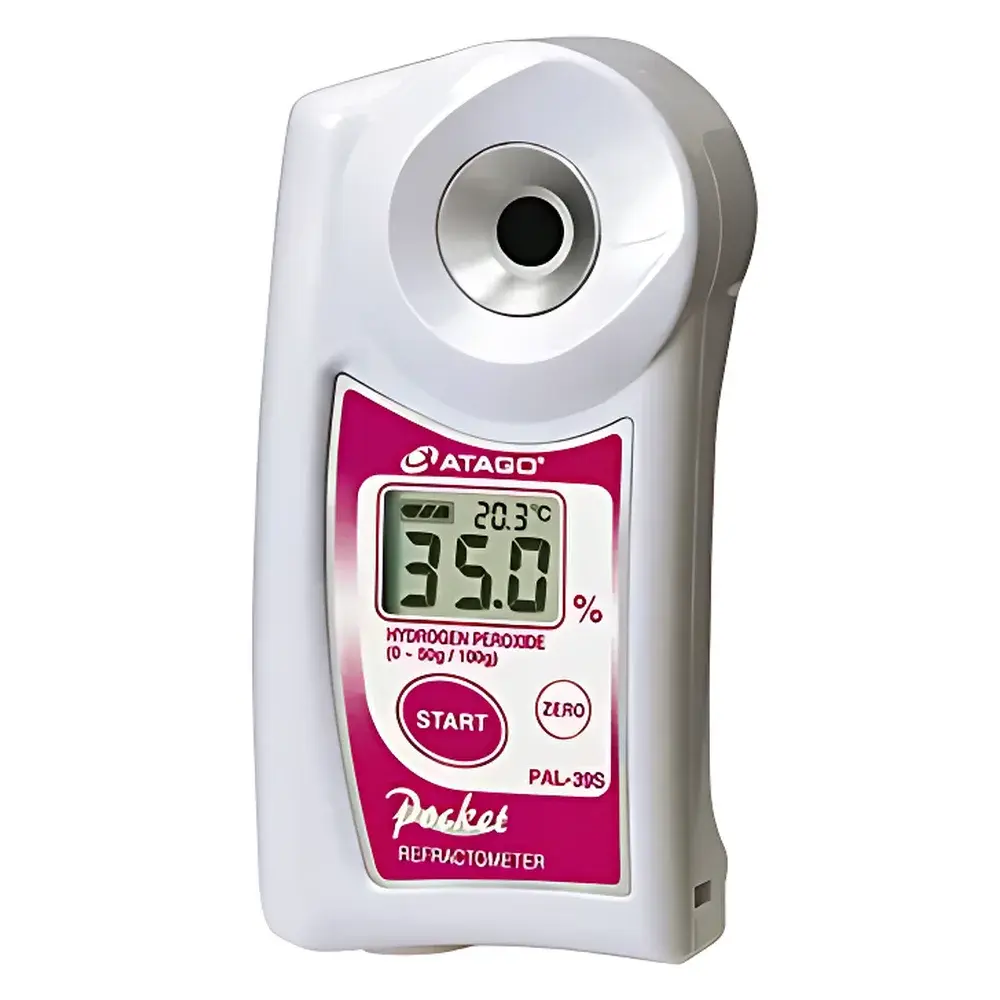
ATAGO PAL-39S Handheld Hydrogen Peroxide Refractometer
| Brand | ATAGO |
|---|---|
| Origin | Japan |
| Model | PAL-39S |
| Product Type | Handheld Digital Refractometer |
| Temperature Control | Yes (ATC) |
| Display | Digital LCD |
| Measurement Range | 0.0–50.0% w/w H₂O₂ (hydrogen peroxide in aqueous solution) |
| Resolution | 0.2% H₂O₂ / 0.1°C |
| Accuracy | ±0.6% H₂O₂ / ±1.0°C |
| Sample Volume | 0.3 mL |
| Measurement Time | ~3 seconds |
| Operating Temperature | 10–35°C |
| Environmental Rating | IP65 |
| Dimensions | 55 × 31 × 109 mm |
| Weight | 100 g (body only) |
| Power Supply | 2 × AAA batteries |
Overview
The ATAGO PAL-39S is a dedicated handheld digital refractometer engineered for rapid, field-deployable quantification of hydrogen peroxide (H₂O₂) concentration in aqueous disinfectant solutions. It operates on the principle of critical-angle refractometry: incident light passes through a prism-sample interface, and the resulting refraction angle—directly correlated to the solution’s refractive index—is converted into mass concentration (%) via a pre-calibrated polynomial algorithm specific to H₂O₂–water binary systems. Unlike generic refractometers, the PAL-39S employs a chemically optimized optical path and temperature-compensated calibration curve validated across the full 0.0–50.0% w/w range. Its design prioritizes operational robustness in industrial hygiene, pharmaceutical manufacturing, food processing, and clinical sterilization environments where real-time verification of disinfectant strength is essential for process validation and regulatory compliance.
Key Features
- Dedicated H₂O₂-specific optical calibration traceable to NIST-traceable reference standards, eliminating cross-solute interference from ethanol, sodium hypochlorite, or organic acids commonly present in multi-component disinfectant formulations.
- Automatic Temperature Compensation (ATC) with integrated thermistor, maintaining measurement integrity across 10–35°C ambient conditions without manual correction or external thermostating.
- IP65-rated enclosure: dust-tight and resistant to low-pressure water jets—enabling full-rinse decontamination after contact with biohazardous or corrosive residues.
- E.L.I. (External Light Interference) optical shielding system, minimizing photometric drift under direct sunlight or fluorescent overhead lighting—critical for on-site validation in uncontrolled environments such as cleanroom corridors or packaging lines.
- Zeroing with distilled water only—no proprietary calibration fluids required—reducing consumable dependency and operator training burden.
- Single-hand operation with ergonomic grip, integrated lanyard hook, and ultra-low mass (100 g), facilitating extended use during shift-based QC audits or mobile sanitation verification rounds.
Sample Compatibility & Compliance
The PAL-39S is validated exclusively for aqueous hydrogen peroxide solutions, including stabilized commercial disinfectants containing common stabilizers (e.g., sodium stannate, phosphoric acid) at concentrations ≤50.0% w/w. It is not suitable for organic peroxides, peracetic acid blends, or viscous gels. The instrument conforms to IEC 60529 (IP65), ISO 21500:2012 (project management—quality assurance of measurement tools), and supports adherence to FDA 21 CFR Part 11 requirements when paired with ATAGO’s optional data logging software (PAL-Log v3.2) for audit-trail generation. Its accuracy specification (±0.6% H₂O₂) aligns with ASTM D1293–22 Annex A1 for refractometric verification of oxidizing biocides in GMP-controlled environments.
Software & Data Management
While the PAL-39S operates as a standalone instrument, it interfaces via optional USB-to-serial adapter with ATAGO’s PAL-Log software for Windows OS. This application enables timestamped batch export of measurement records—including operator ID, sample ID, ambient temperature, and ATC-corrected result—with CSV/Excel-compatible formatting. All entries are write-protected upon saving, satisfying GLP documentation requirements for disinfectant concentration logs in pharmaceutical water system monitoring or ISO 13485-certified medical device reprocessing facilities. No cloud connectivity or firmware updates are embedded; all calibration and configuration remain locally stored and immutable without physical access to the device.
Applications
- Verification of H₂O₂ concentration in vaporized hydrogen peroxide (VHP®) generator feedstock solutions prior to sterilization cycles in isolators and aseptic filling lines.
- Routine monitoring of residual H₂O₂ levels in rinse water following enzymatic decontamination of dairy processing equipment—ensuring compliance with Codex Alimentarius Standard 234–2001 limits.
- On-the-spot validation of disinfectant dilution accuracy in hospital central sterile supply departments (CSSD), supporting Joint Commission EC.02.05.01 standards for high-level disinfection.
- Quality control of H₂O₂-based preservative systems in liquid enzyme formulations (e.g., lactase, glucose oxidase), where excess peroxide deactivates catalytic activity.
- Field verification of sterilant concentration in ambulatory surgical centers performing low-temperature plasma sterilization using H₂O₂ carriers.
FAQ
Does the PAL-39S require periodic recalibration by an accredited lab?
No—its factory calibration is stable for ≥24 months under normal use. Users perform daily zeroing with distilled water; formal recalibration is recommended only after mechanical shock or exposure to temperatures >40°C.
Can it measure hydrogen peroxide in alcohol-based hand sanitizers?
No. Ethanol significantly alters the refractive index–concentration relationship. The PAL-39S is validated only for aqueous H₂O₂ solutions.
Is the prism surface resistant to corrosion from concentrated H₂O₂?
Yes—the sapphire-coated borosilicate glass prism resists oxidative etching up to 50% w/w H₂O₂ at 25°C for >10,000 measurements per cleaning cycle.
How does ATC affect measurement uncertainty?
The built-in thermistor reduces temperature-induced error to <±0.1% H₂O₂ per °C deviation from calibration point—well within the stated ±0.6% total accuracy envelope.
What documentation accompanies the unit for audit purposes?
Each unit ships with a Certificate of Conformance (CoC), factory calibration report referencing NIST SRM 1860a, and ISO/IEC 17025-accredited test data for optical path stability.






