
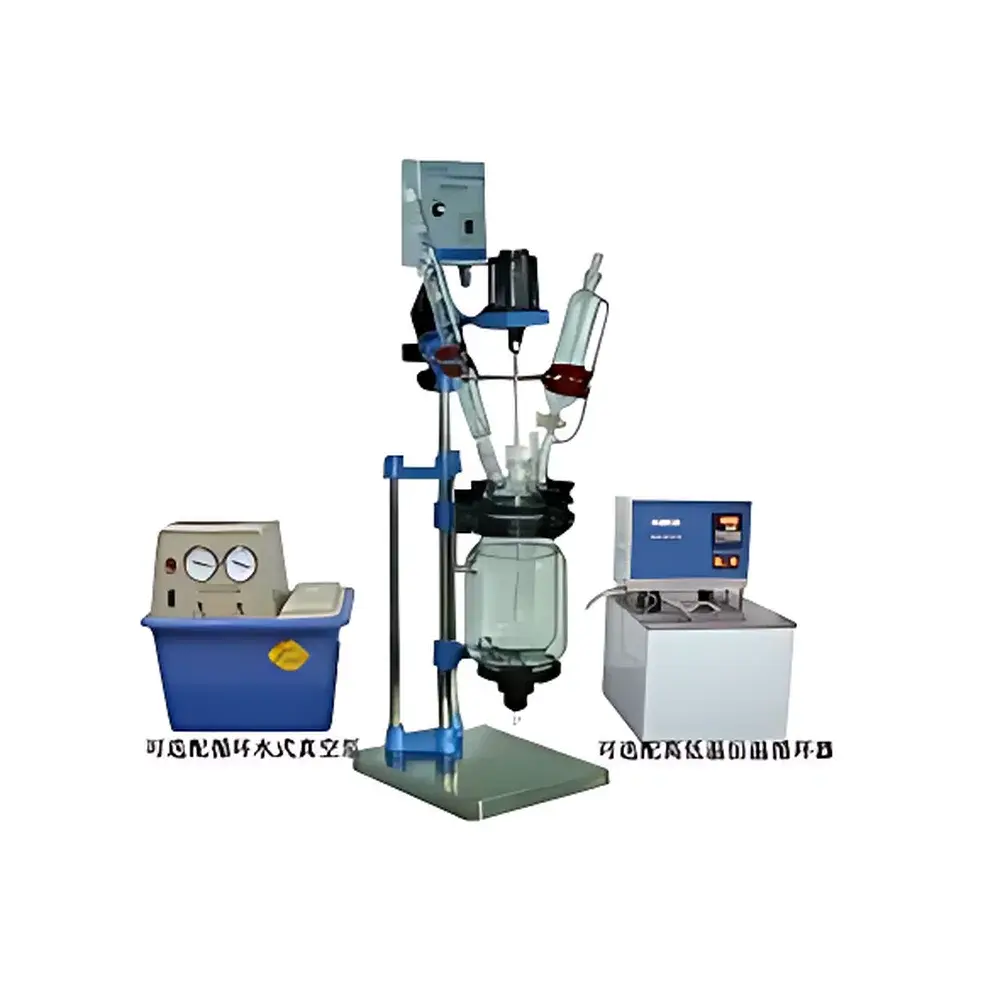
Hanuo HN1L-5L Jacketed Glass Reactor
| Brand | Hanuo |
|---|---|
| Origin | Shanghai, China |
| Manufacturer Type | Authorized Distributor |
| Country of Origin | China |
| Model | HN1L-5L |
| Price | USD 890 (FOB Shanghai) |
| Usable Volume | 1–5 L (Small-scale) |
| Construction Material | Borosilicate Glass 3.3 (DIN ISO 3585) |
| Operating Pressure | Low-pressure, up to 0.1 MPa (gauge) |
| Vacuum Capability | ≤ –0.098 MPa (i.e., ≤ 20 mbar abs) |
| Jacket Inlet/Outlet | Standard 1/2″ FTF ports |
| Stirring Motor | AC gearmotor (40–90 W, adjustable 50–800 rpm) |
| Max Torque | 2400–5000 g·cm |
| Temperature Sensor | Pt100 (IEC 60751 Class B, ±0.3 °C accuracy) |
| Sealing System | Dual-face mechanical seal with PTFE bellows and alloy steel housing |
| Frame | Mobile stainless steel (AISI 304) column stand with leveling feet |
| Lid Configuration | Five-neck standard ground-glass joints (NS 50/NS 29/NS 24/NS 24/NS 19 for HN-5L |
| Bottom Discharge | PTFE plug valve with flanged connection |
| Optional | ATEX-certified explosion-proof motor (IECEx/ATEX Zone 1) |
Overview
The Hanuo HN1L–5L Jacketed Glass Reactor is a modular, vacuum-rated laboratory-scale reaction system engineered for precise thermal control and chemically inert process containment. Based on the Couette flow principle, it enables homogeneous mixing under controlled temperature, pressure, and atmosphere conditions via double-wall borosilicate glass construction. The inner vessel serves as the reaction chamber, while the outer jacket forms a sealed annular channel for circulating heat-transfer media—such as silicone oil (–20 °C to +200 °C), glycol–water mixtures (–40 °C to +100 °C), or tap water (ambient cooling). Designed for operation under ambient pressure, slight positive pressure (≤ 0.1 MPa gauge), or deep vacuum (≤ 20 mbar absolute), this reactor supports reflux, distillation, crystallization, hydrogenation, and anhydrous synthesis workflows common in pharmaceutical process development, fine chemical R&D, and polymerization studies.
Key Features
- Borosilicate glass 3.3 (DIN ISO 3585) construction ensures exceptional resistance to thermal shock (ΔT ≤ 120 °C), chemical corrosion (including HF-free mineral acids, alkalis, and organic solvents), and optical clarity for real-time visual monitoring.
- Five-neck standardized ground-glass joints (NS 50/29/24/24/19 for 5 L model) accommodate simultaneous installation of condenser, thermometer, addition funnel, gas inlet, and stirrer—enabling full process integration without adapter compromises.
- PTFE-coated dual-blade impeller (standard configuration) delivers uniform shear across viscosity ranges from 10,000 mPa·s (pre-polymer melts), with optional anchor or turbine geometries available upon request.
- Pt100 RTD probe mounted directly in the reaction mass provides traceable, linear temperature feedback (±0.3 °C at 25 °C) compatible with external PID controllers or data loggers meeting IEC 60751 Class B specifications.
- Hermetic sealing system combines AISI 316L alloy mechanical seal with PTFE bellows and graphite secondary seal, rated for continuous operation at ≤ 0.1 MPa differential pressure and vacuum down to 20 mbar abs—validated per ISO 21049 (API RP 682).
- Modular stainless steel frame (AISI 304) features height-adjustable clamps, casters with locking brakes, and integrated cable management—supporting ergonomic setup, safe relocation, and GMP-aligned lab layout compliance.
- Bottom discharge assembly includes full-bore PTFE plug valve with DIN 2817 flange interface and zero-dead-volume design, enabling quantitative transfer of viscous or particulate-laden slurries without manual scraping or solvent rinsing.
Sample Compatibility & Compliance
The reactor is suitable for liquid-phase, slurry, and heterogeneous catalytic reactions involving corrosive reagents (e.g., HCl, HNO₃, NaOH, THF, DMF, DCM) and air/moisture-sensitive compounds (when operated under N₂ or Ar purge). All wetted parts comply with USP Class VI biocompatibility requirements and EU Regulation (EC) No. 1935/2004 for food-contact materials. The system meets general-purpose laboratory safety standards per EN 61010-1:2019 (electrical safety) and EN 14175-3:2019 (fume hood compatibility). When equipped with optional ATEX-certified motors (II 2G Ex db IIB T4 Gb), it satisfies Directive 2014/34/EU for use in Zone 1 hazardous areas.
Software & Data Management
While the base unit operates manually via analog speed control and external thermoregulation, it integrates seamlessly with third-party digital systems. The Pt100 output (2-wire, 0–10 V or 4–20 mA) connects to validated data acquisition platforms (e.g., LabVIEW, DeltaV, or Siemens Desigo CC) supporting 21 CFR Part 11-compliant audit trails, electronic signatures, and ALCOA+ data integrity principles. Optional digital speed controllers provide RS485 Modbus RTU communication for remote RPM setpoint adjustment and real-time torque monitoring—enabling reproducible scale-up protocols aligned with ICH Q5C and Q8(R2) guidelines.
Applications
- Pharmaceutical intermediate synthesis under inert atmosphere and controlled exotherm management
- Enzymatic transesterification and biodiesel production at mild temperatures (40–60 °C)
- Sol-gel processing of metal oxide nanoparticles (TiO₂, SiO₂) with pH- and temperature-dependent hydrolysis kinetics
- Catalytic hydrogenation using Pd/C or Raney Ni under 1–3 bar H₂ pressure
- Multi-step Grignard or lithiation reactions requiring cryogenic jacketing (–20 °C to –40 °C)
- Crystallization screening with controlled cooling ramp rates (0.1–5 °C/min) and in-situ FBRM or PVM monitoring ports
- Process analytical technology (PAT) development for QbD-based API manufacturing
FAQ
What temperature range can the jacket support?
The jacket accommodates heat-transfer fluids from –40 °C (using ethylene glycol/water mixtures) to +200 °C (using silicone oil), subject to fluid stability and pump compatibility.
Is the reactor suitable for hydrogenation under pressure?
Yes—when fitted with reinforced PTFE seals and used with appropriate pressure-rated accessories (e.g., high-pressure sight glass, rupture disc), it supports reactions up to 0.1 MPa gauge pressure. For higher pressures, consult Hanuo’s pressurized reactor series.
Can I retrofit a digital controller?
All models accept aftermarket PID temperature controllers and variable-frequency drives (VFDs) via standard 0–10 V analog inputs; Hanuo offers OEM-compatible digital kits with CE-marked power supplies and EMC filtering.
How is calibration traceability ensured?
Pt100 sensors are supplied with individual calibration certificates traceable to NIST or PTB standards; users may perform in-house verification using certified reference thermometers per ASTM E74-22.
What maintenance intervals are recommended?
Mechanical seal inspection every 500 operating hours; jacket flush and vacuum test prior to first use and after each solvent change; annual verification of ground-glass joint tolerances per ISO 3585 Annex C.



