
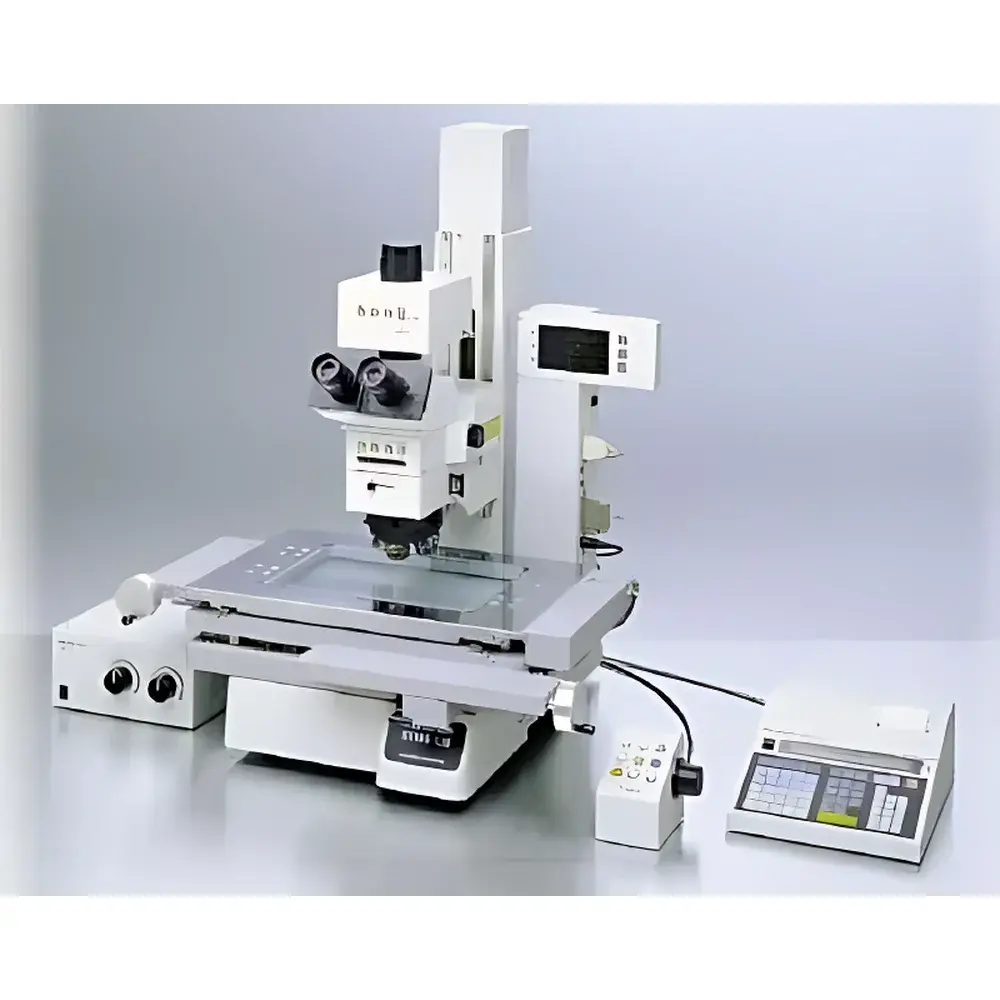
OLYMPUS STM6-LM Large-Field Tool Measuring Microscope
| Brand | OLYMPUS |
|---|---|
| Origin | Japan |
| Manufacturer Type | Original Equipment Manufacturer (OEM) |
| Origin Category | Imported |
| Model | STM6-LM |
| Pricing | Upon Request |
Overview
The OLYMPUS STM6-LM is a high-precision, large-field tool measuring microscope engineered for dimensional metrology of macro-scale industrial components. Built upon OLYMPUS’ UIS2 optical platform with infinite conjugate correction, it employs a dual-path optical design supporting brightfield, darkfield, differential interference contrast (DIC), and simple polarized light observation—enabling both reflective and transmitted illumination modes. Its core measurement principle relies on high-stability mechanical translation coupled with linear encoder-based position feedback, conforming to Abbe’s principle through integrated grating scale placement along the X/Y measurement axes. Designed specifically for quality control laboratories, precision machining shops, and R&D facilities handling oversized parts—such as automotive castings, aerospace structural components, printed circuit board assemblies, or large-scale semiconductor substrates—the STM6-LM delivers traceable, repeatable measurements across extended travel ranges without compromising sub-micrometer resolution.
Key Features
- Large motorized stage with 250 mm × 150 mm travel range, featuring clutch-controlled dual-speed actuation for seamless transition between coarse and fine positioning using a single ergonomic lever.
- Electric Z-axis focusing mechanism with four selectable fine-focus increments (50 µm, 200 µm, 400 µm, and 800 µm per full knob rotation), enabling rapid height/depth profiling while minimizing operator fatigue.
- Integrated high-resolution linear encoders with 0.1 µm or 0.5 µm minimum readout resolution (user-selectable), mounted in strict adherence to Abbe’s principle to suppress cosine and alignment errors.
- Rigid monolithic frame and stage construction utilizing precision-ground linear guideways and thermally stable base materials, ensuring long-term geometric stability under ambient laboratory conditions (20 ± 1 °C).
- Unified electronics architecture housing RS-232C interface, built-in digital counter display aligned at operator eye level, and embedded data logging firmware compatible with external PC acquisition via standard serial protocols.
- UIS2 optical system with LED-based illumination: 10 W white LED for reflected-light imaging and 10 W green LED for transmitted-light applications—providing flicker-free, color-accurate, and intensity-stable illumination over extended operational lifetimes.
- Crosshair reticle optimized for human visual acuity—including crosshair + dashed-line overlay on the focal plane—to improve alignment accuracy during edge detection and feature registration.
Sample Compatibility & Compliance
The STM6-LM accommodates specimens up to 205 mm in maximum height (with metallurgical objectives) or 150 mm (with dedicated measurement objectives), and supports simultaneous multi-sample staging on its expansive XY platform. It complies with foundational metrological standards including ISO 9001:2015 (quality management systems), ISO/IEC 17025:2017 (competence of testing and calibration laboratories), and JIS B 7153 (Japanese Industrial Standard for coordinate measuring microscopes). All critical components—including grating scales, objective lenses, and encoder electronics—are calibrated against NMIJ (National Metrology Institute of Japan)-traceable artifacts, ensuring full compliance with international metrological traceability requirements defined in ISO/IEC 17025 Annex A.2.
Software & Data Management
While the STM6-LM operates as a standalone instrument with real-time digital readout, its RS-232C port enables direct integration into automated QA/QC workflows. Measurement data can be streamed to host PCs running spreadsheet applications (e.g., Microsoft Excel, LibreOffice Calc) or custom LIMS environments. Optional add-on modules—including the dedicated measurement computation unit—support two-dimensional geometric calculations (distance, angle, radius, parallelism, perpendicularity) without requiring manual stage leveling. The system logs all measurement events with timestamped coordinates and supports basic audit trail functionality; when paired with compliant third-party software, it may satisfy FDA 21 CFR Part 11 requirements for electronic records and signatures in regulated environments.
Applications
- Precision inspection of machined surfaces, gear teeth profiles, and stamped metal parts in Tier-1 automotive supply chains.
- Dimensional verification of PCB panel fiducials, solder mask openings, and component land patterns prior to SMT assembly.
- Geometric analysis of injection-molded plastic housings, including wall thickness uniformity, draft angle validation, and gate vestige assessment.
- Calibration and verification of secondary standards used in coordinate measuring machine (CMM) labs.
- Failure analysis of large-area electronic substrates where conventional microscopes lack sufficient field-of-view coverage.
- Research-grade morphological characterization of composite laminates, ceramic tiles, or additive-manufactured structures requiring micron-level spatial correlation across centimeter-scale domains.
FAQ
What is the maximum specimen height supported by the STM6-LM?
The STM6-LM accepts specimens up to 205 mm tall when equipped with metallurgical objectives, or up to 150 mm with dedicated measurement objectives.
Does the STM6-LM support automated focus tracking?
Yes—optional high-precision auto-focus units are available in single-shot and continuous tracking modes, eliminating parallax-induced Z-axis measurement variability.
Is the grating scale resolution traceable to national standards?
Yes—each grating scale undergoes factory calibration against NMIJ-traceable master artifacts, with full documentation provided per unit.
Can measurement data be exported directly to statistical process control (SPC) software?
Yes—via RS-232C serial output, raw coordinate data can be parsed by industry-standard SPC platforms such as Minitab, InfinityQS, or custom Python-based analytics pipelines.
What environmental conditions are recommended for optimal performance?
Operation within a temperature-controlled environment (20 ± 1 °C), relative humidity 40–60 % RH, and vibration-isolated optical tables is strongly advised to maintain specified measurement uncertainty budgets.




